Continued Pretraining for Domain Adaptation
When a model does not know your domain, more pretraining on it can help. Read the method, a worked decision, and when fine-tuning is enough.
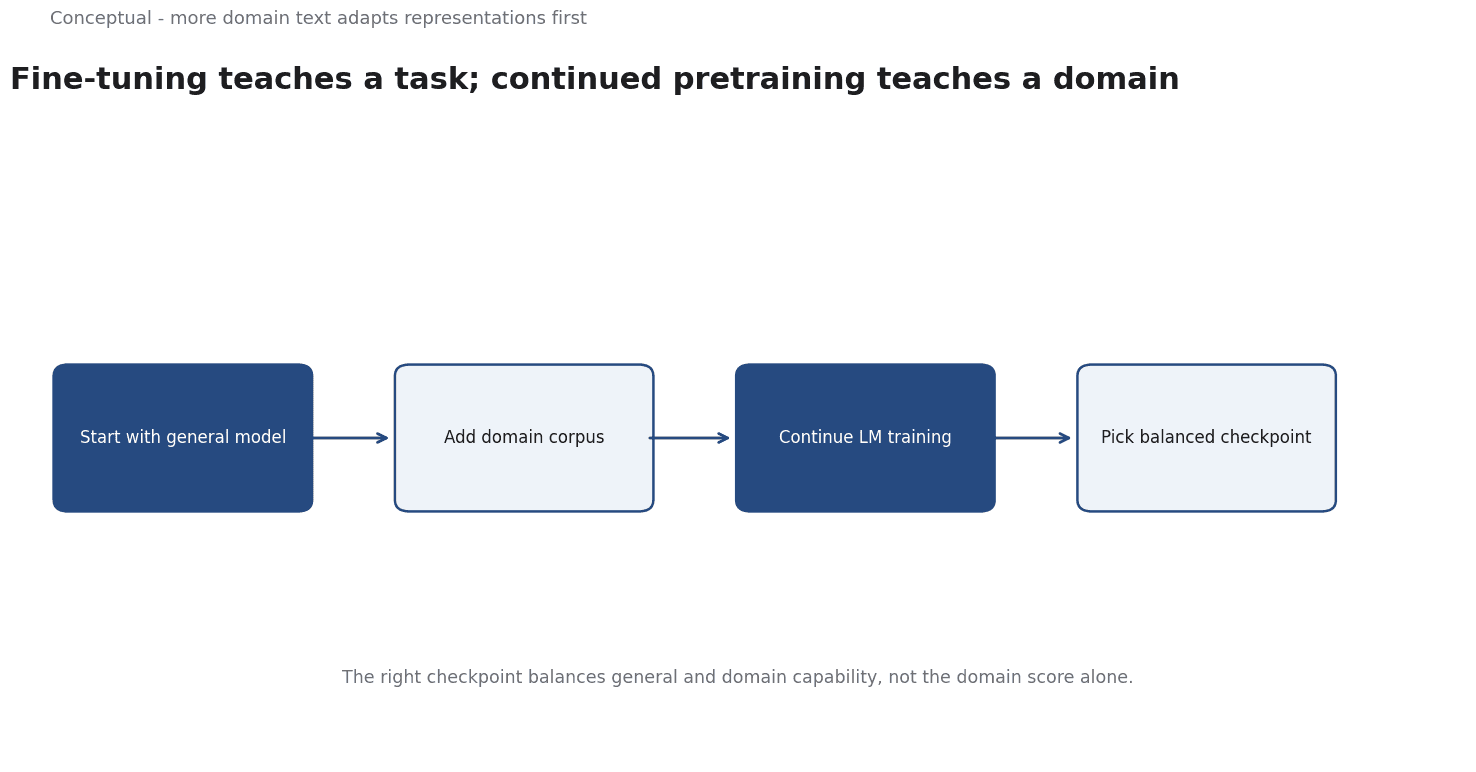
A general model knows a great deal about language and very little about your specific corpus — its terminology, its document formats, the way its experts reason. Fine-tuning on a small labelled set can teach a task, but it cannot teach a domain. Continued pretraining exposes the model to more of the domain's text before task-specific training.
Direct answer: Continued pretraining applies the language-modelling objective to additional domain text, adapting the model's representations before fine-tuning. The deduplication paper is relevant because the quality of that additional text determines whether the adaptation helps. The boundary: continued pretraining is expensive and can damage general capability if the domain corpus is narrow or low-quality — it is not a default step.
When to consider it
Three conditions point toward continued pretraining:
Vocabulary and concepts are unfamiliar. Legal, biomedical, or engineering domains use terms and relationships that general pretraining barely covers.
You have substantial unlabelled domain text. Continued pretraining needs volume. A few thousand documents are not enough; millions of tokens may be.
Fine-tuning has plateaued. If a task-specific set has been exhausted and performance is still poor, the bottleneck may be domain knowledge rather than task format.
A worked decision
The following is hypothetical and illustrative.
A team has 500 million tokens of internal technical documentation and 10,000 labelled question-answer pairs. A fine-tuned general model reaches 78% accuracy on a held-out set.
Three options:
- More fine-tuning. Re-run on the same 10,000 pairs with tuning changes. Likely small gains, since the labelled data is exhausted.
- Continued pretraining then fine-tuning. Train on the 500 million tokens, then on the pairs. Expensive, but it may teach the terminology the pairs assume.
- Retrieval instead. Index the documents and ground answers in retrieved passages, as the RAG article describes. Cheaper and often effective when the knowledge is in the documents.
Three checks decide:
- Is the knowledge in the corpus or in the model? If answers can be retrieved from documents, retrieval is usually cheaper and more updatable than continued pretraining.
- Is the corpus clean? Training on duplicated or stale documents wastes compute and biases the model, which the data-curation article explains.
- Does general capability survive? Continued pretraining on narrow text can degrade performance outside the domain. Evaluate a general benchmark before and after, as the benchmarks article recommends.
Three conclusions follow:
- Retrieval is the first option when the knowledge is documented and verifiable.
- Continued pretraining is justified when the domain changes how language is used, not just what it refers to.
- General capability is a guardrail, not an assumption — measure it.
How to do it safely
Curate the corpus. Remove duplicates, filter low-quality text, and record provenance, as Data Curation for LLM Pretraining: Deduplication and Quality describes.
Mix in general data. A small fraction of general text helps prevent catastrophic forgetting of broad capability. The right ratio is empirical, not a rule.
Use a low learning rate. The model already knows language; the goal is adaptation, not relearning.
Evaluate at checkpoints. Domain accuracy and general capability move at different rates. The best checkpoint is a trade-off, which the evaluation article covers.
Evaluating the adapted model
A successful adaptation improves the domain without destroying the general model. Three evaluations belong in the decision:
Domain benchmark. A labelled set of tasks in the target domain, scored before and after. This is the primary evidence that adaptation worked.
General benchmark. A standard set covering broad knowledge and reasoning, scored before and after. A drop here is the cost of specialisation, as the benchmarks article explains.
Downstream task metrics. The fine-tuned system's actual performance — accuracy, error rate, escalation rate — on real work. Domain improvement that does not reach the task is not useful, which the evaluation article covers.
The three can move in different directions.
The right checkpoint is a trade-off among them, not the one that maximises the domain score alone.
What continued pretraining cannot do
It cannot replace labelled task data. It teaches the domain, not the specific task format or desired behaviour.
It cannot fix an absent corpus. If the knowledge is not written down, there is nothing to train on.
It is not always cheaper than retrieval. The compute cost is substantial, and the result becomes stale as documents change, whereas an index can be updated, as the RAG article explains.
The counterargument — that a larger general model would know the domain already — is fair for some domains and expensive at every request.
Continued pretraining moves knowledge into the weights, which is a different trade from paying for a frontier model each time.
A decision test
- Ask whether retrieval can supply the knowledge first.
- Check corpus volume and quality with deduplication applied.
- Measure the fine-tuning plateau before adding complexity.
- Mix general data to protect broad capability.
- Use a conservative learning rate and evaluate checkpoints.
- Track domain accuracy and general capability together.
- Re-evaluate after corpus changes, not on a fixed schedule.
For the retrieval alternative, see Retrieval-Augmented Generation; for corpus preparation, see Data Curation.
References & Further Reading
- Katherine Lee et al., 2021. Deduplicating Training Data Makes Language Models Better — Exact and near-duplicate removal improves language models and reduces memorisation of training examples.
- Anthropic, 2026. Models overview - Claude Platform Docs — The current Claude model lineup (Opus 5, Fable 5.2, Sonnet 5.5, Haiku 5.5), supported inputs and the official model-selection guidance.