Copyright and AI Training Data: What the Law Currently Says
The legal question is unsettled and jurisdiction-specific. Read what the U.S. Copyright Office has said, what remains open, and how to reduce exposure.
Few AI questions generate more confident answers than the copyright status of training data, and few are less settled. Different jurisdictions are moving in different directions, and even within one country the answer depends on the specific question — training on copyrighted text, the copyrightability of outputs, or liability for generated content.
Direct answer: The U.S. Copyright Office has published reports examining copyright questions raised by generative AI, including whether training on copyrighted works is fair use and whether AI-generated outputs can be registered. The Office's guidance is the primary reference. The boundary: this is an evolving area and this article is educational orientation, not legal advice — the law differs by jurisdiction and changes, so the current authoritative text must be checked before relying on any summary.
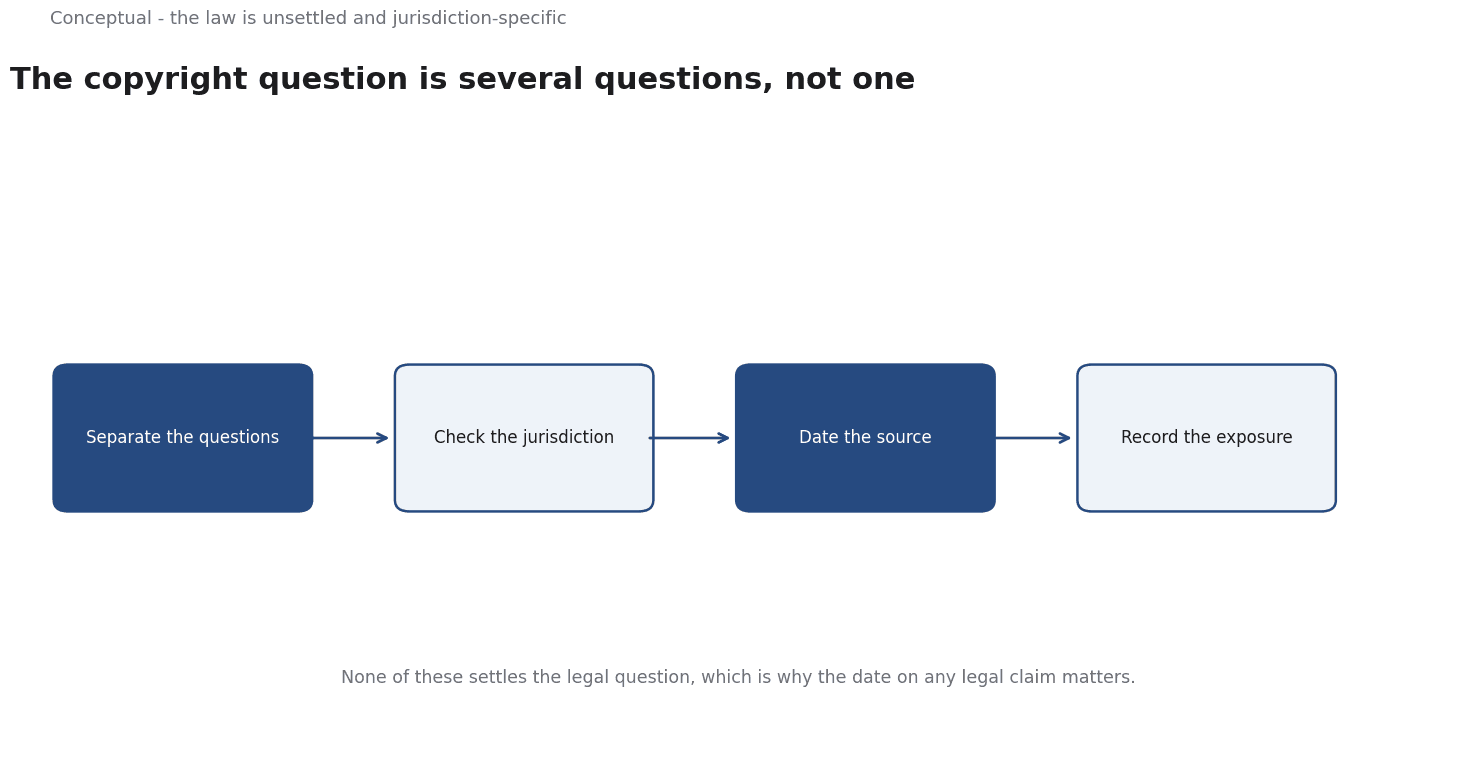
Separate the questions
Three distinct legal questions get conflated:
Is training on copyrighted works infringement? This asks whether copying works into a training set is permitted, and whether the use is transformative or fair. The answer is developing through litigation and policy, not settled by a single rule, as the Copyright Office's reports explain.
Can AI-generated output be copyrighted? Most copyright systems require human authorship. Purely machine-generated material generally cannot be registered, while human-authored material with AI assistance raises a case-by-case question about how much human contribution exists.
Who is liable for infringing output? If a model reproduces protected material or produces something that infringes, the allocation of responsibility among provider, deployer, and user is a separate and developing question.
Three consequences follow:
- A claim about one question does not answer the others. "Training is fair use" says nothing about output ownership.
- Jurisdiction decides. A rule in one country does not transfer to another.
- The answer has a date. Policy and case law evolve, which is why any legal statement should carry the date it was checked.
A worked diligence example
The following is hypothetical and illustrative.
A company builds a product that fine-tunes a model on a corpus of licensed articles and generates marketing copy. Three checks:
- Document the sources. Record where each portion of the corpus came from and under what licence, as Data Curation for LLM Pretraining: Deduplication and Quality recommends. "We scraped it" is not a defensible position if provenance is unknown.
- Check the intended use against the licence. A licence that permits research may not permit commercial product development. The terms, not the general reputation of the source, decide.
- Separate training from output risk. Even if the corpus is licensed correctly, the product should have a process for handling outputs that resemble source material — detection, review, or a restrained generation configuration, as the output-handling controls in the security checklist describe.
Three conclusions follow:
- Provenance is the first control, because you cannot assess rights you have not recorded.
- Licence terms are specific, and a general assumption about fair use does not replace reading them.
- Output handling is a separate workstream, not an afterthought of training.
What a team can do without a lawyer on call
Keep a source register with licences and retrieval dates for training data, which the datasheets paper argues for as a matter of documentation.
Avoid rights-clearing claims you cannot support. A statement that the training data is "all licensed" must be true for every item, not just the majority.
Design for restraint. Configure systems to avoid verbatim reproduction, and review outputs in high-risk domains, as the hallucination article recommends for accuracy reasons that overlap with legal ones.
Escalate genuinely uncertain cases. A novel use of a distinctive corpus deserves specialist review, which the risk-assessment article frames as a decision with an owner.
Uncertainty justifies documented decisions, bounded scope, and a review trigger, not inaction.
How organisations are responding
While the law develops, three practical patterns have emerged among teams that handle training data seriously:
Procurement with rights in mind. Licensing data with explicit terms for machine-learning use avoids an ambiguous fair-use argument. The cost is higher and the terms must be read, but the provenance is clear, which the build-versus-buy article discusses for software components generally.
Filtering and provenance records. Removing likely copyrighted material and recording what was included reduces the surface of the question, even if it cannot eliminate it. The data-curation article covers the mechanics of filtering and why the removed material must be sampled, not just discarded.
Output controls. Configuring a system to avoid verbatim reproduction and reviewing outputs in sensitive domains addresses the output side of the problem regardless of how the training question resolves, as the document-processing article explains for high-stakes content.
None of these settles the legal question, which is why the date on any legal claim matters.
They are risk-reduction measures that remain useful under several possible outcomes.
What this article cannot do
It does not state the law. It describes the shape of the questions and points to a primary source. The Copyright Office's reports and current case law are the authority.
It is not jurisdiction-independent. The discussion is oriented to the United States; other systems reach different conclusions.
It does not settle policy. The field is developing, which is why the date on any claim matters as much as the claim.
A decision test
- Separate training, output, and liability questions.
- Check the current authoritative source in your jurisdiction and record the date.
- Document training-data provenance with licences.
- Match intended use to the licence terms, not general assumptions.
- Build an output-review process for high-risk content.
- Escalate novel or distinctive cases to qualified counsel.
- Re-check when policy or case law changes.
For the data practices, see Data Curation; for the governance frame, see AI Governance.
References & Further Reading
- U.S. Copyright Office, 2025. Copyright and Artificial Intelligence | U.S. Copyright Office — The Copyright Office’s reports and guidance on copyright questions raised by generative AI.
- Wikipedia contributors, 2026. Artificial intelligence and copyright - Wikipedia — An overview of the copyright debates around AI training and outputs; secondary reference.