Credit Ratings Best Practices
A credit rating is an opinion, not a guarantee. Learn what rating agencies actually assess and how to use ratings without outsourcing your own credit judgment.
Teams often treat a credit rating as a verdict handed down by an authority, then build lending or investment decisions on that single letter grade. That convenience hides a real problem: a rating is one organization's forward-looking opinion about default risk, expressed on a scale that compresses a great deal of nuance. When the opinion is mistaken for a fact, the decision inherits assumptions the decision maker never examined.
Direct answer: A credit rating is a structured opinion about an issuer's ability and willingness to meet its obligations, produced by a rating agency and expressed on a standardized scale. Use ratings as one input among several, not as a substitute for reading the underlying financials, the covenant terms, and the business context. This article stays at the level of investor education and valuation concepts; it does not reproduce any agency's proprietary methodology.
Delta: This article adds a decision layer beyond the sources: it maps the difference between an educational description of ratings and a valuation view of credit risk to a concrete set of usage checks, with claim status explicit.
The mechanism
Investor.gov's introduction to investing frames a bond as a loan to a government or corporation, where the issuer promises to pay interest and repay principal. A credit rating enters this picture as an independent assessment of the issuer's ability to make those payments. The scale is ordinal and compact: a small set of letter grades stands in for a continuous distribution of default probability. That compression is the mechanism's central trade-off. A single grade is easy to compare across issuers, but it discards the distance between two issuers that share a grade and the distance between two grades that may carry very different expected losses in different economic conditions.
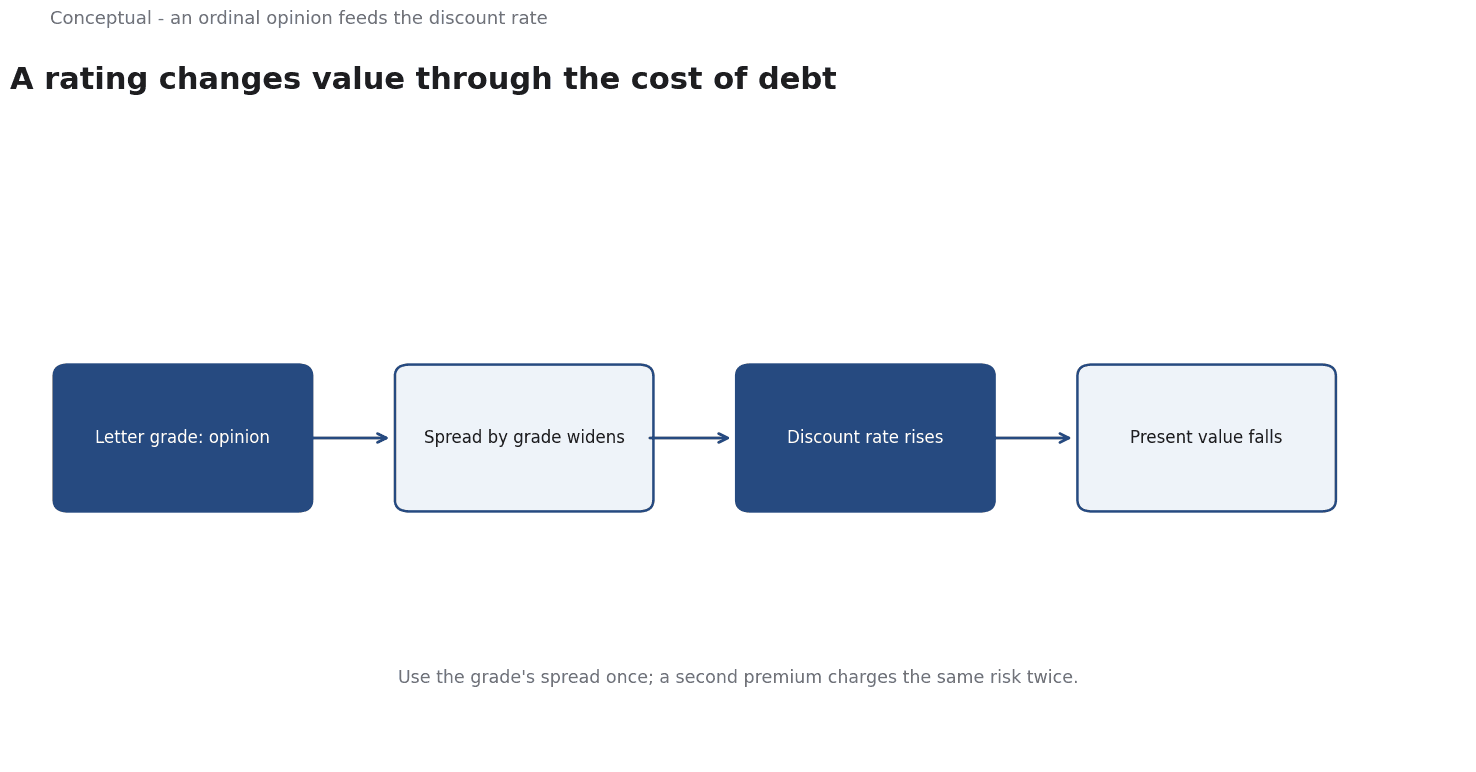
Damodaran's public datasets make the economic consequence of that grade visible. His default-spread and rating tables connect letter grades to observed yields and to the cost of debt that feeds a weighted average cost of capital. In practice, the rating becomes an input to a discount rate. A lower grade raises the spread an investor demands, which raises the discount rate, which lowers the present value of future cash flows.
The rating therefore does not merely label risk; through the cost of debt it changes the number that a valuation produces.
The practical consequence is that a rating carries two distinct kinds of information that should not be blended. The first is the agency's ordinal opinion about default risk. The second is a market signal embedded in yields and spreads that already reflects broader expectations. Treating them as interchangeable leads to double counting: an analyst who uses a low rating to justify a high discount rate and then also adds a separate risk premium is charging for the same risk twice. Keeping the two apart is the discipline that the mechanism demands.
Finally, the rating is a point-in-time opinion with a lag. Agencies update ratings on their own schedule, which means a grade can be stale relative to a fast-changing balance sheet. The rating describes where the issuer was assessed to stand, not necessarily where it stands today. A user who understands the mechanism reads the grade as a dated summary, then asks what has changed since the date.
A worked example
The following is hypothetical and illustrative. A corporate treasury team is deciding whether to buy the bonds of an industrial issuer that carries a single-A rating from two agencies. Rather than accept the grade, the team runs three checks. First, it reads the issuer's latest annual report and confirms that interest coverage has been stable across three years, consistent with the grade. Second, it pulls the default-spread data for that grade and sees the spread the market is currently demanding, then checks that its own discount rate uses that spread once, not twice. Third, it notes the rating's publication date and finds a subsequent quarter in which leverage rose sharply, information the grade does not yet reflect. The outcome: the team proceeds, but trims the position size and shortens the maturity. The rating anchored the analysis; the three checks changed the decision.
Evidence status
| Claim | Status | Source | Verified | Recheck when |
|---|---|---|---|---|
| A bond is a loan in which the issuer promises interest and principal repayment. | source-reported | Investor.gov | 2026-11-18 | Investor.gov revises its bond primer. |
| Ratings are independent assessments of an issuer's ability to pay. | source-reported | Investor.gov | 2026-11-18 | Regulator language on ratings changes. |
| Default spreads by rating grade feed the cost of debt and WACC. | source-reported | Damodaran Online | 2026-11-18 | Damodaran updates his spread datasets. |
| Ratings can lag a fast-changing balance sheet. | inferred | Derived from the sources | 2026-11-18 | Agency update practices are documented otherwise. |
The table separates what the sources state from what this article concludes. The first three rows are educational descriptions that can be checked directly against the two references. The fourth row is an inference about timing; it follows from the fact that ratings are updated on a schedule, but neither source states a specific lag. Revisit it if that assumption changes.
What it cannot do
The first limit is scope. This article operates at the level of investor education and valuation mechanics, using an educational primer and a public dataset repository as its anchors. It does not reproduce, validate, or critique any specific agency's rating methodology, and it cannot tell a reader which rating to trust for a particular issue. The sources describe what a rating is and how credit risk enters a discount rate; they do not supply the issuer-specific investigation that a real allocation decision requires. A reader looking for a view on a named company will not find one here, and that is deliberate rather than an omission.
A hidden cost of relying on ratings is the appearance of diligence without the substance. A decision that cites a strong grade can look well supported in a committee even when no one has opened the financial statements. That creates a documentation trap: the rating is easy to quote, so it becomes the recorded rationale, while the harder analysis is left implicit. Over time the team loses the habit of forming its own view, and the rating becomes a substitute for judgment rather than an input to it. The cost is not visible on any single decision, which is why it accumulates quietly.
The characteristic failure mode is the stale or divergent grade. Agencies can disagree with one another, and a single issuer can carry different grades from different houses.
Related is the failure that follows a downgrade: because ratings tend to move after conditions deteriorate, the portfolio that relied on the grade absorbs the change late, when prices have already adjusted. The mechanism explains why the lag is structural, not an accident of a single agency. A process that does not plan for both divergence and delay is incomplete.
There is also a boundary between credit quality and the other risks that matter to a holder. A rating addresses expected loss from default; it does not address interest-rate risk, liquidity risk, or the risk that a change in the tax or regulatory treatment of a bond alters its value. An issuer can retain a high grade while its bonds fall in price because rates rose. A framework built only on ratings will miss those exposures entirely. This is not a flaw in the rating but a category error in the person using it as a complete measure of risk.
For all these reasons the material needs periodic review. Spread tables change with market conditions, regulator guidance is revised, and the relationship between a grade and a market yield is not stable across cycles. A reader should re-check the data dates and re-read the primer before treating any specific number as current. The decision test that follows is designed to make those checks routine rather than exceptional.
Counterargument:
The claim that ratings invite passive reliance is fair for a buyer who owns no analytical process and incomplete for a buyer who already models credit spreads; for the latter, the grade is a cheap cross-check.
A decision test
- State the purpose of the rating in the decision. Decide whether it is a gate, a cross-check, or an input to a discount rate, and write that down before looking at the grade.
- Confirm the rating's source and date. Record which agency issued it and when, so a later change in the issuer's condition can be compared against the grade's vintage.
- Read one primary source about the issuer. Use an annual report or filing to confirm that the financial picture is consistent with the grade rather than assuming it.
- Pull the default-spread data for the relevant grade. Convert the grade into the spread the market currently demands, and use that spread once in any discount-rate calculation.
- Check for a divergence between grades. If two agencies differ, investigate the reason instead of selecting the more favourable grade.
- Identify what the rating does not cover. List the interest-rate, liquidity, and regulatory exposures that the grade says nothing about.
- Record the decision and the date it can be revisited. Set a review trigger tied to a downgrade, a new filing, or a spread move.
The value of a decision test is that it converts a diffuse best practice into observable steps. Each step produces a record, and the record is what makes the decision defensible later. A rating used inside this sequence informs judgment; a rating used in place of it replaces judgment with a borrowed opinion. The test is meant to be repeated, not remembered.
For further reading, see Cash Flow Forecasting.
References & Further Reading
- FINRA, 2026. Introduction to Investing (SEC Investor.gov) — Regulator explanation of market mechanics, bonds, and investor protection.
- Aswath Damodaran, 2026. Damodaran Online: Home Page for Aswath Damodaran — Publicly maintained datasets for industry averages, WACC, and valuation.