Data Ethics: Responsible Use of Customer Data
Customer data is a responsibility, not just an asset. Learn how organizations can collect, use, and protect data ethically.
Customer data is not an asset to exploit. It is a responsibility to steward.
Direct answer: Data ethics concerns how organizations collect, store, use, and share customer data. Responsible data use means collecting only what is needed, informing customers honestly, protecting data from harm, and being accountable when something goes wrong. Legal compliance (privacy regulations) is the minimum; ethical data use goes further, asking what should be done, not just what can be done.
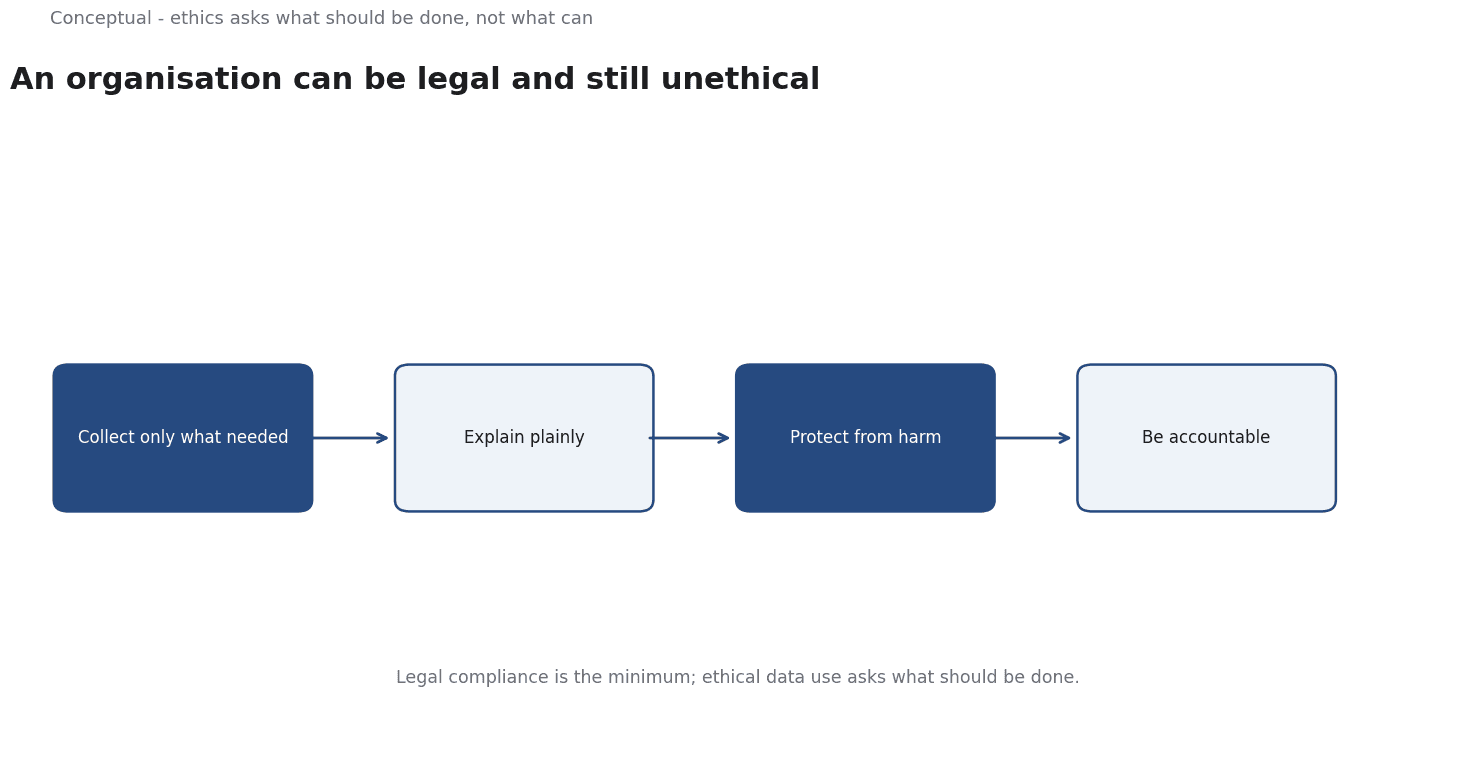
What data ethics covers
Data ethics addresses questions that regulations do not fully answer:
- Collection: what data is truly needed, and what is collected "just in case"?
- Consent: do customers understand what they are agreeing to, or is consent buried in legal text?
- Use: is data used for the purpose it was collected, or repurposed without notice?
- Sharing: is data sold or shared with third parties, and do customers know?
- Retention: how long is data kept, and is it deleted when no longer needed?
- Security: is data protected against breach, loss, and unauthorized access?
The difference between legal and ethical
Privacy regulations (GDPR, CCPA, and equivalents) set minimum standards: disclose practices, obtain consent, allow access and deletion, report breaches. Compliance avoids fines; it does not guarantee trust.
Ethical data use asks more:
- Would the customer be surprised by this use?
- Does this use benefit the customer, or only the company?
- If the data were published, would the customer be harmed?
- Is the value gained worth the risk created?
An organization can be legal and still unethical.
Data minimization
Collect only what you need. Every additional data point increases risk: more to protect, more to leak, more to explain. A product that can function with email and payment data does not need location, contacts, and browsing history.
Data minimization is not just privacy; it is risk reduction. Less data means less damage from a breach.
Transparency that customers can understand
They are liability shields. Ethical transparency means:
- Explaining what data is collected, in plain language.
- Explaining why it is needed, for the customer's benefit.
- Explaining who it is shared with and why.
- Making it easy to change choices, not buried in settings.
Transparency builds trust. Hidden practices destroy it when discovered.
Security as an ethical obligation
Data breaches are not just technical failures; they are ethical failures. Customers entrusted their information. A breach exposes them to fraud, identity theft, and harm. Responsible organizations:
- Encrypt sensitive data in transit and at rest.
- Limit access to those who need it.
- Test for vulnerabilities regularly.
- Report breaches promptly and honestly.
Security is not optional. It is the baseline of ethical data use.
The cost of unethical data use
Unethical data practices cost more than fines:
- Trust loss: customers leave when they feel betrayed.
- Brand damage: reputation takes years to build and days to destroy.
- Employee morale: engineers and product managers do not want to build exploitative systems.
- Regulatory scrutiny: one violation invites closer examination of all practices.
A practical framework
Before collecting or using customer data, ask:
- Why do we need this? What decision or value does it enable?
- Would the customer expect this? If not, do not do it—or explain clearly first.
- Can we delete it? Is there a retention limit and deletion process?
- Can we protect it? Are security measures adequate for the sensitivity?
- Are we accountable? Who answers if something goes wrong?
If you cannot answer these questions, do not collect the data.
For the related question of AI ethics, see AI Ethics: Responsible Use of Artificial Intelligence and why data quality matters, see Why Data Quality Matters More Than Model Complexity.
Fairness is not a single number
The references at the end of this article make an uncomfortable point: fairness is not a single number a team can optimize and then declare done. Barocas, Hardt, and Narayanan show that several reasonable definitions of fairness are mathematically incompatible. A system can satisfy one formal criterion and necessarily violate another. An organization therefore cannot claim to have solved the ethical question by picking a metric and reporting a passing score.
The choice of which criterion to apply is itself an ethical decision, not a technical one. Two teams examining the same data can reach different but internally consistent conclusions, depending on which definition they privileged. The ethical task is to make that choice explicit and defend it in terms of the customers affected, rather than burying it inside a dashboard.
A passing metric is evidence that a specific constraint was met, not proof that the system treats people fairly. Responsible teams report which criteria they chose, which they did not, and why. They keep watching after launch, because an aggregate that looks acceptable can hide harm concentrated in a smaller group.
Documentation as an ethical habit
The two reporting formats cited here, Datasheets for Datasets from Gebru and colleagues and Model Cards from Mitchell and colleagues, are often read as paperwork. They are better understood as ethical infrastructure. A datasheet records a dataset's provenance, composition, and limits so a reviewer can see what it was built to represent and where it falls short. A model card does the same for a trained system, stating intended use, evaluation, and limitations.
Both formats turn claims that would otherwise be vague into claims that can be checked. 'We use representative data' becomes a statement with an answer: representative of whom, collected how, and missing which groups. That shift matters because ethical review is impossible when provenance and limits are unknown. A team cannot weigh the risk of a repurposed dataset if no record exists of the purpose it was originally collected for.
Documentation also outlasts the people who made the decision. Employees leave, systems are inherited, and original intent is forgotten. A datasheet or model card preserves the reasoning so a later team can ask whether an old use is still justified. It is the practical counterpart to the accountability question in the framework above: it gives someone a way to answer for the system years after launch.
A worked example
The following is hypothetical and illustrative. Consider a company that builds a model to prioritize which support tickets get the fastest response. The training data comes from historical tickets, and the team notices the model ranks some groups lower. A reviewer reaches for a single fairness score and finds one that looks acceptable in aggregate.
The framework above and the sources behind it suggest a different sequence. First, the team consults the fairness criteria literature and recognizes that choosing a definition is a value judgment, so it documents which definition it picked and which it set aside. Second, it writes a datasheet for the ticket data, recording how labels were assigned and which customer segments are underrepresented. Third, it publishes a model card stating the intended use and the limits the team already knows about.
None of this guarantees a fair outcome. What it does is make the decision reviewable: a customer, auditor, or future employee can see what was claimed, on what evidence, and with what acknowledged limits. When the company later considers reusing the same data for a different purpose, the documentation makes the surprise question concrete. The customer would likely be surprised, and the record exists to show why that answer matters.
A counterargument
Despite acknowledging incompatible fairness criteria, the article treats making a choice explicit as the destination rather than the start of an argument. Barocas, Hardt, and Narayanan show that reasonable definitions of fairness are mathematically incompatible, so documenting which one was chosen does not show that the group bearing the cost was treated fairly; it records that a trade-off occurred. Datasheets and model cards are, by Gebru and Mitchell's own descriptions, reporting formats: they make limits reviewable but do not remove an underrepresented group from the data or repair a biased label. A critic would argue the framework can become the liability shield the article criticises in privacy policies - a complete record of acknowledged harms that leaves the decision unchanged.
Reviewability is a genuine gain, but it is not the same as an ethical outcome.
References & Further Reading
- Solon Barocas, Moritz Hardt, and Arvind Narayanan, 2019. Fairness and Machine Learning: Limitations and Opportunities — The free textbook on fairness criteria and their incompatibility results.
- Timnit Gebru et al., 2021. Datasheets for Datasets — The document format that makes a dataset's provenance and limits reviewable.
- Margaret Mitchell et al., 2019. Model Cards for Model Reporting — The reporting template used to document intended use, evaluation, and limitations.