Database Indexing Costs Explained
Indexes speed reads but cost storage and slow writes. Learn what index structures and query optimizers do, a worked trade-off, and when an index fails to pay.
Indexes are often added as a reflex whenever a query feels slow, without asking what the database must give up in exchange. The database index entry describes a structure that speeds retrieval at a cost, and the query optimization entry describes how a database chooses among plans. The real problem is deciding when an index earns its keep rather than simply adding one.
Direct answer: A database index is a structure that improves the speed of data retrieval, usually by maintaining an ordered or hashed access path, at the cost of extra storage and slower writes. A query optimizer decides whether to use available indexes when it plans a query.
An index pays off only when the read benefit exceeds its write and storage cost.
Delta: This article adds a claim-status table and an index-to-workload mapping beyond the sources: it maps an index structure to a read-write trade-off decision, with claim status explicit.
The mechanism
The database index entry describes a data structure that improves the speed of data retrieval operations on a table, typically at the cost of additional writes and storage. In practice, an index keeps a copy of selected columns in a form that can be searched quickly, so the engine can find matching rows without scanning the whole table. The source presents the index as a trade-off, not a free improvement. That framing is the key: every index is paid for on every write, whether or not any query ever uses it.
The query optimization entry describes how a database examines possible execution plans and selects one it estimates to be efficient. Indexes are inputs to that choice. An optimizer may use an index for a selective lookup and ignore it for a query that returns most of a table, because a full scan can be cheaper than many index lookups. The sources treat these as separate topics: one describes the structure, the other the decision to use it. Useful evaluation requires both.
The practical consequence is that indexing is a workload decision. A read-heavy table with selective filters can benefit from indexes; a write-heavy table may suffer because each insert and update must maintain every index. Because the sources describe mechanisms rather than workloads, deciding which columns to index is an inference. That decision should be recorded with the queries it was meant to serve, because an index added for one access pattern can become dead weight when that pattern disappears.
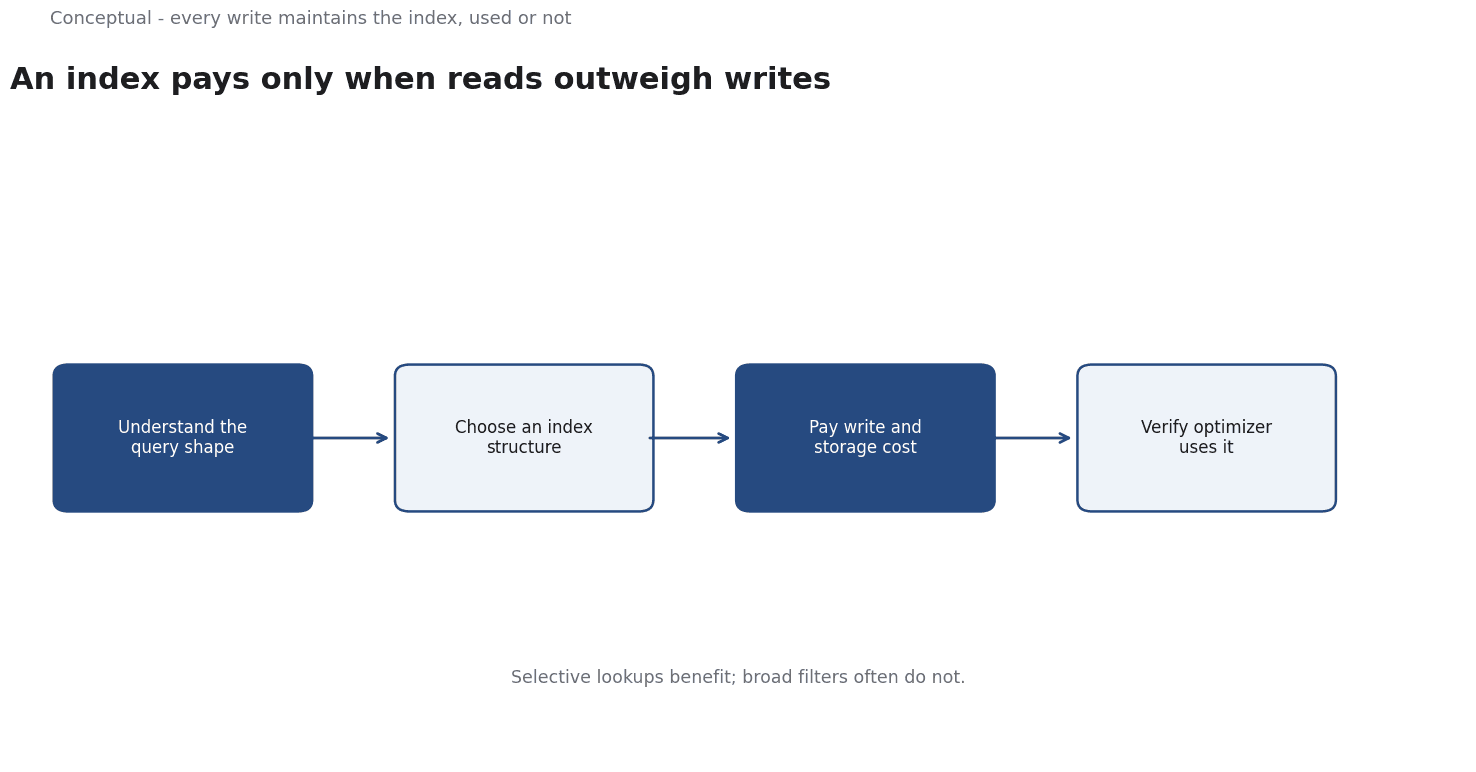
A further consequence is that an index is not a guarantee of speed. It helps only when the optimizer chooses it and when the query shape suits its structure. A function applied to an indexed column, a mismatched data type, or a broad filter can make the index irrelevant. The mechanism is therefore a chain: understand the queries, choose an index structure, pay the write and storage cost, then verify the optimizer uses it. Every link is a decision that should be visible when performance is reviewed.
A worked example
The following is hypothetical and illustrative. A team considers adding an index to a table that is written frequently and queried by one common filter. Three checks shape the decision. First, the team confirms the query is selective, returning a small fraction of rows, since a broad filter would not benefit. Second, it estimates the write cost by counting how often the table changes, because every change must maintain the new index. Third, it inspects the query plan after the index is created to verify that the optimizer actually uses it. The checks show that the filter is selective but the table is write-heavy, so the index helps reads while slowing ingestion. The team adds the index only to the read replica. The figures are hypothetical; the verification method is the contribution.
Evidence status
| Claim | Status | Source | Verified | Recheck when |
|---|---|---|---|---|
| Indexes speed retrieval at a write and storage cost | source-reported | Database index - Wikipedia | 2026-11-18 | Definition revised |
| Optimizers choose among execution plans | source-reported | Query optimization - Wikipedia | 2026-11-18 | Description changed |
| Match index choice to the read-write workload | inferred | Derived from the sources | 2026-11-18 | Query mix or write rate changes |
The first two rows restate the mechanisms as the source entries present them and can be checked directly. The third row is a synthesis, because neither source tells you which columns a particular workload should index. Recheck the source rows if the entries change, and recheck the inferred row when the query mix or write rate changes.
What it cannot do
An index cannot make every query faster. It helps specific access patterns, chiefly selective lookups and ordered retrieval, and can be ignored by the optimizer when a scan is cheaper. A query that returns most of a table gains little from an index and may run no faster than before. The sources describe the structure and the planning process, not a promise of improvement. Adding an index to satisfy a vague sense that reads are slow is a guess, and a guess that is never verified will leave the original problem untouched while adding cost elsewhere.
The hidden cost is ongoing rather than one-time. Each index consumes storage and must be updated on every relevant write, so a write-heavy workload pays repeatedly for a structure that may be used rarely or never. There is also a maintenance cost: indexes accumulate as applications change, and unused ones are seldom removed because nobody owns them. The result is a table that grows slower to write over time, with no clear culprit. Neither source addresses this operational cost, so it is an inference from the gap between adding an index and living with it.
An index can exist and still be unused because the query does not match its structure, a function wraps the indexed column, or the optimizer judges a scan cheaper. A related failure is assuming the optimizer is always right: it chooses from available indexes and estimates, so a missing index or stale statistics can produce a poor plan. The sources describe the mechanism without guaranteeing correct choices, so verification remains the team's responsibility.
There is a boundary around what these topics cover. The database index entry describes access structures; it does not cover schema design, normalization, or the cost of joins. Query optimization describes plan selection; it does not tune the application queries that feed the planner. An indexing decision can improve one query while leaving a deeper design problem in place. It also cannot substitute for measurement, because the benefit depends on real data distribution and real load, which no definition supplies.
Because workloads change, indexing needs periodic review. Query plans should be rechecked when access patterns shift, and index usage should be examined before assuming an old index still earns its cost. Each index should be recorded with the query it was added for and a date, so it can be challenged when that query disappears. Without that record, indexes persist as invisible write overhead long after their purpose has passed.
The counterargument that adding more indexes is fair because it covers more query shapes is reasonable for read flexibility and incomplete for writes, since every extra structure is maintained on every change whether or not it is used.
A decision test
- Identify the specific query the index is meant to serve.
- Check that the filter is selective rather than broad.
- Estimate the write and storage cost of the new structure.
- Match the index structure to the query's access pattern.
- Inspect the query plan to confirm the optimizer uses it.
- Measure performance under realistic load before and after.
- Record the index, its purpose, and a recheck date.
An index pays off when it speeds a real query more than it slows the writes that maintain it. The test keeps that trade-off visible, so an indexing decision is defended by a measured plan and a known workload rather than by the assumption that indexes are always good. For further reading, see Data Quality in Practice.
References & Further Reading
- Wikipedia contributors, 2026. Database index - Wikipedia — Data structure that speeds up row retrieval.
- Wikipedia contributors, 2026. Query optimization - Wikipedia — How a planner chooses an execution strategy.