Database Replication in Practice
Replication copies data across systems. Read the trade-offs, a worked setup, and why a replica can be correct and still be stale.
Replication is often described as making more copies of the data, which hides the trade-offs. The Wikipedia entry describes copying data across systems, and the CAP theorem treats the limits of consistency, availability, and partition tolerance. The practice is about choosing which property to favour.
Direct answer: Replicate for a stated purpose — availability, read scale, or recovery — then choose a consistency model that fits it and measure lag. The sources describe the mechanism; the choice rule is a synthesis.
Delta: This article adds a claim-status table and a worked setup, separating documented properties from the local choice of consistency.
The mechanism
Three points matter:
- Purpose decides topology. The replication entry describes copies across systems. Read scale and disaster recovery produce different designs.
- Consistency has a cost. The CAP theorem describes the trade-off under partition. Stronger consistency usually means more coordination and latency.
- Lag is visible. A replica can be correct in the sense of eventually matching the source while still being behind at a given moment.
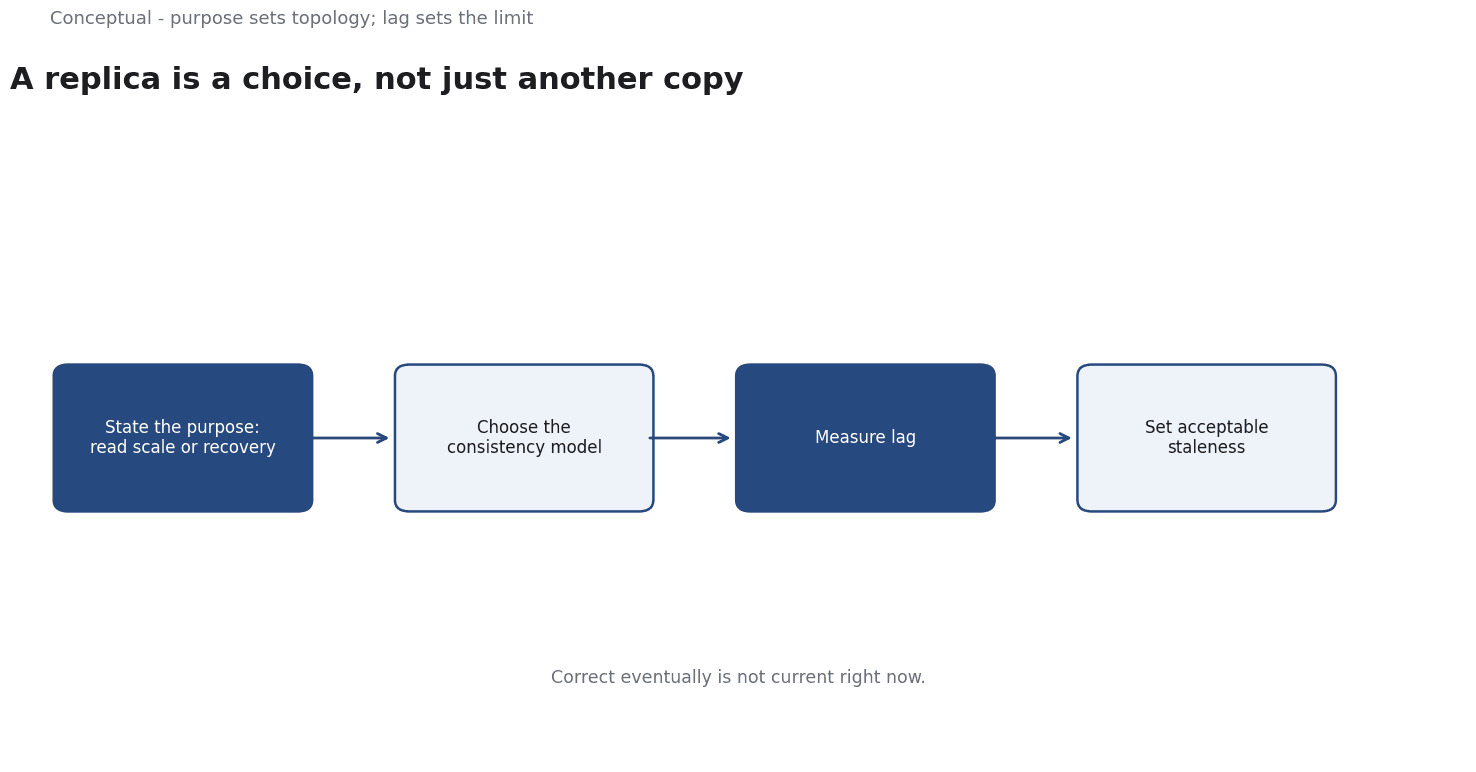
The sequence is: state the purpose, choose the model, measure lag, then define what staleness is acceptable.
The choice is local judgement, so it is inferred; the properties are source-reported.
A worked setup
Illustrative. A service adds a read replica to reduce load on the primary.
Three checks decide. First, can the application tolerate a replica that is slightly behind, or does it need read-after-write consistency? Second, how is lag monitored, and what value would trigger a fallback to the primary? Third, how does the system behave when the primary is unavailable?
The outcome is a replication policy with a recorded trade-off. The scenario is hypothetical; the method is the contribution.
Why the purpose changes the design
Read scale and disaster recovery both use copies, but they impose different requirements. Read scale tolerates some lag as long as the replicas serve requests. Recovery requires a copy that is complete and restorable, which is a different test. A design borrowed from one purpose and applied to the other will fail at the moment it is needed.
Why lag belongs in the dashboard
Monitoring lag turns an invisible condition into a visible one. The threshold should be set from the application's tolerance for staleness, not from a generic number.
Evidence status
| Claim | Status | Source | Verified | Recheck when |
|---|---|---|---|---|
| Replication copies data across systems | source-reported | Wikipedia, Replication | 2026-11-18 | Definition changes |
| Consistency and availability trade off under partition | source-reported | CAP theorem | 2026-11-18 | Theory revised |
| Choose the model from the stated purpose | inferred | Derived from the trade-off | 2026-11-18 | Workload changes |
Why a replica can be correct and stale
A replica that eventually matches the primary is not necessarily current. An application that reads from it immediately after a write may see old data, which is a design consequence rather than a fault. Naming the acceptable staleness is the practical control.
Replication also cannot replace a backup taken for recovery. A replica that mirrors a mistaken delete will faithfully reproduce it, which is why the two mechanisms are not interchangeable. A recovery plan needs a point in time to return to, and that requires a history rather than a live copy.
The final consideration is the failure mode under partition. When a replica cannot reach the primary, it must choose between refusing writes and accepting divergent data. That choice is the CAP trade-off in practice, and it should be made deliberately rather than discovered during an outage. Recording the choice makes the system's behaviour predictable.
The application should also be written with the chosen model in mind, because code that assumes immediate consistency will misbehave on a lagging replica even when the infrastructure is correct.
A recorded failure test is more useful than an assumed behaviour, because the choice under partition is only visible when a partition occurs.
The chosen consistency model should be stated where the application reads from the replica, so a future change does not silently assume something stronger.
A replica does not remove the need to test a restore, because a copy that cannot be restored is not a recovery path. Testing the restore is the only way to know whether the design works, and it should happen before the failure rather than during it.
What it cannot do
It cannot remove the need for backups, which serve a different purpose. It does not guarantee availability under every failure. And it cannot make a partition disappear.
The counterargument that more replicas always improve reliability is fair for read scale and incomplete for write consistency.
A decision test
- State the purpose.
- Choose the consistency model.
- Measure lag.
- Define a staleness threshold.
- Test failure behaviour.
- Record the decision and recheck condition.
For the data model, see NoSQL Design at Scale.
References & Further Reading
- Wikipedia contributors, 2026. Replication (computing) - Wikipedia — Copying data across systems for availability and scale.
- Wikipedia contributors, 2026. CAP theorem - Wikipedia — The consistency, availability and partition-tolerance trade-off in distributed stores.