EU AI Act Compliance in Practice
Compliance is a set of role-specific duties, not a badge. Read the practice, a worked review, and why a documented process still needs evidence.
The EU AI Act is often treated as a label to obtain, which misses that its duties depend on the role an organisation plays. The Act's official material describes the obligations, and the NIST AI RMF provides a risk-management frame. Practice means knowing which duties apply and showing evidence for them.
Direct answer: Identify your role, map the applicable obligations to concrete controls, and keep evidence that the controls work. The sources define the duties; the mapping is a synthesis.
Delta: This article adds a claim-status table and a worked review, separating documented obligations from the local decisions about how to evidence them.
The mechanism
Three points matter:
- Roles differ. The Act's material distinguishes providers and deployers. Duties do not transfer automatically between them.
- Risk classification matters. The obligations depend on the use. A general assistant and a high-risk system are not treated alike.
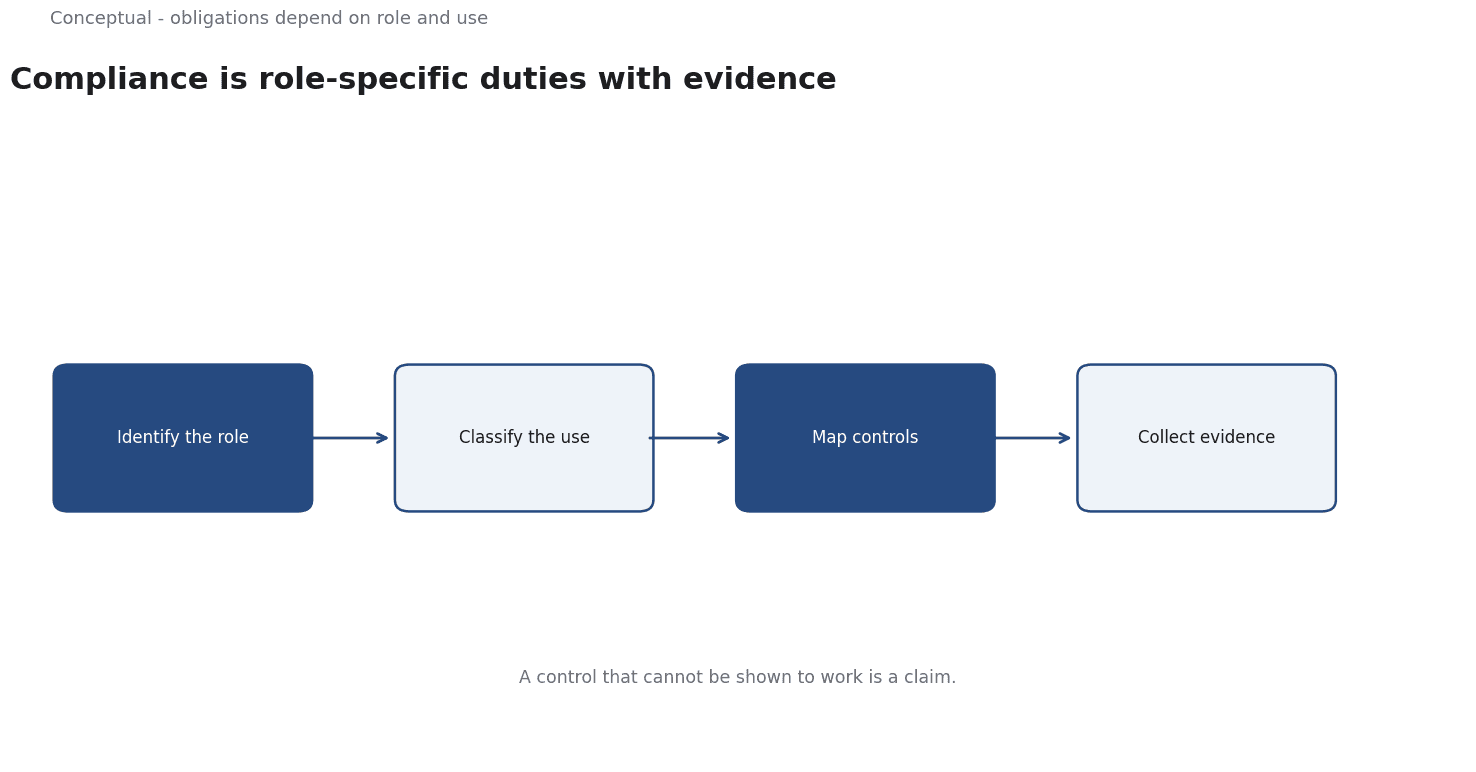
- Evidence is the test. The NIST RMF describes measurement and management. A control that cannot be shown to work is a claim.
The sequence is: identify the role, classify the use, map controls, then collect evidence.
The mapping is local work, so it is inferred; the obligations are source-reported.
A worked review
Illustrative. A company uses a model to screen job applications.
Three checks decide. First, is the organisation a provider, a deployer, or both for this use? Second, which obligations apply given the classification of the system? Third, what evidence shows that the controls — human review, bias checks, records — are operating?
The outcome is a duty map with evidence gaps. The scenario is hypothetical; the mapping method is the contribution.
Why the role determines the work
A provider and a deployer of the same system have different duties, so a generic checklist cannot describe the work. Identifying the role first prevents a team from collecting evidence that is irrelevant to its obligations. It also reveals cases where the organisation plays both roles, which usually means two sets of controls.
The classification of the use is the second decision. A system that supports a decision about a person is treated differently from one that drafts internal text. Naming the use honestly is a precondition for mapping duties, because a favourable classification that does not match reality will fail at the first review.
Why evidence has to be current
Systems change, and so do the people operating them. Reviewing evidence on a schedule is part of compliance, not an optional improvement to the initial documentation.
Evidence status
| Claim | Status | Source | Verified | Recheck when |
|---|---|---|---|---|
| The Act defines role-specific duties | source-reported | EU AI Act official material | 2026-11-18 | Law amended |
| Risk management covers measurement and management | source-reported | NIST AI RMF | 2026-11-18 | Framework updated |
| Map duties to evidence, not just documents | inferred | Derived from the obligations | 2026-11-18 | Use changes |
Why documentation is not compliance
A policy can exist while the control it describes is not operating. Evidence — records of review, test results, and decision logs — is what shows the difference. Keeping it alongside the policy makes the two consistent.
A final consideration is the boundary between this article and legal advice. The regulation is complex and the facts of each deployment differ, so a general framework cannot determine which obligations apply in a specific case. Qualified review is part of the process, not a sign that the internal work was inadequate.
The framework also needs a recheck condition. Guidance and enforcement practice develop over time, and a mapping that was reasonable when it was written may need revision. Recording the date and the source of the mapping makes that revision possible.
The evidence should be tied to a specific control, not collected in a general folder. A record of a bias check, for example, should state the system version and the date, so a reviewer can connect it to the deployment it was meant to cover. General documentation cannot make that connection.
A review that is never revisited becomes a historical document rather than a control that operates today.
The date of the mapping belongs beside the conclusion it supports.
The role Assignment should be revisited whenever the system's function changes, because a new use can create new duties.
What it cannot do
It cannot provide legal advice, which depends on jurisdiction and facts. It does not remove the need for a dated check of the current law. And it cannot guarantee that a regulator will agree with the classification.
The counterargument that a template is sufficient is fair for structure and incomplete for evidence.
A decision test
- Identify your role.
- Classify the use.
- Map applicable duties to controls.
- Collect evidence for each control.
- Check the current law.
- Record the review and recheck date.
For the framework, see NIST AI RMF guidance.
References & Further Reading
- EU AI Act Explorer, 2026. EU Artificial Intelligence Act | Up-to-date developments and analyses of the EU AI Act — A structured, readable resource on the EU AI Act text, obligations and timelines; secondary reference for the deployer perspective.
- NIST, 2023. AI Risk Management Framework | NIST — The governance framework referenced in AI risk and compliance work.