Executive Communication: Common Questions
Common questions about executive communication answered with bounded claims: what a short update carries, how meetings support decisions, and where the limits are.
Executives rarely lack information; they lack a decision-ready version of it. Communication that lists activity instead of stating a change forces the listener to do the analysis. The recurring question is not how to say more, but what a short, decision-oriented message must contain.
Direct answer: Executive communication is the practice of encoding a state, a change, and an ask so a decision-maker can act without reconstructing context. The communication-skills source frames messaging as encoding and decoding with feedback; the meeting source describes gatherings with purpose, agenda, and record. The boundary: a clear message cannot supply missing evidence or force a decision.
Delta: This article adds a question-to-decision map beyond the two sources: it maps common executive-communication questions to concrete message choices, with claim status explicit.
The mechanism
The communication-skills source describes communication as a process in which a sender encodes a message, a channel carries it, and a receiver decodes it, with feedback closing the loop. Applied to an executive update, this means the sender owns the encoding: a list of raw facts is not a decoded message.
The practical consequence is that the burden of structure sits with the communicator, not the listener.
If the receiver has to ask what changed, the encoding failed even though every fact was present.
Feedback is the part most often skipped. A message that produces no response gives the sender no signal about whether it was understood. The source treats feedback as part of the loop, so an update that ends with an open question is weaker than one that ends with a specific ask. The consequence is measurable in principle: a clear ask yields a decision or a targeted question, while a vague update yields silence or a request for a longer meeting.
The meeting source describes a gathering convened for a purpose, typically with an agenda and some record of what was decided. For executive communication, this frames the meeting as a decision venue rather than a status venue. Status can be read; decisions need dialogue. The practical consequence is that material meant for updating should arrive in writing before the meeting, leaving the meeting itself for the contested choice.
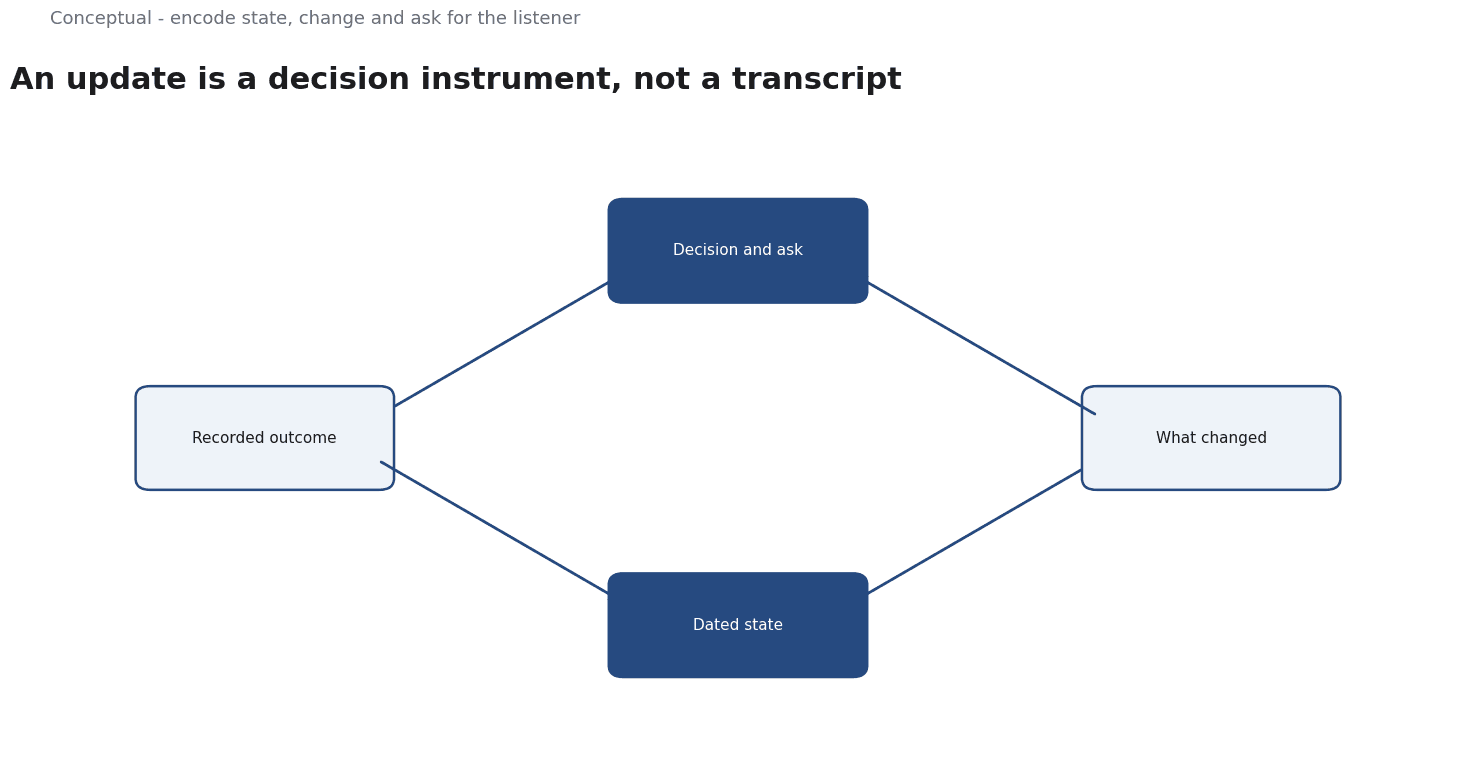
Together these ideas point to a simple structure: state the current state with a dated measure, name what changed, present the decision needed, and record the outcome. Each element reduces decoding work for the listener. The boundary is that structure cannot manufacture certainty. A crisp sentence about an uncertain number is still uncertain, and the honest version says so plainly instead of hiding the gap behind fluent wording.
A worked example
The following is hypothetical and illustrative. A program lead sends a weekly written update before a fifteen-minute meeting. Three checks decide whether it works. First, can the executive name the decision after reading the first two lines, without scanning the rest? Second, does the meeting produce a recorded decision and owner, as the meeting format intends, or does it drift into a status re-read? Third, does the feedback loop close, meaning the lead receives a decision or a specific question rather than silence? In this hypothetical case, the lead moves status into a one-page appendix, leads with a two-week schedule risk, and ends with a recommendation. The meeting then resolves the scope question in six minutes and records the owner.
Evidence status
| Claim | Status | Source | Verified | Recheck when |
|---|---|---|---|---|
| Communication is modeled as encoding, transmission, decoding and feedback | source-reported | Wikipedia: Communication skills | 2026-11-18 | Source definitions change |
| Meetings are purpose-driven gatherings with agenda and record | source-reported | Wikipedia: Meeting | 2026-11-18 | Meeting practice guidance changes |
| A specific ask reduces follow-up cycles | inferred | Derived from the sources | 2026-11-18 | Team communication norms change |
The table keeps source statements separate from inference. The first two rows are descriptive definitions from the references, reported rather than measured here. The third row is an inference about behavior and depends on local norms, so it should be rechecked if the team changes how it records decisions or runs meetings.
What it cannot do
Clear communication cannot replace the substance being communicated. A well-encoded update about a program with no evidence is still noise, just faster to read. The communication model treats encoding as one stage; it says nothing about whether the message is true. Teams sometimes confuse the smooth delivery of a message with the quality of its content, and a listener who feels informed may skip the verification that the numbers deserve.
Fluency is not evidence.
The hidden cost of brevity is preparation. A five-minute update that looks effortless usually required significant work to decide which measure matters and which change is real. That work does not disappear; it moves to the sender. Organizations that adopt short updates without funding the preparation get short updates that omit the hard part, which is the judgment about what changed and why. The format then becomes a ritual rather than a decision tool.
An update that lists meetings held, tickets closed, and work in progress feels informative but leaves the executive with no choice to make. The meeting then fills with questions that could have been answered in writing. Another failure is the recommendation without evidence, where a crisp ask rests on an unstated assumption; when the assumption is challenged later, the whole message collapses and trust in future updates falls with it.
The boundary is the decision itself. Communication can surface a decision, frame it, and record it, but it cannot make a reluctant executive act or resolve a genuine disagreement about facts. That requires evidence, authority, or escalation. A communicator who expects a well-worded message to settle a contested technical question is asking the channel to do the work of the data, and the channel will not deliver it.
The format also needs review. What counts as the right level of detail changes as a program moves from exploration to execution, and the executive's information needs change with it. A scheduled check of whether decisions are actually being made in the meeting, and whether follow-up questions are shrinking, is a better test than counting slides sent. If the same questions recur, the update is missing something and should be changed rather than repeated more loudly.
Counterargument: "The counterargument that executives can read raw data themselves is fair for a single analyst and one dataset and incomplete when many teams compete for a decision-maker's attention."
A decision test
- State the current status with a dated, sourced measure.
- Name what changed since the last update, not what was done.
- Identify the decision needed, its owner, and its deadline.
- Give a recommendation with the one or two numbers behind it.
- Say what is unknown and what would change the recommendation.
- Move detail to an appendix and keep the message short.
- Record the decision and confirm the feedback loop closed.
These steps convert a message from a transcript of activity into an instrument for a decision. The test is not how complete the update feels to its author but whether the listener could act on it. For a fuller treatment of written decision documents, see Decision Memos.
References & Further Reading
- Wikipedia contributors, 2026. Communication skills - Wikipedia — Context for concise, structured reporting and communication.
- Wikipedia contributors, 2026. Meeting - Wikipedia — The structure and purpose of meetings.