EU AI Act: What Deployers Actually Need to Know
The AI Act assigns duties by role and risk level. Read what deployers do, how obligations phase in, and where to verify current text.
The EU AI Act is often described as a set of restrictions on AI, which obscures how it actually works. It assigns obligations to different roles — providers, deployers, importers — and scales them with the risk of the system. For most organisations, the relevant question is what a deployer must do, which is different from what a provider of a model must do.
Direct answer: The Act regulates AI systems by risk category and assigns specific duties to deployers, including use according to instructions, human oversight, monitoring, and record-keeping for higher-risk systems. The European Commission's AI Act page is the primary source for the framework and its staged application; the EU AI Act Explorer provides a readable structure of the text. The boundary: this is educational orientation, not legal advice — the Act's application depends on role, system type, and jurisdiction, and the definitive text is the regulation itself.
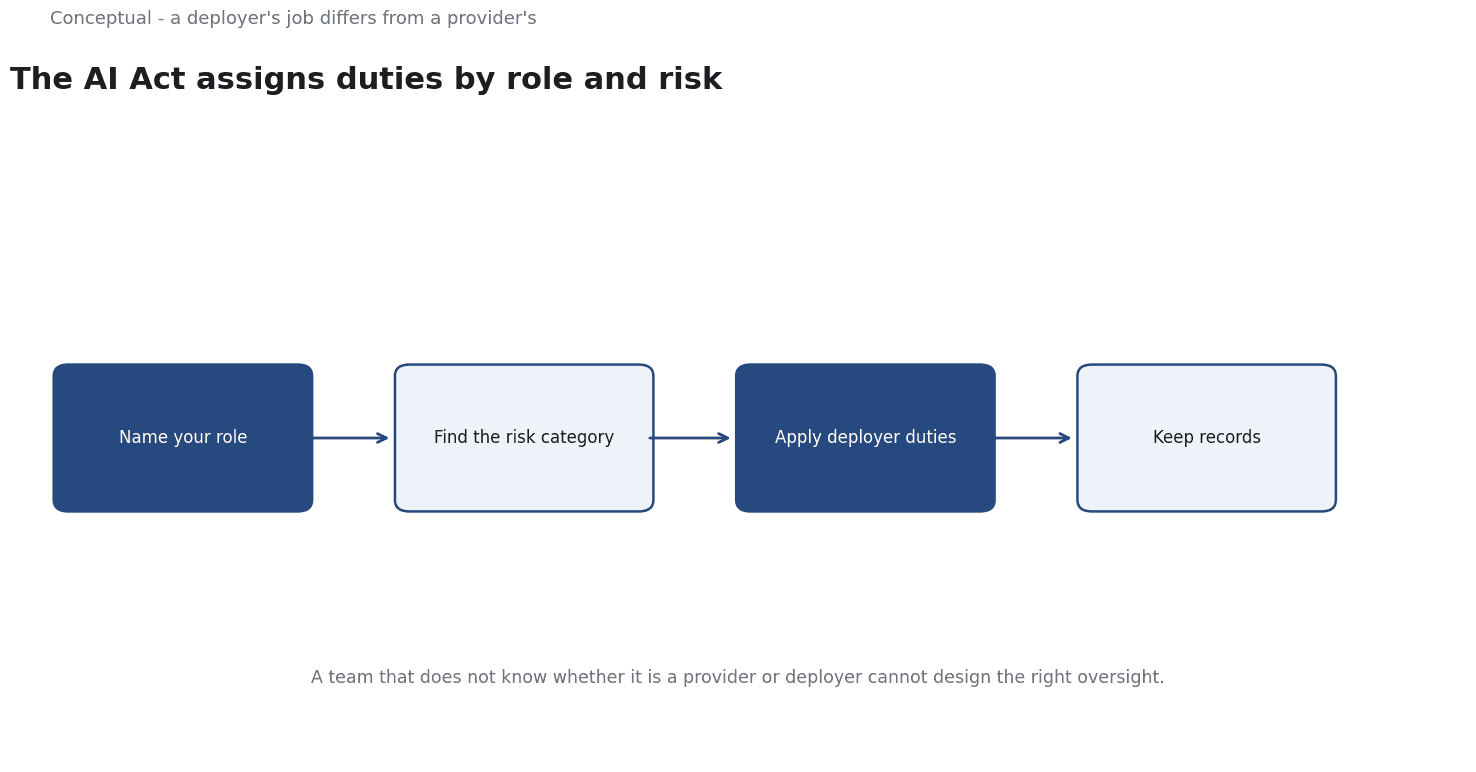
Roles matter first
Provider — the entity that develops an AI system or has one developed and places it on the market under its name. Providers face the heaviest conformity and documentation duties.
Deployer — the entity that uses an AI system under its authority. Most organisations that adopt AI are deployers, not providers, though the line can shift — fine-tuning a system under your own name may change your role.
Importer and distributor — roles in the supply chain with their own obligations.
Three consequences follow:
- Know your role before reading obligations. A deployer's duties are not a provider's duties.
- Role can change with what you do. Rebranding or substantially modifying a system has implications, which the build-versus-buy article discusses for software generally.
- Documentation from the provider matters because deployers must follow the instructions that come with a system, as the model-card article explains for AI artefacts.
Risk categories
The Act structures obligations around risk:
Unacceptable risk — practices that are prohibited. The consequence is not a control but a ban on the practice.
High risk — systems in defined domains such as employment, credit, education, or critical infrastructure. Deployers of high-risk systems face concrete duties: use according to instructions, assign competent human oversight, monitor operation, and keep logs.
Limited and minimal risk — lighter obligations, with transparency duties in some cases, such as informing people they are interacting with a chatbot.
General-purpose AI — a separate category with obligations that scale with capability and systemic impact, which mainly concern providers of large models.
A worked deployer check
The following is hypothetical and illustrative.
A company deploys a tool that screens job applications. Employment is a defined high-risk domain, so the deployer assumes heightened duties.
Four checks follow:
- Confirm the role. If the company uses a third-party tool unchanged, it is a deployer. If it rebrands the tool, its obligations may change, as the role discussion above explains.
- Check the provider's instructions. The system must be used for its intended purpose with the stated conditions, which the model-card article argues for independently.
- Assign human oversight. A named person with authority to override decisions and the competence to understand the system's limits — the human-in-the-loop design applies here, as the oversight article describes.
- Monitor and log. Record inputs, outputs, and overrides so decisions can be reviewed, which the observability article covers operationally.
Three conclusions follow:
- The deployment needs governance, not just a licence. Oversight and logging are ongoing duties, which the governance checklist describes.
- Worker communication and data protection are separate concerns that interact with the Act but are not replaced by it, as the data-privacy article explains.
- The compliance basis must be dated. The Act's obligations phase in over time, so a statement that is true today should carry the date it was checked.
What this orientation cannot do
It is not legal advice. Whether a specific system is high-risk depends on its intended purpose and context, which the definitive text and a qualified adviser must settle.
It does not fix a system. Compliance duties and safety are related but distinct. The risk-assessment article covers the technical side.
It will not stay current. The framework and guidance evolve.
Check the Commission's page and the regulation text before relying on any summary, including this one.
A team that does not know whether it is a provider or deployer cannot design the right documentation or oversight, which the AI-governance article explains.
A decision test
- Identify your role — provider, deployer, importer, or distributor.
- Classify the system's risk category by its intended purpose.
- List the deployer duties that apply to that category.
- Check the provider's documentation and use the system within its stated conditions.
- Assign competent human oversight where required.
- Set up monitoring and logs with an owner.
- Verify against current text and record the date of the check.
For the governance frame, see AI Governance; for oversight design, see Human in the Loop by Design.
References & Further Reading
- European Commission, 2026. AI Act | Shaping Europe’s digital future — The European Commission’s primary page on the AI Act regulatory framework and its staged application.
- EU AI Act Explorer, 2026. EU Artificial Intelligence Act | Up-to-date developments and analyses of the EU AI Act — A structured, readable resource on the EU AI Act text, obligations and timelines; secondary reference for the deployer perspective.