ETF vs Mutual Fund: Structure, Cost, and Liquidity
Two wrappers for diversified exposure. Read the structural differences, a worked cost example, and which one fits which investor.
Exchange-traded funds and mutual funds both hold a basket of assets, which is why they look interchangeable on a screen. The differences lie in how they trade, how they are priced during the day, and how costs are charged. Those structural differences decide which wrapper fits a particular investor, as the valuation article argues for looking beyond the label of an investment.
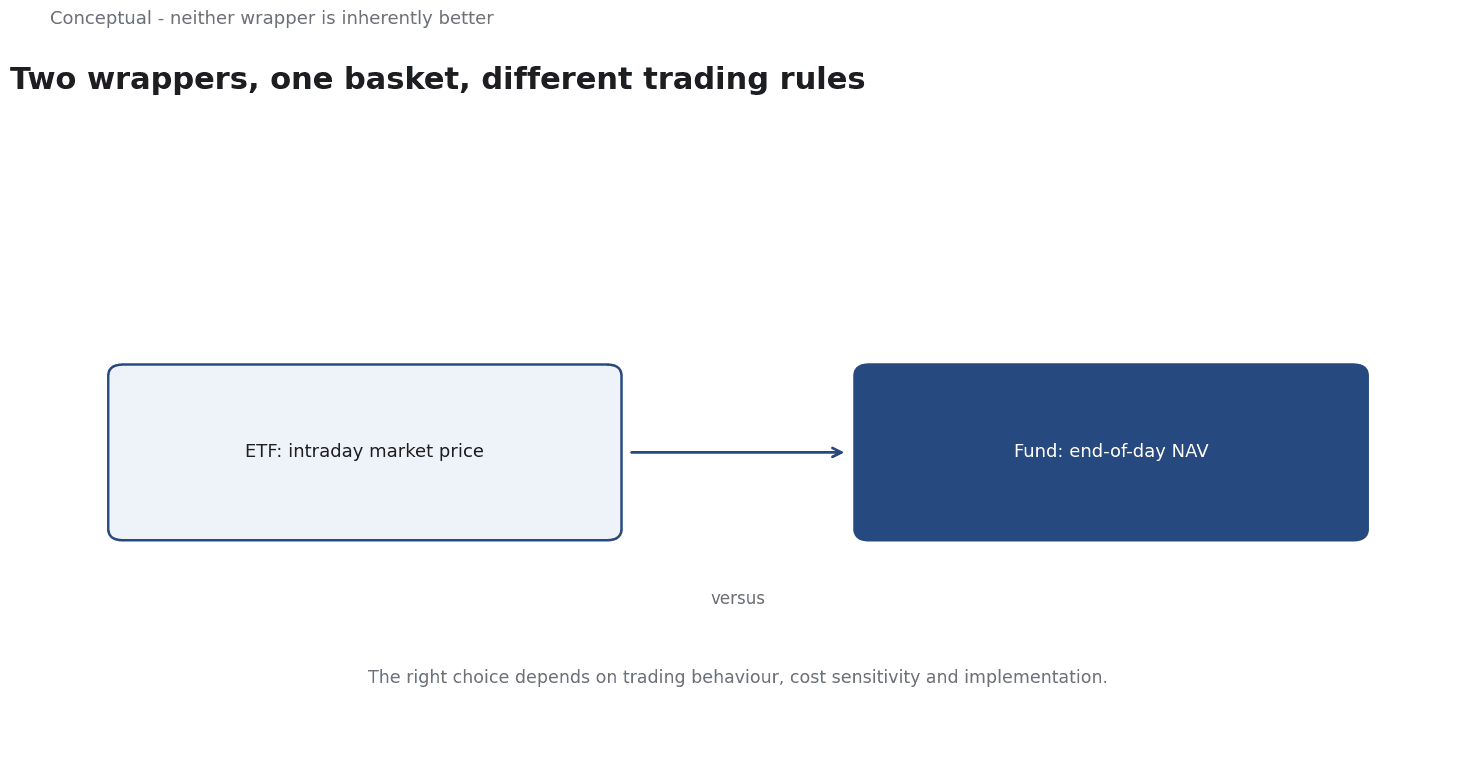
Direct answer: An ETF trades intraday at a market price that can deviate from net asset value; a mutual fund trades once a day at end-of-day NAV. Investor education covers the products and their risks, and the cost article explains how fees compound. The boundary: neither wrapper is inherently better — the right choice depends on trading behaviour, cost sensitivity, and the specific fund's implementation, as the factor-investing article treats the underlying strategy as the primary decision.
The structural differences
Trading. ETFs trade like shares throughout the day, which lets an investor set a limit price or react to news. Mutual funds execute at the closing NAV, which removes intraday timing but also means an order placed in the morning executes at an unknown price, as the market-mechanics article explains for end-of-day pricing.
Pricing. An ETF's market price can differ from its underlying value, particularly in less liquid funds or stressed markets. The size of that discount or premium is a real cost, which the market-microstructure article treats as a question of liquidity.
Costs. ETFs typically publish an expense ratio and incur a trading spread; mutual funds may charge a load or a distribution fee in addition to the expense ratio. The cost estimator explains how a small annual difference compounds over decades, which the compound-interest article illustrates with numbers.
Tax efficiency. In many jurisdictions, ETFs can be more tax-efficient because of how they handle redemptions, which the tax-efficient-investing article treats as a jurisdiction-specific question requiring a current check.
A worked comparison
The following is hypothetical and illustrative. An investor holds 100,000 for twenty years and compares two funds tracking the same index.
Fund A is an ETF with a 0.10% expense ratio and an average trading spread cost of 0.05% per trade, traded twice a year. Fund B is a mutual fund with a 0.20% expense ratio and no load. Ignoring taxes, Fund A's annual drag is about 0.15% versus 0.20%, which the cost article calculates as a meaningful difference over twenty years. Three checks decide whether it matters. First, does the investor actually trade twice a year, or does the ETF's flexibility encourage more activity, which the behavioural-finance article treats as a bias toward action? Second, is the premium or discount on the ETF persistent, which the market-data article warns about drawing conclusions from a single observation? Third, what is the tax treatment in the investor's jurisdiction, as the tax-efficient-investing article requires a dated check?
Three conclusions follow.
The structural advantage is small when the underlying index is the same, as the factor-investing article treats strategy as primary.
Costs are certain, which the valuation article argues for treating explicitly. And the decision should be recorded, as the decision-memo article requires for consequential choices.
What the wrapper cannot do
It cannot improve a weak underlying index, which the asset-allocation article treats as the primary decision. It cannot guarantee liquidity in a crisis, which the financial-crises article treats as a question of market structure. And it cannot remove tax obligations, which the tax-efficient-investing article makes jurisdiction-specific.
A low-cost mutual fund can beat an ETF with a persistent premium, which the worked example shows for the same index.
A decision test
- Check the underlying index or strategy first, as Asset Allocation for Long Horizons advises.
- Compare total costs including spreads and loads, as the cost estimator requires.
- Check typical premium or discount for the ETF, as the market-data article recommends.
- Match trading frequency to the wrapper's strengths.
- Check tax treatment in your jurisdiction with a dated source.
- Verify the fund holds what it claims, as the data-governance article requires.
- Review on change in fees or family, as the monitoring article advises.
For the baseline, see Asset Allocation; for costs, see LLM Cost Estimator for the general arithmetic of compounding fees.
References & Further Reading
- U.S. Securities and Exchange Commission (Investor.gov), 2026. Introduction to Investing — Primary regulator guidance on market mechanics and investor protection.
- Wikipedia contributors, 2026. Valuation (finance) - Wikipedia — Overview of absolute and relative valuation approaches; secondary reference.