Getting Started with Server-side Tagging
Browser tags lose data to restrictions and script load. Learn what server-side tagging in Google Tag Manager actually changes, a worked example, and its limits.
Browser-side tagging depends on the client to execute every tag, so ad blockers, cookie restrictions, and browser privacy features can drop events before they are recorded. Each additional vendor tag also adds script weight to the page, slowing the very experience the business is trying to measure. Server-side tagging proposes to move that work off the browser, but the decision is usually framed as a fix rather than a trade-off.
Direct answer: Server-side tagging in Google Tag Manager routes collection through a server container the operator controls, so events are assembled on infrastructure you own rather than relying solely on the browser. It can improve data control, reduce client-side script load, and give finer say over what reaches each endpoint. It does not remove consent obligations or make measurement immune to every form of data loss.
Delta: This article adds a decision framing beyond the Google documentation: it maps when server-side tagging is worth its hosting and maintenance cost to a specific measurement problem, with claim status explicit.
The mechanism
Google's server-side tagging model moves the tag execution environment from the web page to a server container, typically deployed on a cloud endpoint the operator provisions. In the browser-side model, the tag manager snippet loads and runs tags inside the user's page, where each vendor script competes for resources and is subject to whatever blocking or cookie policy the client applies. The server-side model replaces that with a first-party endpoint: the browser sends a single request to the operator's own domain, and the server container forwards transformed data to the tag endpoints. The practical consequence is that the point of collection sits under the operator's control rather than the browser's.
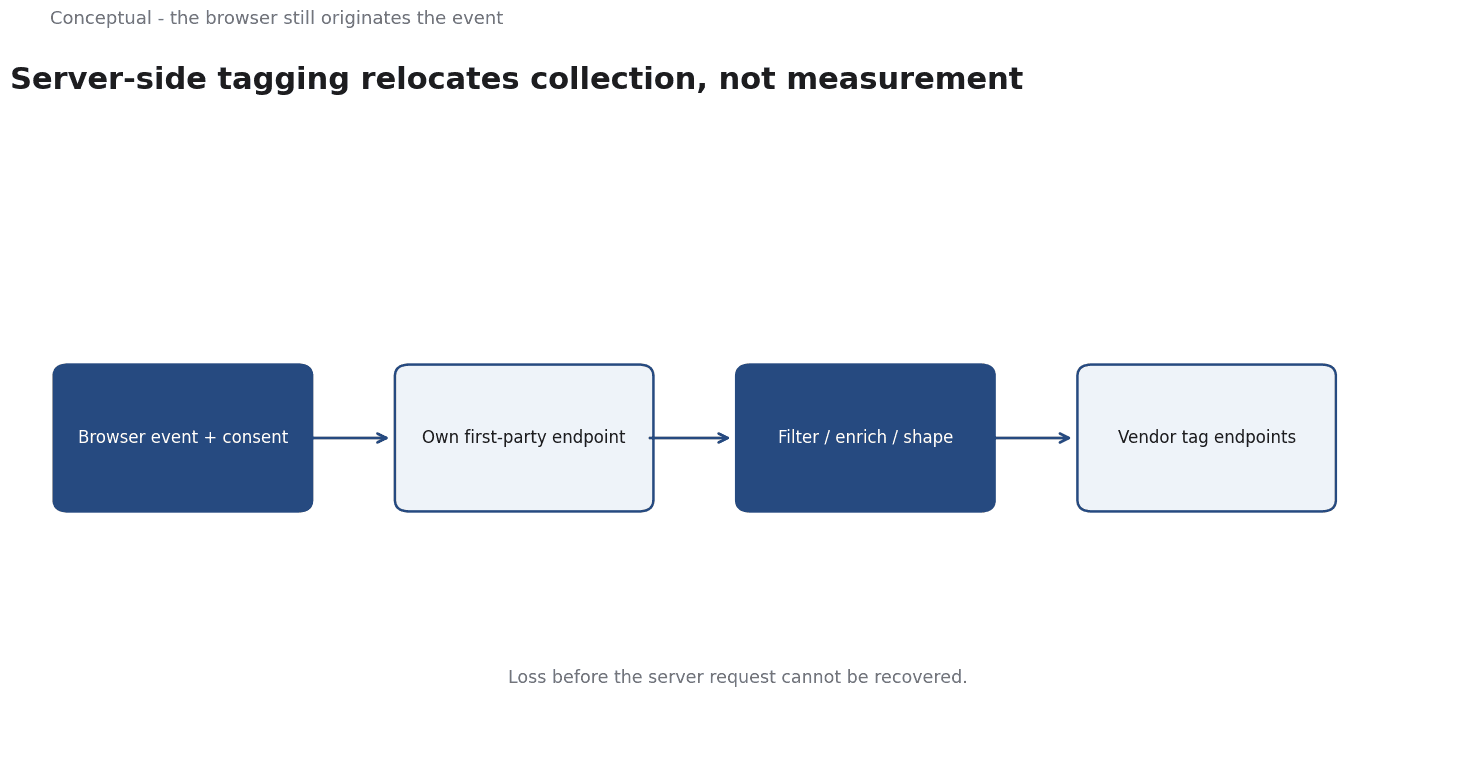
Because the server constructs the outgoing requests, it can filter, enrich, and shape what leaves the environment before it reaches any third party. A business can decide which parameters a vendor receives, strip identifiers that are not permitted, and avoid exposing vendor URLs directly in the page source. The trade-off is that the browser still originates the event, so any loss that happens before the first request reaches the server, such as a user who never loads the page or a blocked initial call, is not recovered by moving tagging server-side.
The documentation treats server-side tagging as a way to work within a consent framework, not around it. Consent state must still be collected in the browser and passed to the server, which must honor it when dispatching tags. Separately, because fewer scripts run in the page, client-side script load can fall, which can improve page responsiveness. The practical consequence is that the performance benefit is a side effect of consolidation, while the governance benefit comes from control over the forwarding logic, and neither is automatic.
Running a server container introduces infrastructure the browser-side model did not require: an endpoint to provision, capacity to size, monitoring to maintain, and a deployment path to manage.
The mechanism is therefore a relocation of complexity, from the client page to the operator's stack.
Teams that adopt it without assigning ownership for that stack often find the measurement is more controlled but less understood.
A worked example
The following is hypothetical and illustrative. A retailer tags purchases in the browser and notices that reported conversions drift below orders recorded in its own database, while page load time rises as vendor scripts accumulate. It moves the purchase event to a server container on its own domain, passing consent state from the page and forwarding a reduced set of parameters to each endpoint. Three checks decide whether the change helped. First, compare server-recorded purchase events against the order database to see whether the reporting gap narrowed. Second, measure client-side script count and page load before and after to confirm the consolidation reduced weight. Third, verify that vendor payloads contain only the parameters the consent and data policy allow. If the gap persists, the loss occurs before the event reaches the server and no amount of server-side forwarding recovers it. The outcome is a controlled measurement path with a clear boundary, not a guarantee of perfect data.
Evidence status
| Claim | Status | Source | Verified | Recheck when |
|---|---|---|---|---|
| Server-side tagging moves tag execution to a server container the operator controls | source-reported | Google GTM server-side | 2026-11-18 | When the product documentation changes |
| Server-side tagging can improve data control and reduce client-side script load | source-reported | Google GTM guide | 2026-11-18 | When browser or platform behavior shifts |
| Adoption is justified when measurement loss and script cost exceed hosting burden | inferred | Derived from the sources | 2026-11-18 | When infrastructure or consent rules change |
The first two rows describe capabilities the source documentation states directly. The third row is a decision rule inferred from those capabilities and is not a claim the sources make. Recheck the source-reported rows when Google updates the product; recheck the inferred row when the team's consent environment or hosting cost changes materially.
What it cannot do
Server-side tagging cannot recover data that never reaches the server. If consent denies the event, the user blocks the initial request, or the page never loads, no server configuration reconstructs it. The model relocates tag execution; it does not create information.
The hidden cost is operational ownership. A server container is a service that must be provisioned, scaled, patched, and monitored, with someone accountable when it fails. Browser-side tagging pushes most failure modes onto vendors and the page; server-side tagging pulls them into the operator's stack. For a small team, that means new responsibilities in deployment, incident response, and capacity planning that have little to do with marketing measurement.
A common failure mode is silent misconfiguration. Because the server forwards data on behalf of many clients, a wrong parameter mapping or an over-broad payload can affect every event at once, and the error may not surface in a dashboard that only counts events. Debugging requires tracing a single request from the browser through the container to each endpoint, a skill set distinct from reading a tag configuration in a browser extension.
The boundary is consent and law. Server-side tagging does not override a user's consent choice or satisfy a privacy regulation on its own. Consent must be captured in the browser and honored in the server dispatcher, and the business still owns the legal basis for collection. Presenting server-side tagging as a compliance solution risks shipping a system that is more controlled but not more lawful.
Because the platform and browser environment keep changing, the setup needs periodic review. Browser privacy features, vendor endpoint requirements, and the tag product itself all evolve. A review cadence that checks payloads, consent propagation, and script load keeps the system honest; without it, the container becomes unexamined infrastructure that quietly shapes what the business believes it knows.
Counterargument: "The counterargument that server-side tagging is a straightforward upgrade is fair for teams already running measurement infrastructure and incomplete for small teams without an owner for a new server stack."
A decision test
- Identify the specific measurement loss or script-load problem you are trying to fix.
- Confirm the loss happens after the event reaches your own endpoint, not before.
- Verify consent can be captured in the browser and honored in the server dispatcher.
- Estimate hosting, scaling, and maintenance cost against the value of recovered data.
- Assign an owner for the server container and its failure modes.
- Define checks for data completeness, script load, and payload compliance before launch.
- Schedule a periodic review of payloads, consent propagation, and platform changes.
Use this test to decide whether the change is justified rather than inevitable. If the measurement loss originates before the server, or no owner exists for the container, the cost likely outweighs the benefit. The decision is an operational one as much as a technical one.
For further reading, see Data Governance: Managing Data as an Asset.
References & Further Reading
- Google, 2026. Google Tag Manager - Server-side - Google for Developers — Server-side tagging concepts and setup.
- Google, 2026. About Google Tag Manager | Tag Platform | Google for Developers — Primary documentation on tag management and server-side tagging options.