Getting Started with Venture Debt
Venture debt is a loan for venture-backed companies, unlike SBA 7(a), 504, and microloans. Learn the definitions, a worked fit check, and the comparison limits.
Venture debt is a loan extended to companies backed by venture capital, often used to extend runway without another equity round. The sources describe this instrument and, separately, the small-business loan programs administered through the SBA. The real problem is that founders and small-business owners often treat these funding forms as interchangeable, when eligibility, structure, and repayment logic differ.
Direct answer: Venture debt is debt financing tied to a venture-backed company, while SBA 7(a), 504, and microloans are government-supported loan programs with their own eligibility rules. The sources define the instrument and list the program types; the comparison is a synthesis. Choose between them by matching the borrower profile, not by treating them as one category.
Delta: This article adds a claim-status table and a borrower-fit decision test beyond the sources: it maps each funding form to an eligibility decision, with claim status explicit.
The mechanism
Venture debt is presented as a form of debt financing for companies that have raised venture capital. It is commonly used to extend runway, support growth, or bridge toward a later round, and it may be paired with equity-linked rights such as warrants. The practical consequence is that it remains a loan: principal and interest must be serviced on a schedule, so it introduces repayment obligations that an equity round does not. A founder evaluating it is therefore taking on a fixed claim on future cash.
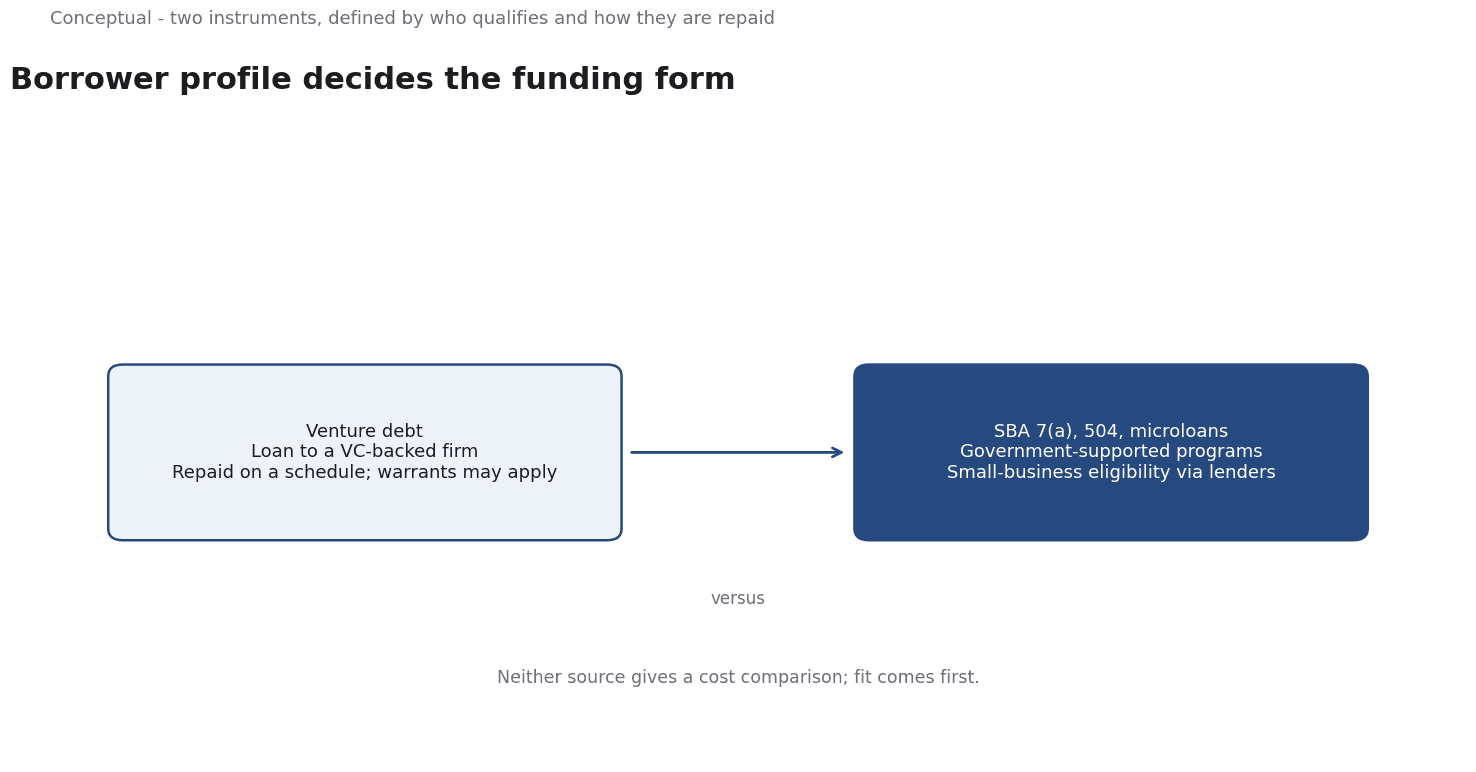
The SBA source groups 7(a), 504, and microloans as routes to affordable financing for small businesses. These are government-supported loan programs, each defined by its own eligibility rules and administered through lenders. The practical consequence is that access depends on fitting the program's criteria rather than on the negotiating strength of the company. A small business without institutional backing looks to these programs precisely because conventional credit may be harder to obtain.
The two forms differ mainly in who qualifies and how the obligation is structured. Venture debt is organized around a venture-backed firm whose investors understand dilution and repayment risk; SBA programs are organized around small-business eligibility and lender participation.
The decision therefore starts with the borrower profile, not with a term sheet.
A company with venture backing and a board that accepts warrants may reasonably consider venture debt, while a business outside that profile examines the SBA programs.
Neither source supplies a cost comparison, a selection rule, or a decision threshold. Venture debt pricing, warrant coverage, and covenants are local negotiation facts, and SBA eligibility depends on current program rules. The discipline is to mark those items as inferred or as points to verify, and to keep the definitional claims separate from the funding decision. Doing so prevents a definition from being mistaken for a recommendation.
A worked example
The following is hypothetical and illustrative. A venture-backed software firm with a recent institutional round is weighing venture debt against an SBA loan. Three checks decide the review. First, does the borrower profile match the instrument, meaning is the company venture-backed with investors who understand warrant dilution? Second, what repayment obligation does each option create, and can current receipts service it without raising a new round? Third, is SBA eligibility actually met, since those programs target small businesses rather than venture-scale firms? The review finds the firm fits the venture debt profile while the SBA path is uncertain on eligibility. The outcome is a fit decision, not a claim that one instrument is cheaper. The scenario is hypothetical; the verification method is the contribution.
Evidence status
| Claim | Status | Source | Verified | Recheck when |
|---|---|---|---|---|
| Venture debt is debt financing for venture-backed companies | source-reported | Wikipedia, Venture debt | 2026-11-18 | Definition revised |
| SBA offers 7(a), 504, and microloan programs | source-reported | SBA, Funding programs | 2026-11-18 | Program rules change |
| Borrower profile determines which funding form fits | inferred | Derived from the sources | 2026-11-18 | Eligibility criteria change |
The first two rows are factual claims drawn directly from the sources. The third is an inference about how a borrower chooses between them, because neither source endorses a selection rule. Recheck the definitions when the source entries change, and the inferred claim when eligibility criteria or the company's backing changes.
What it cannot do
This comparison does not establish which form is cheaper or better. The sources define an instrument and list a set of programs; they do not supply pricing, warrant coverage, covenants, approval odds, or repayment schedules. Treating the comparison as a verdict on cost is a category error. It answers what each funding form is and who it is aimed at, not what it would cost a particular company to use it.
The hidden cost is diligence and servicing. Venture debt requires documentation, negotiation, and ongoing repayment regardless of whether the planned growth materializes. Warrant coverage, if present, transfers a share of future equity and must be tracked through later financings. SBA applications carry their own documentation burden and depend on lender cooperation. These costs are paid in attention and in future cash, not only at signing, and they recur for as long as the obligation is outstanding.
The main failure mode is category confusion.
A small-business owner may assume an SBA program is automatically available, only to find that eligibility is narrow. Both errors come from skipping the fit check. The result is a financing plan built on a label rather than on the actual obligations and criteria.
There is a boundary around what these sources support. They do not model downside scenarios, covenant breaches, or changes in program rules. They do not replace a full financing plan, a cash forecast, or an assessment of whether debt service is affordable under stress. A company that needs to know what happens if a round is delayed, or if rates reset, will find no answer here. Those questions require a model built from local assumptions.
Because terms and eligibility change, the comparison needs a periodic review. Each assumption should carry a recheck condition, and the borrower profile should be restated whenever the company's backing or cash position changes. Without that record, a future reviewer cannot tell which parts of the decision were grounded in the sources and which were local judgments made under time pressure.
The counterargument that venture debt is fair for extending runway is incomplete when repayment is due before the next expected round.
A decision test
- Identify the borrower profile, including whether the company has venture backing.
- List the funding forms under consideration.
- Check eligibility for each named program.
- Identify the repayment obligation each form creates.
- Compare those obligations with current and expected receipts.
- Record which form fits the profile and why.
- Set a recheck date for eligibility and terms.
The comparison is useful only when the borrower profile and each obligation are stated explicitly. The test turns a funding label into a sequence of fit decisions with a visible recheck point, so a reviewer can see why one form was chosen and what would change the answer. For further reading, see Cash Flow Forecasting: A 13-Week Operating Model.
References & Further Reading
- Wikipedia contributors, 2026. Venture debt - Wikipedia — An overview of venture debt as late-stage financing for startups.
- U.S. Small Business Administration, 2026. Access affordable 7(a), 504, and microloans — How SBA-guaranteed lending works, including Lender Match and the note that guaranteed loans generally carry rates and fees comparable to non-guaranteed ones.