How to Evaluate Cap Table
A cap table maps ownership and a valuation estimates worth. Learn how to evaluate both, what each can and cannot tell you, and which claims deserve a second check.
Founders and early employees often read a capitalization table as a single number: their own percentage. The real problem is that a cap table is a structured record of ownership across share classes, options, and convertible instruments, and evaluating it means linking that structure to valuation and dilution. Without a method, people misread preference stacks and overstate what their stake is worth.
Direct answer:
A capitalization table records a company's equity ownership across shareholders, share classes, options, and convertible instruments.
Wikipedia's capitalization table entry describes that structure. Wikipedia's valuation entry covers methods for estimating a company's worth, which a cap table alone does not supply. The boundary: a cap table shows who owns what; it does not by itself establish value.
Delta: This article adds a mapping from cap-table structure and valuation methods to the decision of what to check before accepting an offer or a term, with claim status explicit.
The mechanism
A capitalization table is a detailed record of who owns a company's equity and under what terms. Wikipedia's entry describes the different share classes, such as preferred and common stock, along with options, warrants, and convertible notes that can turn into shares. The practical consequence is that two people with the same headline percentage can hold very different economic positions. Preferences, liquidation multiples, and vesting terms sit behind the simple percentage and change what that percentage actually delivers.
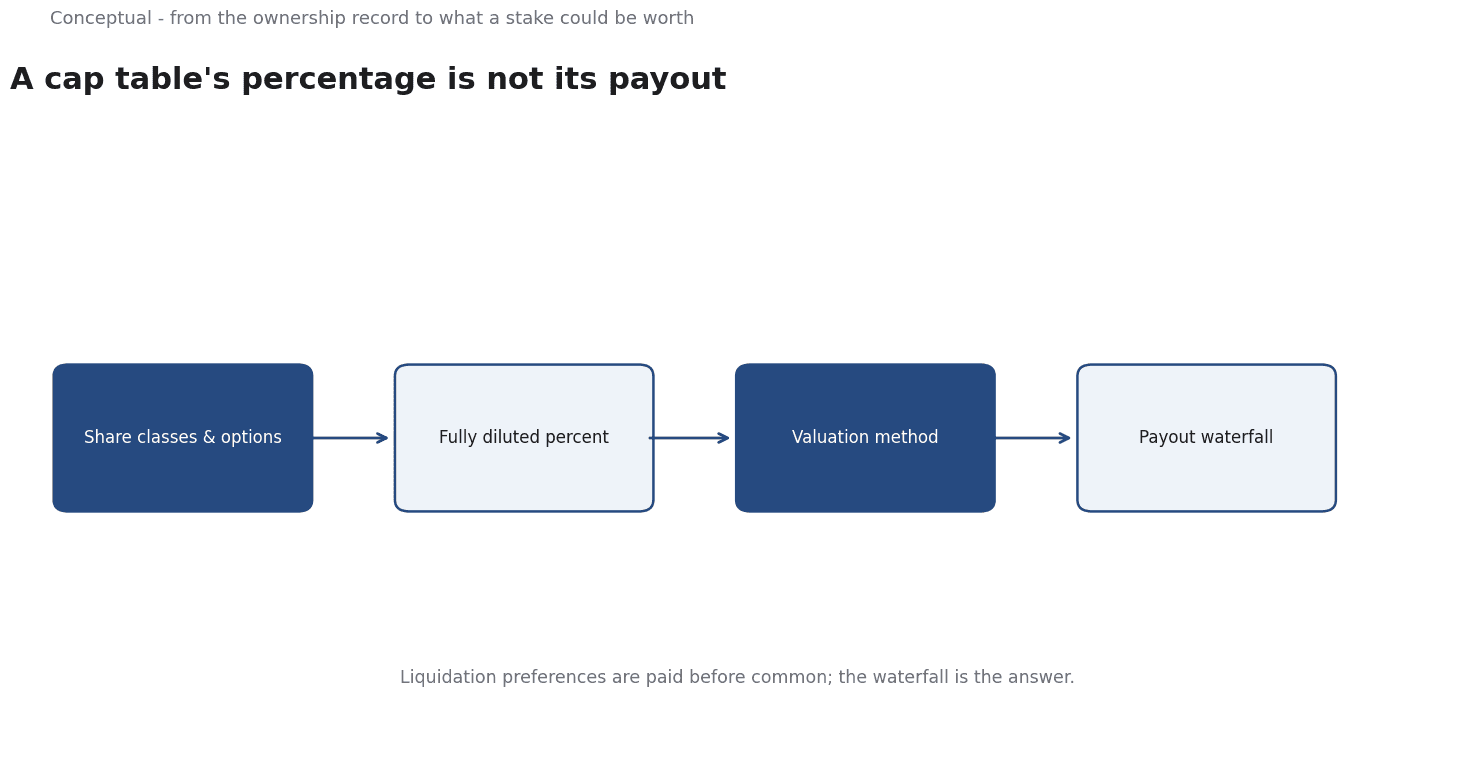
Evaluating ownership therefore starts on a fully diluted basis. That means counting not just shares outstanding today but also the shares that options and convertibles could create. The capitalization table entry discusses this broader view.
Once the unissued option pool and outstanding notes are included, the real percentage is usually lower. Recognizing this early prevents a candidate from negotiating against a number that will shrink.
Valuation is a separate question. Wikipedia's valuation entry describes approaches that estimate what a company is worth, commonly grouped as income, market, and asset based. For a private company there is no quoted price, so any valuation is an estimate built on assumptions about future cash flows or comparable firms. The practical consequence is that a cap table's implied value depends on which method and which assumptions were used. A number presented as a fact is often a model output, and the model deserves as much scrutiny as the result.
The two ideas meet in the payout waterfall. Preferred shareholders frequently hold liquidation preferences that are paid before common shareholders in an exit. That means a meaningful-looking common percentage can translate into little or nothing in a modest sale. Evaluating a cap table honestly means tracing that waterfall, not stopping at the ownership chart. It is the step that converts a static record of ownership into an answer about what a stake could actually be worth under different outcomes.
A worked example
The following is hypothetical and illustrative. An early employee is offered a small equity stake and evaluates it before signing. Three checks are applied. First, the percentage is recomputed on a fully diluted basis, including the unissued option pool and any outstanding notes. Second, the preference stack is read, noting the liquidation multiple and whether preferences participate. Third, the valuation behind the implied price is questioned, asking which method and assumptions produced it. The outcome is that the headline number is less informative than it appeared. The employee does not reject the offer, but asks for the fully diluted percentage and the preference terms in writing before treating the stake as meaningful.
Evidence status
| Claim | Status | Source | Verified | Recheck when |
|---|---|---|---|---|
| A capitalization table records equity ownership across classes, options, and convertibles | source-reported | Wikipedia Cap table | 2026-11-18 | The capitalization table entry changes |
| Valuation estimates worth through income, market, or asset approaches | source-reported | Wikipedia Valuation | 2026-11-18 | The valuation entry is revised |
| Fully diluted ownership is often lower than a headline percentage | inferred | Derived from the sources | 2026-11-18 | The company's option pool or notes change |
The first two rows reflect what the cited sources state. The third is an inference: including options and convertibles in the denominator reduces a simple share-based percentage. Neither source evaluates a particular company's cap table, so the claim is marked inferred and must be recalculated whenever the underlying instruments change.
What it cannot do
A cap table cannot tell you what a company is worth. It records structure: who holds shares, which classes exist, and how instruments convert. Value enters through a valuation exercise built on assumptions about the business. Reading the table as a valuation statement is a category error that leads people to treat a percentage as a price. The two documents answer different questions, and a careful evaluation keeps them separate rather than collapsing one into the other.
It also cannot predict an exit outcome. Ownership on paper is not the same as proceeds from a sale. Preferences, participation rights, and the order of payments determine how an exit is divided, and those terms can divert most of the proceeds to earlier investors in a modest outcome. A cap table shows the inputs to that calculation but does not perform it. Anyone evaluating a stake must model the waterfall under several exit values rather than assume that percentage and proceeds move together.
A hidden cost is the opacity of the inputs. A cap table is only as reliable as the records behind it, and early-stage records are often maintained in spreadsheets that lag behind new issuances. Options granted but not recorded, notes close to conversion, and side letters can all change the picture. Verifying the table means reconciling it to board approvals and legal documents, which takes time and expertise. Treating a stale spreadsheet as current is a common and avoidable source of error.
A frequent failure mode is anchoring on the headline percentage. A number offered in conversation is usually computed against shares outstanding, not the fully diluted count, and it rarely mentions preferences. Once that number is anchored, later information is interpreted relative to it rather than replacing it. The remedy is to rebuild the calculation from primary documents before forming an opinion, and to write down the assumptions used so they can be challenged.
The boundary is that both the cap table and the valuation are snapshots. New financing changes ownership and preferences, and valuation assumptions age quickly. An evaluation is therefore valid only for a point in time and a specific set of assumptions. It must be revisited when the company raises capital, issues options, or converts notes, because each event can change both the ownership map and the value attached to it.
The counterargument that a cap table is too technical for an employee to question is fair for someone with no context and incomplete for anyone making a consequential financial decision.
A decision test
- Is the percentage recomputed on a fully diluted basis?
- Are all share classes, options, warrants, and convertibles listed?
- Are liquidation preferences and participation rights documented?
- What method and assumptions produced the valuation behind the stake?
- Has the payout waterfall been modeled under more than one exit value?
- Is the table reconciled to board approvals and legal documents?
- Has the evaluation been dated and flagged for review after the next financing?
Evaluating a cap table is an exercise in asking what the headline number leaves out. These questions turn a static ownership record into a set of checkable assumptions. The goal is not to distrust every offer, but to ensure that the number you rely on has been rebuilt from primary evidence rather than accepted as given.
For further reading, see Decision Memos.
References & Further Reading
- Wikipedia contributors, 2026. Capitalization table - Wikipedia — Ownership and security records of a company.
- Wikipedia contributors, 2026. Valuation (finance) - Wikipedia — Overview of absolute and relative valuation approaches; secondary reference.