Decision Memos That Survive Review
A decision memo is not a status update. Read the structure that makes a decision reviewable, a worked example, and why the recommendation comes last.
Most internal documents described as decision memos are not about a decision. They describe a situation, list options, and end with "let's discuss". The reader leaves with context but no clear claim to accept, reject, or modify. A memo that survives review does the opposite: it makes a specific recommendation easy to challenge.
Direct answer: A decision memo is a short written document that states the decision, the evidence, the trade-offs, and the recommendation so a reviewer can evaluate the reasoning rather than reconstruct it. Wikipedia's memo entry describes the memo as a written instrument for internal communication, and decision-making literature separates the quality of a decision from the quality of its outcome. The boundary: a memo structures a decision, it does not guarantee a good one — and a document written to win an argument rather than test a claim will fail its purpose regardless of format.
What the memo has to do
Four jobs matter:
Make the decision concrete. "Should we migrate the billing service to a new provider?" is a decision. "Explore billing options" is a project. A memo without a decided question cannot be reviewed.
Separate facts from judgements. The evidence — costs, dates, measured performance — should be distinguishable from the interpretation of it. A reviewer who disagrees with the recommendation should be able to say which input or inference they dispute.
State the alternative. A recommendation without a named alternative is not a choice. The comparison should include the option of doing nothing, with its cost.
Make reversal possible. Write down what would change the decision — a new datum, a changed constraint, a failed assumption. Without that, a decision is treated as permanent and revisited only after it fails.
A structure that works
A reviewable memo has seven parts:
- Decision requested — one or two sentences, with the person who will decide.
- Context and constraint — why this now, and what bounds the choice.
- Options considered — including the status quo, with the criteria used to compare.
- Evidence — measured facts with sources and dates, separated from interpretation.
- Recommendation and reasoning — the chosen option and why it wins on the stated criteria.
- Risks and reversal conditions — what could go wrong and what would change the answer.
- Decision record — the outcome, who made it, and the review date.
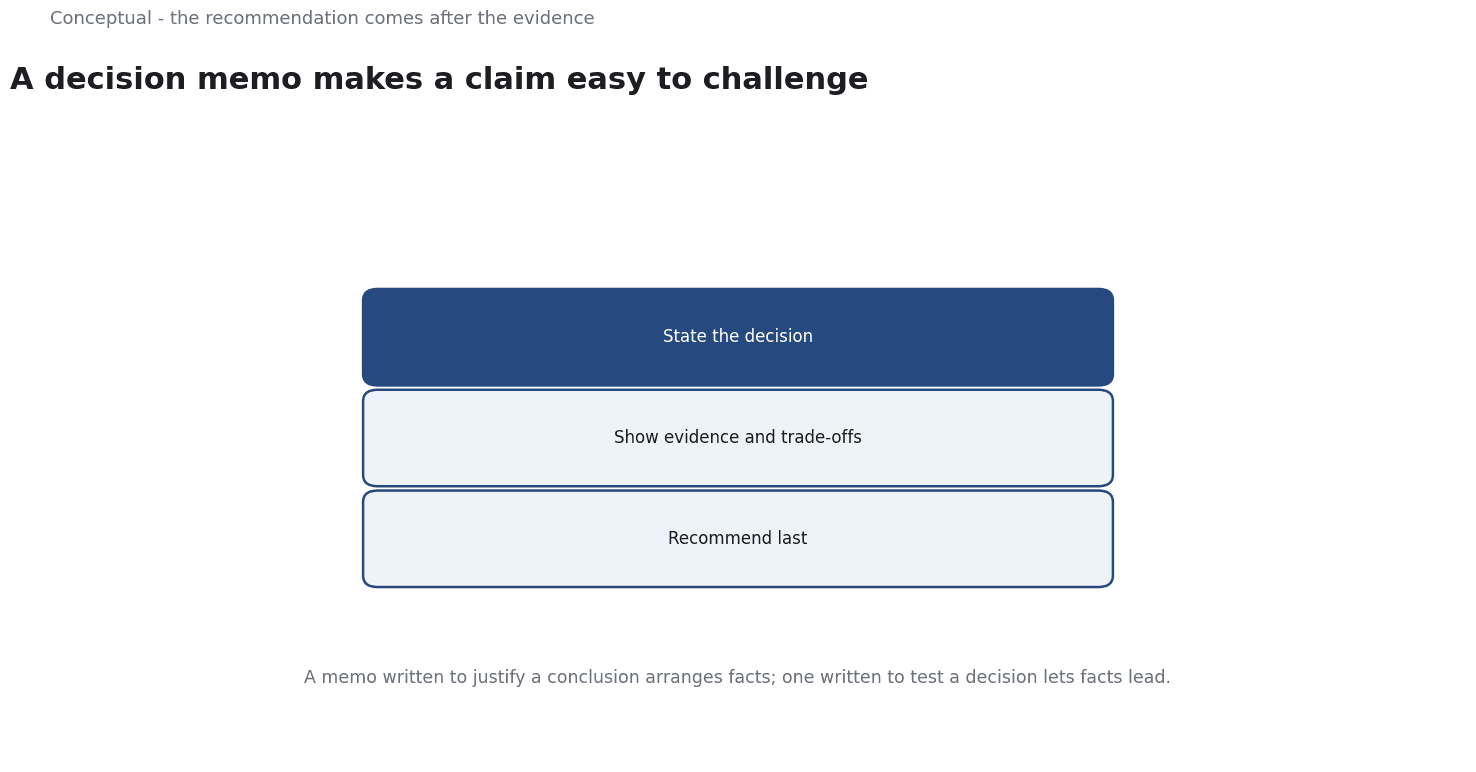
The recommendation comes after the evidence, not before.
A worked example of a weak and strong memo
The following is hypothetical and illustrative.
Weak version: "We are considering moving billing to a new provider. The current provider has been slow and support is frustrating. The new provider looks better. Let's discuss."
Strong version, using the structure:
- Decision: whether to migrate billing to Provider B within the next quarter. Owner: the CFO.
- Constraint: the migration must not interrupt invoice delivery; the team can absorb one engineer-quarter.
- Options: stay with A; migrate to B; renegotiate with A.
- Evidence: current provider's invoice delivery averaged 3.2 days late over the last six months; two outages exceeded four hours; B's published SLA is 99.9% with a 30-day termination clause; migration estimated at one engineer-quarter.
- Recommendation: renegotiate with A first, with migration as fallback. The SLA gap is real but the migration cost is large; a contractual remedy may capture most of the benefit.
- Risks: renegotiation may fail, costing a quarter before migration starts. If A misses two more SLAs during negotiation, migrate.
- Record: decision and review date filled in after the meeting.
Three lessons follow:
- The weak version hides the alternative. Staying put is presented as a complaint, not an option with a cost.
- The strong version is falsifiable. A reviewer can dispute the 3.2-day figure or the SLA claim, and there is a stated trigger for changing course.
- The recommendation changed. Starting with "the new provider looks better" and doing the analysis produced a different answer — renegotiate first. A memo that lets the analysis run is a decision tool, not a sales document.
Writing for the reviewer
A reviewer reads a memo under time pressure and with a specific job: decide whether to accept, reject, or change the recommendation. Three writing choices help:
Put the decision in the first line. A reviewer who has to read three paragraphs to discover what is being asked will form an opinion before seeing the evidence. State the question and the owner immediately.
Use tables for comparisons. Options and evidence are easier to check in a table than in prose, because a reader can scan a single column. Prose is for the reasoning that connects the comparison to the recommendation.
Keep it short enough to finish. A memo that nobody reads has no effect on the decision. Length should be a function of the decision's consequence, not of the author's desire to show thoroughness. An appendix can hold the detail a reviewer may want.
The opposite of this is a document written to demonstrate how much work went into the analysis. That document is a performance, and reviewers can tell.
What the memo cannot do
It cannot replace conversation. A memo makes a decision reviewable; it does not build agreement. The discussion should start from the memo, not re-derive it.
It cannot remove uncertainty. Reversal conditions are a way of admitting what is unknown. A memo that claims certainty it does not have is less useful than one that states the uncertainty plainly.
It is not a status report. Progress updates belong elsewhere. A memo that mixes the two buries the decision under information nobody needs to make it.
The counterargument — that writing a memo is slow — is fair for small decisions.
The format earns its cost when the decision is consequential, contested, or likely to be revisited. For a routine choice, a short note with the recommendation and the reversal condition is enough.
A decision test
- Can you state the decision in one sentence?
- Is the owner named?
- Are the options, including doing nothing, explicit?
- Can a reader separate the measured facts from your interpretation?
- Is the recommendation supported by the stated criteria?
- What would change your mind, and is that written down?
- Will someone record the outcome and the review date?
For the broader skill, see How to Think Like an Engineer; for documentation craft, see Technical Writing.
References & Further Reading
- Wikipedia contributors, 2026. Memo - Wikipedia — The memo as a written instrument for internal communication and decisions; secondary reference.
- Wikipedia contributors, 2026. Decision-making - Wikipedia — Overview of decision processes, trade-offs and the distinction between the decision and its outcome; secondary reference.