How to Evaluate Martech Stacks
A marketing stack is a set of dependencies. Read how to audit one, a worked example, and why tool count is a poor measure.
A marketing technology stack grows one tool at a time. Each purchase solves a real problem, and over years the collection becomes a set of overlapping systems with unclear ownership and unreliable data. Evaluating the stack means asking which tools still change a decision and which are now cost without effect.
Direct answer:
Audit the stack by decision, data flow, and ownership, with a measured test of whether each tool contributes.
Geo-experiment guidance offers a design for testing a tool's effect, and AAPOR's standards apply to any survey used in the audit. The boundary: a stack audit cannot fix a weak strategy, which the value-proposition article treats as the prior question, and no structure guarantees a marketing result, as the publication standard states.
The audit
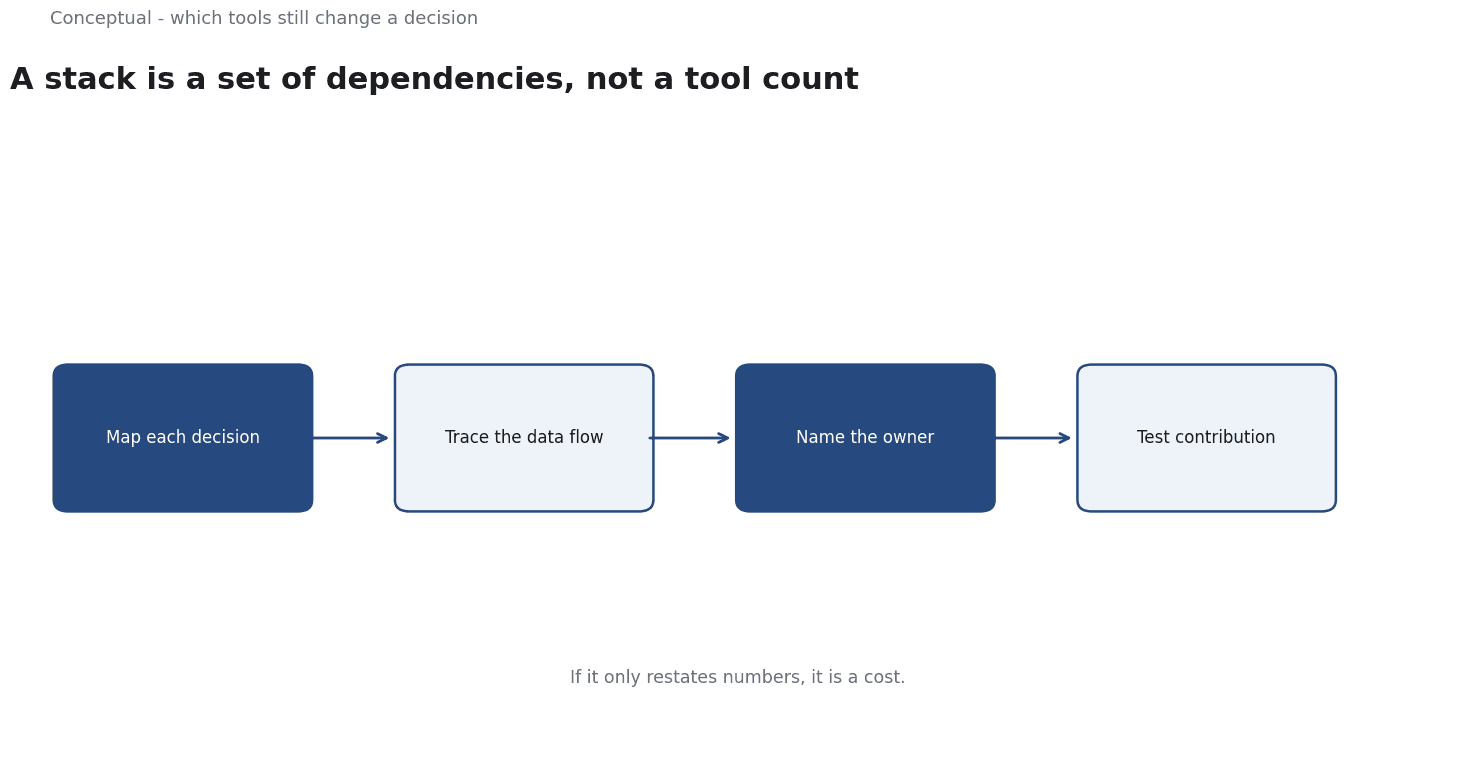
List the tools and their job. For each, write the decision it supports and the owner, as the governance checklist requires for any maintained system. A tool with no decision is a candidate for removal, which the technical-debt article treats as accumulated cost without benefit.
Trace the data. Where does each tool get its inputs and where do its outputs go, as Data Governance: Managing Data as an Asset requires for relied-upon records? Overlapping tools often create conflicting numbers, which the attribution article explains for different credit rules.
Check adoption and cost. Is the tool used, and what does it cost in fees and time, as the cost estimator requires for any workload? Low adoption with high cost is a clear signal, as the content-operations article argues for retiring material that does not perform.
Test the effect. Where a tool claims to improve a decision, use a comparison, as the geo-experiment guidance recommends, rather than a before-and-after chart, which the brand-lift article warns about for background trends.
Three consequences follow. The audit produces a decision to keep, replace, or remove each tool, as the decision-memo article requires for a recorded judgement. It should be revisited after a material change, as the monitoring article advises. And it should include the people who use the tools, as the voice-of-customer article recommends for evidence about the work.
A worked example
The following is hypothetical and illustrative. A team has four tools: an analytics platform, an email tool, a survey tool, and a dashboard that aggregates them.
Three checks decide the audit. First, does the dashboard change a decision that the underlying tools cannot, which the dashboard article asks for a reason to exist?
Second, do the tools' definitions agree, as Data Governance: Managing Data as an Asset requires for relied-upon metrics? A disagreement in how a conversion is defined produces conflicting reports, as Marketing Attribution: Multi-Touch Models, Incrementality, and Budget Allocation explains. Third, does removing or replacing one tool change a qualified outcome, which the geo-experiment guidance tests?
Three conclusions follow. Redundancy is often in aggregation, not in data collection, which the dashboard article implies. Ownership of definitions matters more than the number of tools, as Data Governance: Managing Data as an Asset argues for accountability. And the result should be recorded with the evidence, as the decision-memo article requires.
The people question
A stack audit that looks only at software misses the people who keep it running. A tool with a powerful feature set but no one who understands its configuration will produce unreliable data, which the data-governance article treats as an ownership failure. The right question is not only what a tool can do but who is accountable for what it actually does, as the governance checklist requires for any maintained system.
This also changes how overlap is judged. Two tools that appear redundant may serve different teams with different workflows, and consolidating them can impose a cost that is not visible in licence fees, as the build-versus-buy article argues for counting integration and training. Conversely, two teams using different definitions of the same metric is a governance problem that no tool will fix, which the attribution article explains for conflicting credit rules.
The audit should therefore end with owners and decisions, not a shorter list. A stack that is deliberately kept, with each tool tied to a decision and a person, is a healthier outcome than one that was cut to look efficient, as the decision-memo article argues for recorded judgement over activity.
What a stack audit cannot do
It cannot create a clear strategy, which the value-proposition article treats as prior. It cannot guarantee that a cheaper stack performs better, which the cost article treats as an empirical question. And it does not remove the need for good measurement, which the attribution article treats as a separate discipline.
The counterargument that tools are cheap relative to people is fair in licence terms and misses integration and maintenance time, as the cost article requires for a full accounting.
A decision test
- List tools with a decision and an owner, as the governance checklist requires.
- Trace data inputs and outputs, as Data Governance: Managing Data as an Asset advises.
- Check definitions across tools, as Marketing Attribution: Multi-Touch Models, Incrementality, and Budget Allocation warns.
- Measure adoption and full cost, as the cost estimator requires.
- Test claimed effects with a comparison, as the geo-experiment guidance recommends.
- Decide keep, replace, or remove, as the decision-memo article requires.
- Re-audit after a change, as the monitoring article advises.
For the governance, see Data Governance; for the measurement, see Marketing Attribution.
References & Further Reading
- Brian Vaver and Koehler, 2011. Measuring Ad Effectiveness Using Geo Experiments — Geo experiments for incrementality, the cleanest way to attribute marketing spend.
- American Association for Public Opinion Research, 2026. AAPOR — The professional association for public opinion and survey research; its standards and resources underpin the survey-design discussion.