Marketing Attribution: Multi-Touch Models, Incrementality, and Budget Allocation
Attribution allocates credit; incrementality measures what would not have happened. Read why the second is the one that decides budgets.
Marketing attribution is one of the most confident-sounding areas of analytics and one of the least reliable as a decision tool. The output is a precise-looking split of credit across channels — 30% first touch, 50% last touch, 20% in between — and the precision is misleading, because the numbers come from a rule the analyst chose, not from a measurement of what each channel caused.
Direct answer:
Attribution models assign credit for a conversion across the interactions that preceded it; they do not tell you what would have happened without those interactions.
Google Ads says it directly: "Attribution models let you choose how much credit each ad interaction gets for your conversions", with data-driven attribution now the default and last-click still supported. For budget allocation you need the incremental effect, which comes from experiments — and where user-level randomisation is impossible, from geo-level designs. Use attribution to describe journeys; use experiments to decide spend.
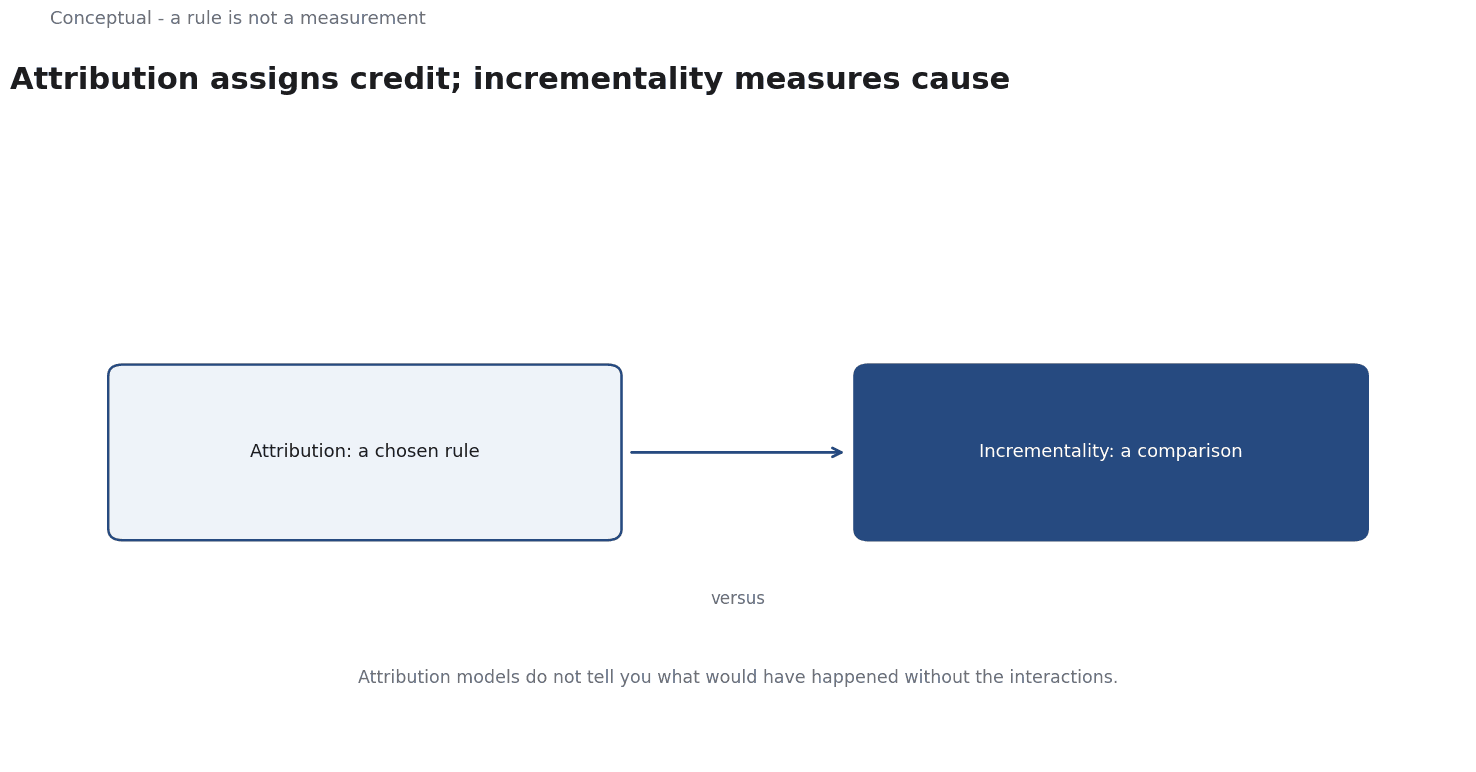
A model is a rule, not a finding
The main models differ only in how they distribute credit:
- Last-click gives everything to the final interaction. It is simple, and it systematically over-credits channels that catch customers at the end of a journey they did not create.
- First-click gives everything to the first interaction, with the mirror-image problem.
- Linear, time-decay, and position-based models spread credit by a stated rule. Each is a reasonable convention; none is derived from your customers.
- Data-driven attribution uses observed patterns to distribute credit statistically. It is more responsive to data, and it remains a model of association unless the underlying variation was experimental.
Google Ads notes that "conversion actions that used the deprecated attribution models have been upgraded to use data-driven attribution", and that "attribution models can give you a better understanding of how your ads perform and can help you optimize across conversion journeys". That is a fair description of the use case — understanding journeys — and the important word is "understanding" rather than "measuring causation".
The practical consequence is that two teams using different models on the same data can reach opposite budget recommendations, and both will say the data supports them. When that happens, it is not a data-quality problem; it is a disagreement about a rule that was never made explicit.
Incrementality is the missing measurement
The question a budget decision actually needs is: if we stopped spending on this channel, how much revenue would disappear? That is a counterfactual, and attribution cannot answer it because all the journeys in the data include the channel's presence.
Two designs can answer it.
Randomised user-level tests work when the intervention can be assigned to individuals. Hold out a group from a campaign, compare outcomes, and the difference is the incremental effect.
Geo experiments work when the intervention operates at a market level — a brand campaign, a regional price change, a channel rollout. Google's published work states that "one approach that Google has successfully employed to measure advertising effectiveness is geo experiments", and describes them as having "a systematic and effective design process" with results that are "easy to interpret".
Both require more planning than a dashboard, and the planning is the point: you state the comparison, the horizon, and the decision rule before you look at the result.
Why the two answers diverge, and which to trust
Attribution and incrementality disagree in predictable situations.
The channel catches existing demand. Branded search often gets credited with conversions that would have happened anyway; a holdout reveals that its incrementality is small. This is the most common and most expensive discrepancy.
The channel assists rather than closes. A social campaign may create awareness that converts much later through search. Last-click credits search; a geo holdout shows the campaign mattered.
The channel cannibalises another. A new paid channel may take credit for customers who would have arrived organically, so total revenue barely changes despite a large attributed number.
In all three cases the incremental answer is the one that should govern the budget, and the attribution number remains useful for diagnosing why the discrepancy appeared.
A budget process that uses both
- Use attribution to map the journey and identify which channels appear where. Treat the model as a stated convention and name it.
- List the channels where attributed and incremental effects may diverge — branded search, retargeting, and any channel that intercepts existing demand.
- Run a holdout on the largest uncertain channel first. The value of information is proportional to the budget at stake.
- Use geo designs for market-level interventions, with the same discipline about sample and horizon.
- Compare the incremental cost per outcome across channels, fully loaded, and reallocate towards the better one.
- Keep attribution for diagnosis and incrementality for decisions.
For the experimental method, see A/B Testing; for how these numbers feed acquisition economics, see SEO vs Paid Advertising.
A worked example
The following is hypothetical and illustrative. Suppose a team runs a brand awareness campaign and a branded search campaign, with last-click credit flowing almost entirely to search. Three checks separate the two answers. First, the attribution model is named explicitly, and the journey map is used only to describe where each channel appears, not to set the budget. Second, a user-level holdout is run on the largest uncertain channel, with the comparison, horizon, and decision rule fixed before results are read. Third, because the brand campaign operates at market level, a geo experiment in the style of Vaver and Koehler is used, matching treated and control markets. In this imagined case last-click over-credits search for demand the brand campaign created, while the holdout and geo results show a smaller incremental effect for search and a real one for brand. Budget follows the incremental cost per outcome, and attribution stays as the diagnostic for why the discrepancy appeared.
A counterargument
A reasonable critic would note that the prescription to decide budgets from experiments is narrower than it sounds. Google itself calls geo experiments a "systematic and effective design process," which concedes they need planning and enough markets to resolve an effect; a holdout that settles a large brand campaign may be underpowered for the long tail of smaller channels where most budget questions arise. A test also returns the average incremental effect for one intervention at one moment, not the journey-level picture attribution was built to describe, and the article concedes the attribution number stays useful for diagnosis.
The objection is not that incrementality is wrong but that the piece never says how to choose between a noisy experiment and a stated convention when a decision cannot wait.
References & Further Reading
- Google Ads Help, 2026. About attribution models - Google Ads Help — First-party documentation of attribution models and their limits.
- Brian Vaver and Koehler, 2011. Measuring Ad Effectiveness Using Geo Experiments — Geo experiments for incrementality, the cleanest way to attribute marketing spend.