How to Evaluate Monetary Policy
Policy is judged against objectives and lags, not a single rate. Read the evaluation frame, a worked example, and why causation is hard to claim.
Monetary policy is often reduced to the current policy rate, which tells little about whether policy is working. The Federal Reserve's monetary-policy entry describes the objectives and tools, and FRED provides dated series. Evaluation requires comparing outcomes with objectives over time.
Direct answer: Evaluate policy by stating the objective, reading the instruments and their lags, and comparing outcomes against a clear counterfactual — with causal claims kept separate from observations. The sources provide definitions and data; the evaluation rule is a synthesis.
Delta: This article adds a claim-status table and a worked evaluation, separating what the institution documents from the local analytical choices.
The mechanism
Three elements matter:
- Objectives. The Fed's material describes mandated goals. Without naming them, any judgment of success is arbitrary.
- Instruments and lags. A rate change works through credit, expectations, and spending with delays. A short window can show no effect even when the policy is effective.
- Data. FRED provides dated series, which makes it possible to align observations in time rather than comparing unrelated periods.
The sequence is: state the objective, choose dated indicators, allow for lags, then separate observed association from a causal claim.
The choice of indicators is judgement and is inferred; the objectives and series are source-reported.
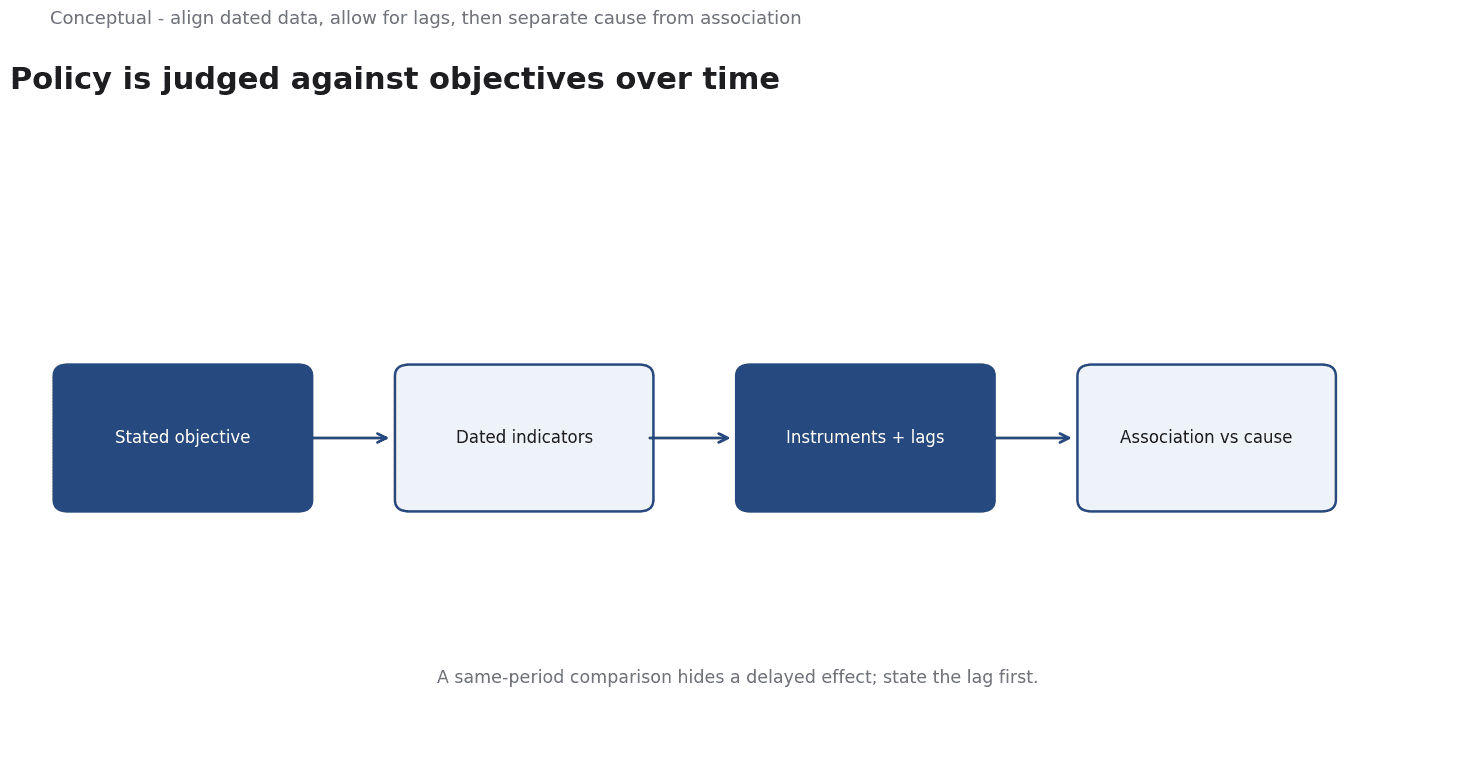
A worked example
Illustrative. An analyst asks whether a tightening cycle reduced inflation.
Three checks decide. First, what is the stated objective and over what horizon? Second, are the inflation and rate series dated and aligned, with the lag taken into account? Third, what else changed in the same period, and what would the counterfactual plausibly have been?
The outcome is a qualified judgement rather than a verdict. The numbers are hypothetical; the separation of observation from causal claim is the contribution.
Why objectives come before indicators
An evaluation without a stated objective is a search for a number that supports a preferred conclusion. The Fed's published material names the goals, which gives the analyst a fixed reference point. Choosing an indicator that happens to move favourably is not evaluation; it is selection.
Once the objective is fixed, the indicator should match it. A broad price index answers a different question from a measure of core prices, and an employment measure says little about price stability. Using several indicators is reasonable, but each should be tied to a stated objective rather than added because it is available.
Monetary policy works through expectations, borrowing costs, and spending decisions, none of which change instantly. A comparison that uses the same month for the action and the outcome is therefore uninformative. Choosing the lag after looking at the data is equally problematic, because any pair of series can be aligned to show a relationship. The lag should be stated before the comparison and kept fixed while the result is read.
What a qualified judgement contains
A useful evaluation records the objective, the indicators, the lag, the observed outcome, and the alternative explanations considered. It does not end with a verdict. When two defensible readings disagree, the disagreement is the finding, because it identifies where more evidence is needed.
Evidence status
| Claim | Status | Source | Verified | Recheck when |
|---|---|---|---|---|
| Monetary policy has stated objectives and tools | source-reported | Federal Reserve | 2026-11-18 | Mandate or tools change |
| Dated economic series are publicly available | source-reported | FRED | 2026-11-18 | Series discontinued |
| Allow for lags and separate causal claims | inferred | Derived from evaluation practice | 2026-11-18 | Method changes |
Why causation is the hard part
An outcome can be consistent with a policy without being caused by it. Inflation may fall because policy worked, because supply conditions changed, or because both moved together. The causal-inference literature treats this as a design problem, not a matter of interpretation. An evaluation that ignores it reports correlation as explanation.
Lags compound the problem. A policy action taken today affects conditions later, so a same-period comparison can show no relationship. Choosing the lag after seeing the data creates a different problem, because any series can be aligned to produce an apparent effect. The lag should be stated before the comparison.
A final consideration is the audience for the evaluation. A central bank communicates through statements and projections, and those documents are themselves evidence of how the institution frames the problem. Comparing the stated framing with later outcomes is a different exercise from forecasting, and it is often more useful for understanding whether policy was coherent. The distinction belongs in the record so that readers do not mistake an assessment of communication for an assessment of effects.
What it cannot do
It cannot prove a counterfactual from observed data alone. It does not remove uncertainty about other factors. And it cannot guarantee that the same policy works in a different period.
The counterargument that a single rate explains everything is fair as shorthand and incomplete for evaluation.
A decision test
- State the objective.
- Choose dated indicators.
- State the expected lag before comparing.
- Separate observation from causal claim.
- List alternative explanations.
- Record the judgement and its limits.
For the market context, see How to Evaluate Yield Curve.
References & Further Reading
- Board of Governors of the Federal Reserve System, 2026. Monetary Policy — The Federal Reserve’s monetary policy framework, tools, and reporting, including the Monetary Policy Report and the Beige Book.
- Federal Reserve Bank of St. Louis, 2026. FRED economic data — The primary time-series database used for macro indicators.