How to Evaluate Salary Negotiation
Salary negotiation hinges on how pay is defined and benchmarked. Learn what salary data and occupational tools cover, a worked comparison, and the limits.
Candidates often negotiate a single number without agreeing on what that number includes or how it was benchmarked. The salary entry describes pay as a defined form of compensation, and O*NET OnLine supplies occupational descriptions and wage estimates. The real problem is turning those references into a comparison that can actually support a negotiation.
Direct answer: Salary is a fixed regular payment made for work, usually on a periodic schedule, and it is only one part of total compensation. Occupational data provides benchmarks for a role.
An offer is evaluable only when the components and the benchmark are both made explicit.
Delta: This article adds a claim-status table and a benchmark-to-offer mapping beyond the sources: it maps an occupational wage reference to a specific compensation decision, with claim status explicit.
The mechanism
The salary entry describes a fixed regular payment made by an employer to an employee, typically on a recurring schedule, and distinguishes it from pay tied to hours worked or output. That distinction is the starting point for evaluation. When an offer arrives, the first task is to separate the fixed base from variable pay, bonuses, and benefits, because a higher base is not the same as a better package. The source defines the term; it does not rank offers.
O*NET OnLine is a source of occupational information, including task descriptions, required skills, and wage estimates for occupations. Its practical use in a negotiation is to supply a reference point for what a role pays in a given context. The tool describes occupations rather than individuals, so it answers what a job typically pays, not what a particular candidate should receive. Treating an occupational estimate as a personal target is a category error, but treating it as a sanity check is reasonable.
The consequence is that evaluation combines a definition with a benchmark. The salary concept tells you which components to compare; the occupational data tells you whether a number is in a plausible range for the work. The sources do not specify how to weigh the components against each other, so building a total-compensation comparison is an inference. That comparison should be recorded, because two offers with different mixtures of base, bonus, and benefits can look comparable until the assumptions behind each are written down.
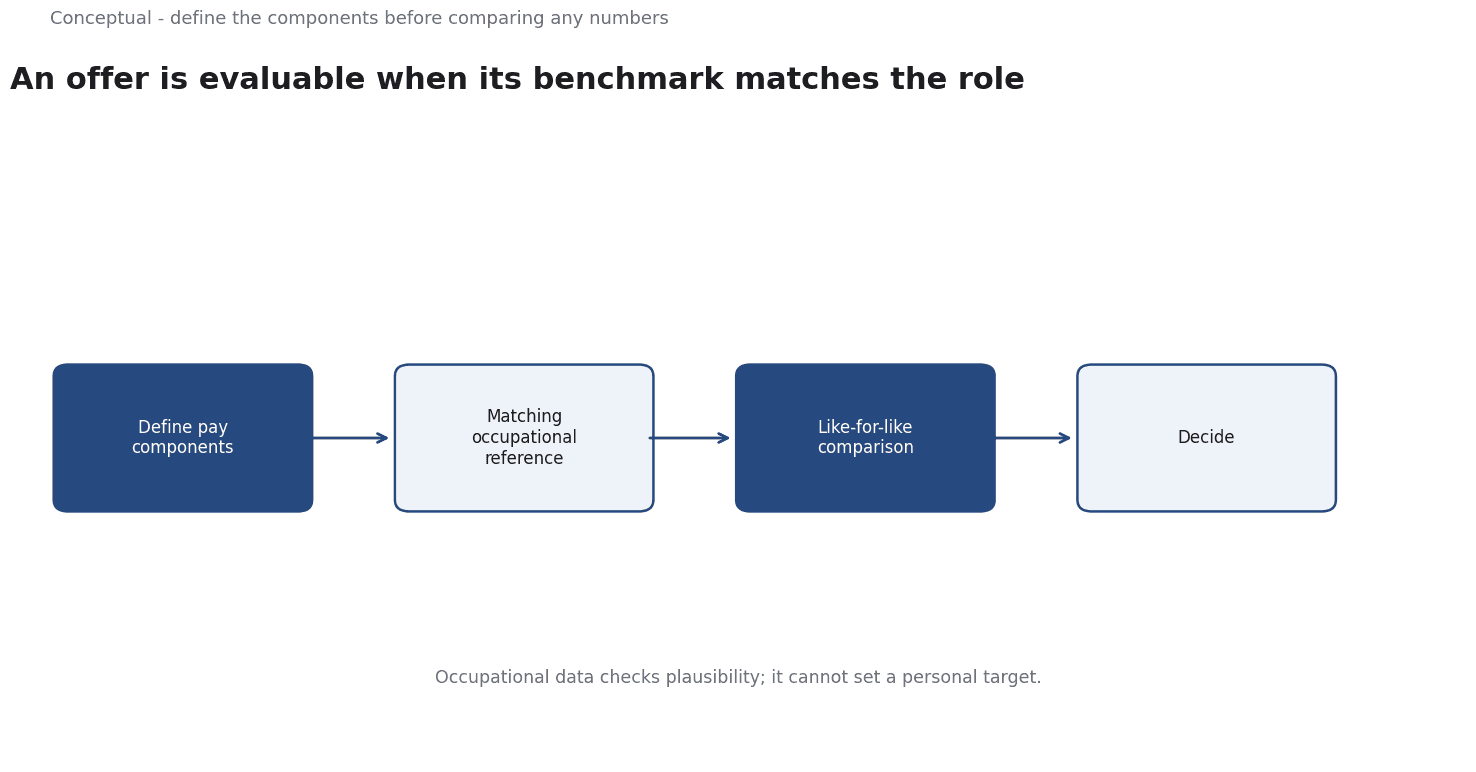
A further consequence is that a benchmark is contextual. Wage estimates vary by occupation, geography, and time, and an estimate gathered for one location may not describe another. A number is only a reference if its scope matches the role being evaluated. The mechanism is therefore a chain: define the pay components, find a matching occupational reference, build a like-for-like comparison, then decide. Each step is a judgement that should be visible to anyone who has to defend the negotiation.
A worked example
The following is hypothetical and illustrative. A candidate compares two offers for the same occupational role and wants to evaluate them before responding. Three checks shape the work. First, the components of each offer are separated into fixed base, variable pay, and benefits, so unlike items are not added together carelessly. Second, an occupational wage reference is checked for scope, confirming that the occupation and location match the role being considered. Third, the candidate states what decision the comparison will support, such as whether to accept, counter, or ask for clarification. The checks show that one offer's higher headline figure depends on a variable component with uncertain value, so the comparison is repeated using base pay alone. The offers then rank differently. The figures are hypothetical; the verification method is the contribution.
Evidence status
| Claim | Status | Source | Verified | Recheck when |
|---|---|---|---|---|
| Salary is a fixed regular payment for work | source-reported | Salary - Wikipedia | 2026-11-18 | Definition revised |
| O*NET OnLine provides occupational descriptions and wage estimates | source-reported | O*NET OnLine | 2026-11-18 | Tool content changes |
| Compare offers with matched scope and explicit components | inferred | Derived from the sources | 2026-11-18 | Role or location changes |
The first two rows restate what the source entries present and can be checked directly. The third row is a synthesis, because neither source tells a candidate how to compare offers. Recheck the source rows if the entries change, and recheck the inferred row when the role, location, or offer structure changes.
What it cannot do
Occupational data cannot tell you what you personally should be paid. It describes a role and a labor market, not your performance, leverage, or the specific budget of an employer. A benchmark can show that an offer is low, high, or typical for an occupation, but it cannot decide whether the offer is right for you. The tools describe pay and occupations; the decision about an individual belongs to the person negotiating. A candidate who treats an estimate as a personal entitlement will negotiate from a statistic rather than from the actual trade-off on the table.
The hidden cost is the effort of building a genuine like-for-like comparison. Offers package base pay, bonuses, equity, and benefits differently, and translating them onto one scale takes time and assumptions. Each assumption is a place where the comparison can be tilted, often toward the more familiar form of compensation. There is also a cost to over-precision: building an elaborate model for a small difference in pay can consume more energy than the decision warrants. Neither source addresses this cost, so it is an inference from the gap between having data and using it.
A wage estimate for one occupation or region applied to another produces false confidence, and a headline figure that bundles uncertain variable pay can mask a lower guaranteed base. A related failure is anchoring on the first number offered, because the benchmark then serves only to defend a position rather than to test it. The sources provide definitions and estimates without guarding against either misuse, so the candidate must supply that discipline.
There is a boundary around what these references cover. The salary entry defines a form of payment; it does not address negotiation strategy or the value of non-pay terms. O*NET OnLine describes occupations; it does not evaluate a specific employer or forecast future pay. An evaluation built from both can check whether components are defined and whether a number is plausible, but it cannot judge culture, growth, or risk. Those factors lie outside the sources and still belong in the decision.
Because wage estimates and offer structures change, the comparison needs periodic review. A benchmark should be rechecked for its occupation, location, and date before it is cited, and the offer components should be re-examined if terms shift during discussion. Each comparison should record the reference used, the scope assumed, and the decision it informed, so the reasoning can be revisited rather than repeated. Without that record, an old estimate keeps anchoring a current negotiation.
The counterargument that a published benchmark is fair because it reflects a whole occupation is reasonable for a reality check and incomplete for an individual decision, since personal value and employer context rarely match an average.
A decision test
- Define what decision the negotiation must resolve.
- Separate fixed base from variable pay and benefits.
- Find an occupational reference that matches the role and location.
- Check the scope and date of that reference.
- Build a like-for-like comparison of the offers.
- State the assumption behind each component before comparing.
- Record the reference, scope, and decision for later review.
A salary offer is evaluable when its components are explicit and its benchmark matches the role. The test keeps that match visible, so a negotiation is defended by a like-for-like comparison rather than by a headline figure. For further reading, see Cash Flow Forecasting: A 13-Week Operating Model.
References & Further Reading
- Wikipedia contributors, 2026. Salary - Wikipedia — Fixed periodic compensation for employees.
- U.S. Department of Labor, 2026. O*NET OnLine — The standard occupational taxonomy used to compare roles across industries.