How to Get Systems Thinking Right
Systems thinking traces patterns to structure. Read the method, a worked example, and why a feedback loop is a hypothesis until tested.
Systems thinking is often reduced to "seeing the whole", which gives no method. The Wikipedia entry describes feedback and structure over time, and the decision-making entry covers the structure of a choice. The practical question is which structure could produce the pattern you observe.
Direct answer: Observe a pattern over time, name a candidate structure, intervene on one variable, and check whether the pattern changes as predicted. The sources define the concepts; the intervention rule is a synthesis.
Delta: This article adds a claim-status layer to the systems-thinking concept: it separates what the source states (source-reported) from the intervention rule proposed here (inferred), and shows which part is illustrative.
The mechanism
Three ideas from the sources do the work:
- Feedback. An output becomes an input elsewhere. The Wikipedia entry treats this as central to systems behaviour.
- Delay. The effect of an intervention may appear later than the action. This is why a fast fix can look successful before it fails.
- Structure over event. A recurring pattern points to structure, not to a single event. The root-cause distinction between symptom and cause is the practical form of this.
A loop is therefore a hypothesis.
It earns credibility only when an intervention produces the predicted change, which is the causal-inference distinction between association and intervention.
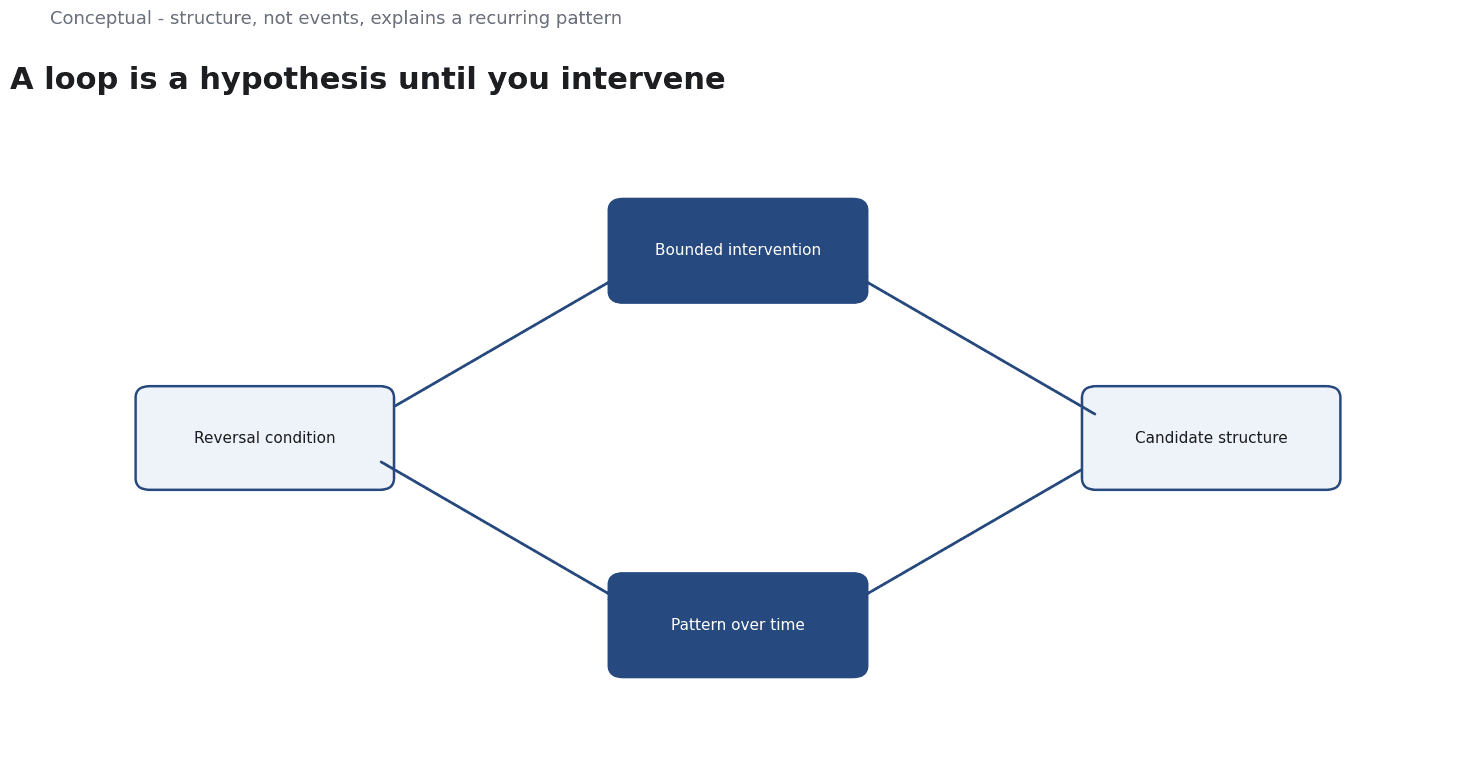
Three consequences follow. Define the pattern before the model. State the loop as a testable claim. Record what would falsify it. These are method rules (inferred), not statements from the source.
A worked example
Illustrative. A support queue keeps growing after the team adds staff.
Three checks decide. First, is the queue a recurring pattern over several weeks, rather than a single spike? Second, could adding staff change the inflow, for example by making it easier to promise quick fixes? Third, if that loop is real, would reducing incoming commitments shrink the queue faster than adding capacity?
The outcome is a decision: test the inflow hypothesis with a bounded change, and record the reversal condition. The numbers here are hypothetical; the method is the contribution.
Why loops need evidence
A system diagram is persuasive because it makes complexity look orderly. Boxes, arrows, and labels turn a confusing pattern into something that can be explained in a sentence. That clarity is useful and dangerous.
The diagram is a hypothesis about which relationships matter, and the neatness of the drawing is not evidence that the relationships exist.
The first check is temporal. A loop claim predicts a sequence: a change in one place should be followed by a change elsewhere, often after a delay. If the pattern in the data does not show that order, the loop is at best incomplete. A support queue that grows before staffing changes, for example, is poorly explained by a loop that makes staffing the cause. Looking at the order of events is a cheap way to reject weak explanations before designing an intervention.
The second check is intervention. Watching two variables move together does not tell you which one influences the other, or whether a third factor drives both. The causal-inference distinction is directly relevant here: an intervention is what turns an association into a tested claim. In practice this means changing one variable deliberately, on a small scale, and observing whether the predicted downstream change appears. A bounded experiment costs less than a wrong large change.
The third check is delay. Systems thinking is most useful where effects are not immediate.
This is why the reversal condition is part of the method rather than an appendix: it states in advance what observation would count as evidence that the intervention failed. Without it, a temporary improvement is easily mistaken for a solution.
Taken together, these checks turn a diagram into a working instrument. The structure is still a simplification, but it is a simplification that can be challenged with data, which is the property that makes it worth writing down.
Evidence status
| Claim | Status | Source | Verified | Recheck when |
|---|---|---|---|---|
| Systems thinking focuses on feedback and structure | source-reported | Wikipedia, Systems thinking | 2026-11-18 | Definition revised |
| Choice structure can be described explicitly | source-reported | Wikipedia, Decision making | 2026-11-18 | Source substantially revised |
| Intervention is stronger evidence than association | source-reported | Causal inference literature | 2026-11-18 | New methodology |
What it cannot do
It cannot prove a structure from a pattern alone. It does not replace measurement, because a loop without data is a story. And it cannot guarantee that an intervention works, which the reversal condition exists to admit.
The counterargument that a simple fix is better is fair for isolated problems and incomplete for recurring patterns, which the worked example shows.
A decision test
- Define the pattern and its period.
- Name a candidate structure.
- State the expected effect of an intervention.
- Test with a bounded change.
- Check the result against the prediction.
- Record the decision, the reversal condition, and what remains uncertain.
For the common questions, see Systems Thinking.
References & Further Reading
- Wikipedia contributors, 2026. Systems thinking - Wikipedia — Understanding feedback, structure and behaviour over time.
- Wikipedia contributors, 2026. Decision-making - Wikipedia — Overview of decision processes, trade-offs and the distinction between the decision and its outcome; secondary reference.