Hreflang Clusters Metrics that Matter
Hreflang helps search engines pick a localized page; canonical tags consolidate duplicates. Focus on structural metrics of a healthy language cluster, not raw traffic.
Sites that publish several language versions often treat a traffic report as a health check for the whole cluster. Google's localized versions documentation explains how to tell search engines which regional or language variant a page targets, and the canonical link entry explains how to signal a preferred URL among near duplicates. The real problem is that a cluster can be structurally broken in ways ordinary traffic and ranking metrics never reveal, and a structurally correct cluster can still underperform for unrelated reasons.
Direct answer:
Hreflang annotations and canonical tags are configuration signals that help search engines choose and consolidate URLs; the metrics that matter are coverage and consistency, not raw traffic.
The sources document the two mechanisms. The claim that these are diagnostics rather than performance guarantees is a synthesis.
Delta: This article adds a claim-status table beyond the sources: it maps annotation checks to a publishing decision, with claim status explicit.
The mechanism
Google's localized versions documentation describes hreflang as a way to tell Google which language and region a page is intended for, so the right version can be shown to the right user. Annotations can be expressed in page markup, in a sitemap, or in HTTP headers. The documentation emphasizes that annotations should be reciprocal: each alternate version should point back to the others, and each page should include a self-referencing annotation. The practical consequence is that a cluster is a graph rather than a list. If one node is missing a return tag, or uses an invalid language code, Google may ignore the annotations for that group of pages.
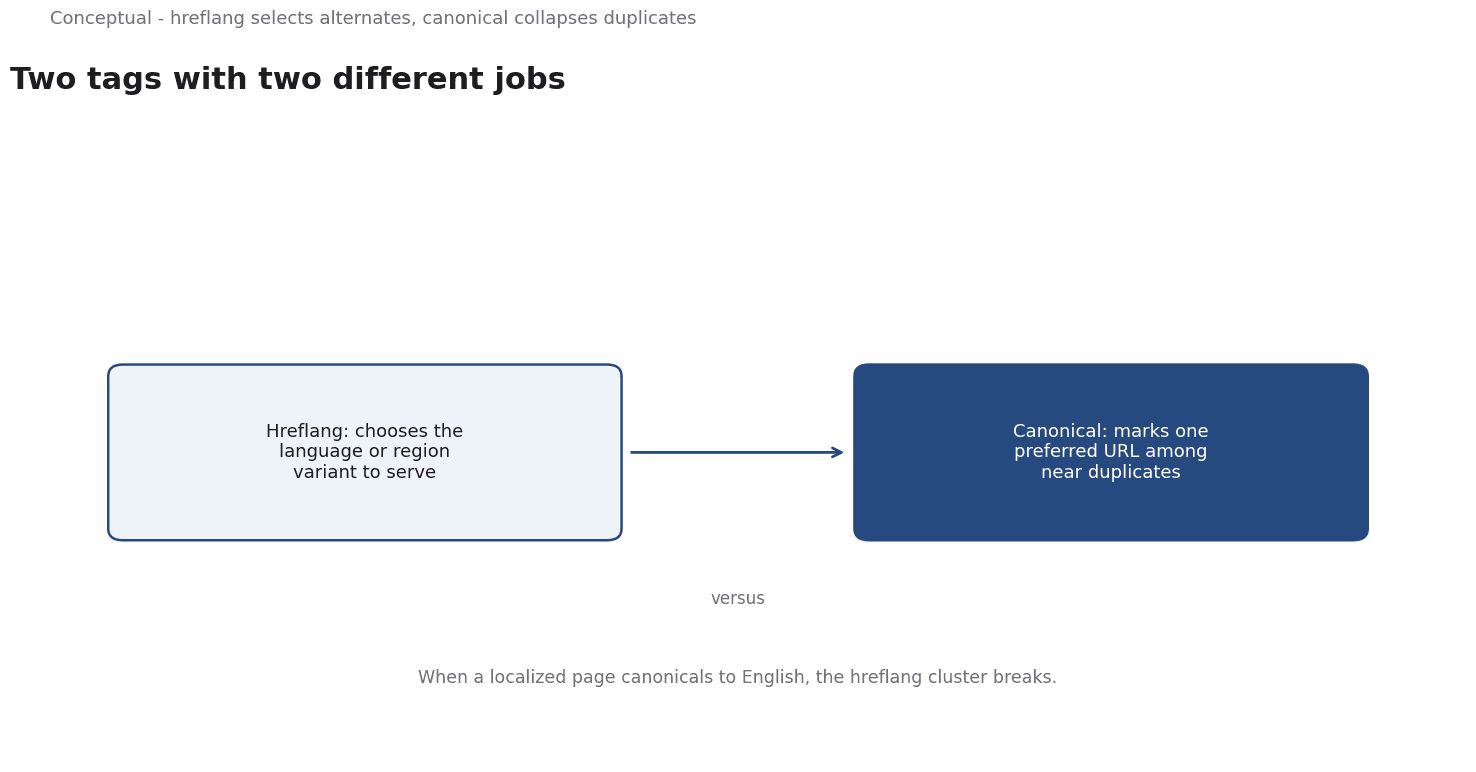
The Wikipedia entry on the canonical link element describes a rel=canonical tag as a signal that one URL is the preferred version of a near-duplicate page, allowing ranking signals to be consolidated. The practical consequence is that hreflang and canonical solve different problems and can conflict. Hreflang distinguishes alternate versions intended for different audiences; a canonical merges versions that are effectively the same. If a localized page carries a canonical tag pointing to the English original, the two signals work against each other, and the alternate that hreflang depends on can be consolidated away.
Read together, the two signals operate at different layers. Hreflang selects among alternates; canonical collapses duplicates. Confusing them produces a specific error: a team canonicalizes language variants to a single URL in the name of avoiding duplicate content, then wonders why the hreflang cluster no longer behaves as expected. The practical consequence is that an international cluster can look acceptable in a report while being structurally incoherent underneath, because traffic metrics do not expose the conflict between the two tag types.
A coherent reading treats structural checks as leading indicators and traffic as a lagging outcome. The metrics that matter for a language cluster are annotation coverage, reciprocity, validity of language and region codes, completeness of the set of alternates, alignment of canonical tags with the intended version, and indexability of each variant. Traffic and rankings are downstream results confounded by demand, content quality, and competition. Checking structure first isolates configuration problems; checking traffic alone mixes configuration with everything else. That ordering is the mechanism, with each check narrowing the space of plausible causes before performance is interpreted.
A worked example
The following is hypothetical and illustrative. A site publishes English, German, and French versions of a product page, and organic traffic to the German version drops over one quarter. Three checks decide the interpretation. First, verify that every hreflang pair has a matching return tag and that each page carries a self-reference. Second, confirm that the canonical tag on each localized page points to that same localized URL rather than to the English original. Third, confirm that every annotated URL returns a successful status and is not blocked from indexing. The outcome: the German page's canonical pointed to the English version, which let the localized alternate be consolidated and broke the cluster. After correcting the canonical and rechecking reciprocity, the structure is sound; traffic is then judged on its own terms. The figures are invented; the sequence of checks is the contribution.
Evidence status
| Claim | Status | Source | Verified | Recheck when |
|---|---|---|---|---|
| Hreflang annotations tell search engines which localized page to serve | source-reported | Google, Localized Versions | 2026-11-18 | Google changes its internationalization guidance |
| A canonical link element indicates a preferred URL among near duplicates | source-reported | Wikipedia, Canonical link element | 2026-11-18 | Canonical specifications or guidance change |
| Reciprocal and valid annotations are leading indicators of cluster health | inferred | Derived from the sources | 2026-11-18 | Search guidance on hreflang validation changes |
The first two rows are documented in the sources: one explains the targeting signal, the other defines the duplicate-consolidation signal. The third row is an inference from their requirements, since neither source presents validation as a performance metric. Recheck it if search platforms change how they treat reciprocal annotations or publish new validation tooling.
What it cannot do
Hreflang cannot force a search engine to serve a particular version to a particular user. It is a hint that expresses intent, not a directive that guarantees selection. A search engine may ignore annotations that are inconsistent, or may serve a different version because of user settings, personalization, or the absence of an exact match. The limit is structural: the site can declare a mapping, but the decision happens in a system the site does not control, using signals the site cannot see.
A hidden cost of maintaining a cluster is operational effort that grows with scale. Every new locale, URL change, or template update can invalidate annotations or canonical tags across the whole set. A sitemap that is not regenerated after a migration leaves stale URLs, and a CMS template that emits the wrong language code silently degrades one group of pages. The cost is not in adding the first annotation but in keeping hundreds of them consistent over time, which is why a checklist and automated validation matter more than a one-time implementation.
A common failure mode is contradictory signals.
The failure is dangerous because the pages still render and still receive traffic, so nothing looks broken from a user perspective. Diagnosing it requires inspecting the raw annotations rather than the rendered page, which is a different and less familiar habit for most teams.
The boundary of the measurement is what the search platform reports and what the site can inspect. Structured reports can surface errors such as missing return tags, but they do not reveal whether a user was actually shown the intended variant, nor whether a translation is adequate for the market. Third-party syndication and cached copies fall outside the cluster entirely. Claims about user experience or conversion by locale therefore exceed what annotation metrics can establish, even when every structural check passes.
These checks need review whenever URLs, the locale list, domain structure, or publishing templates change. A cluster that validated last quarter may be inconsistent now if a new market was added or a canonical rule was edited in the CMS. Recording the annotation method, the canonical strategy, and the last validation date beside each report is the only way to keep the diagnostics interpretable over time.
The counterargument that traffic is the outcome that ultimately matters is fair for judging business impact and incomplete for diagnosing why a language cluster is underperforming, since traffic confounds configuration with demand and content quality.
A decision test
- List every intended language and region variant of the page or site.
- Confirm each variant carries a self-referencing hreflang annotation.
- Check that every pair of variants has matching reciprocal annotations.
- Validate all language and region codes against the supported formats.
- Verify each localized page has a canonical tag pointing to itself, not across languages.
- Confirm every annotated URL returns a successful status and is indexable.
- Re-run validation after any URL, locale, or template change before reading traffic trends.
These steps separate configuration health from performance. They do not guarantee that a search engine will serve the intended version, but they remove the errors that most often invalidate a cluster. The result is a publishing decision based on verifiable structure, with traffic interpreted only after the structure is sound. For further reading, see what AI search actually measures.
References & Further Reading
- Google, 2026. Localized Versions of your Pages — How hreflang, canonicals, and locale variants are supposed to work together.
- Wikipedia contributors, 2026. Canonical link element - Wikipedia — HTML element indicating a preferred URL.