HTTP/3: a Decision Framework
HTTP/3 changes the transport, not the application. Read what RFC 9114 specifies, how to check client support, and a decision test for adopting it.
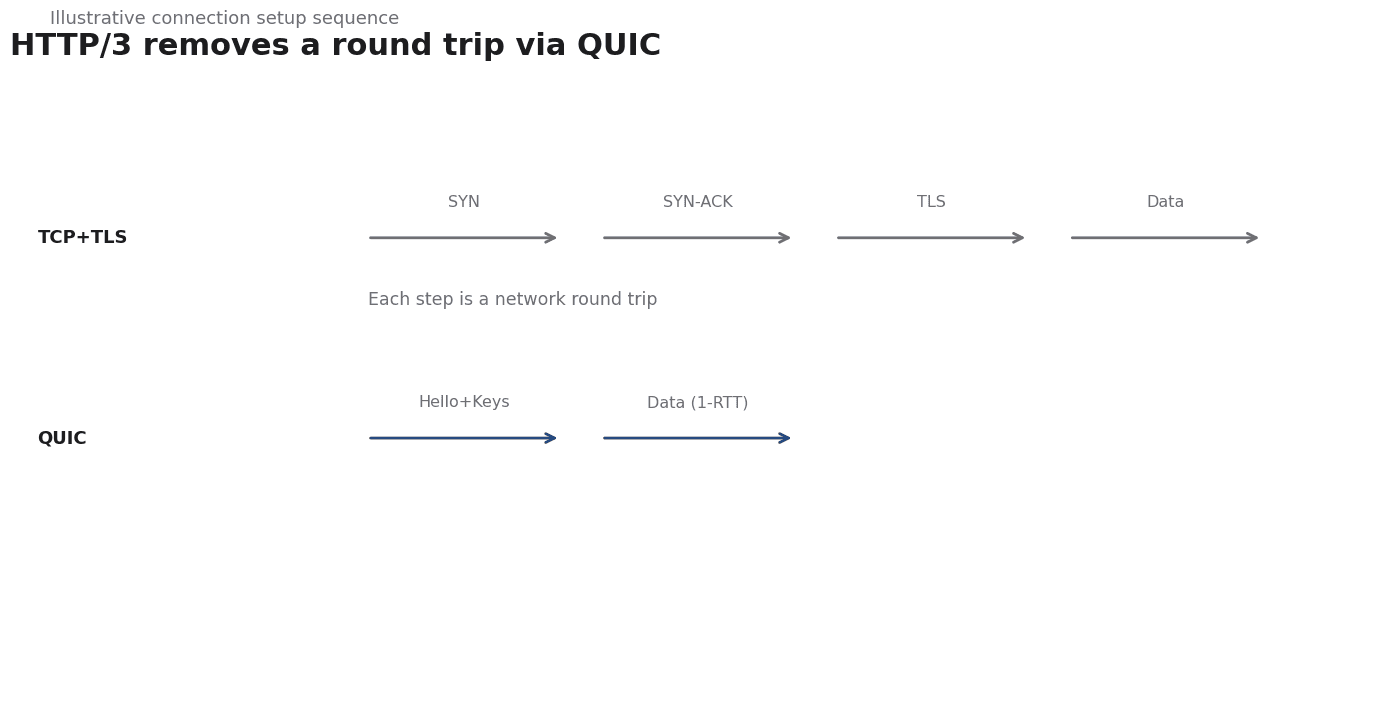
Teams hear that HTTP/3 is faster and feel pressure to switch it on. The standard changes how bytes move between client and server, not what an application does with them, so the speed claim cannot be evaluated in the abstract. The real problem is deciding whether this transport change helps a specific service, given the clients it serves and the stack that terminates connections. RFC 9114 defines the protocol, and public support tables describe which clients can use it at a point in time.
Direct answer:
HTTP/3 is a transport variant specified in RFC 9114 that runs over QUIC, with TLS integrated and independent streams that avoid transport-level head-of-line blocking.
Whether to adopt it depends on your traffic mix, client base, and edge stack, not on the protocol in isolation. Check dated client and server support before assuming the change reaches your users.
Delta: This article adds a claim-status table and an adoption decision test beyond the standard and the support tables: it maps transport properties to a deployment decision, with claim status explicit.
The mechanism
RFC 9114 specifies how HTTP semantics are carried over QUIC rather than over TCP. QUIC runs on UDP and builds connection setup and encryption into the transport, using TLS 1.3 for the cryptographic handshake. The practical consequence is that a new connection typically needs fewer round trips before application data can flow, which matters most on paths where latency is high. This is a property of the handshake, not of the content being served, so a small API response and a large video segment gain the same reduction in setup time.
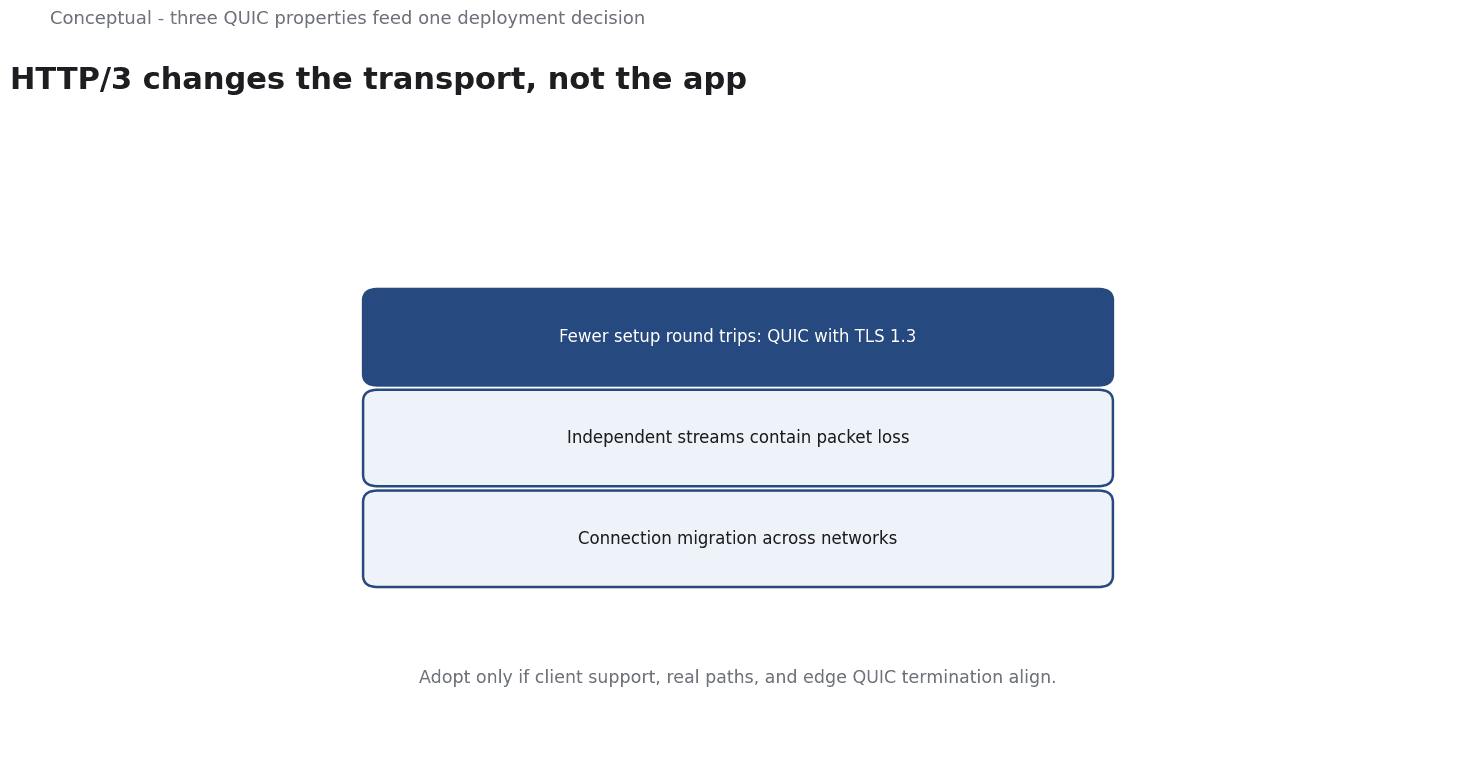
The second property is stream independence. In HTTP/2 over TCP, a lost packet can stall all streams sharing the connection because TCP presents a single ordered byte stream. QUIC multiplexes streams so that loss affects only the stream whose data was lost. The practical consequence is smoother behavior on lossy links, such as mobile networks, where packet loss is routine. It does not repair a lossy link; it contains the damage to one stream instead of the whole connection.
A third property is connection migration. Because the connection is identified by IDs rather than by the four-tuple of addresses and ports, a client that changes networks can continue an existing connection. For applications used on the move, this reduces the disruption of switching between Wi-Fi and cellular. The effect is conditional on the client and network supporting it, so it belongs in the decision as a possibility rather than a guarantee.
These properties translate into a deployment question rather than a verdict. A support table records which browsers and platforms implement the protocol, and that record changes over time. The decision is therefore whether the gain on your actual paths outweighs the cost of running and observing a UDP-based endpoint. That is local judgement, not something the standard can answer.
A worked example
The following is hypothetical and illustrative. A team with a large mobile audience considers enabling HTTP/3 at its content edge, where TLS is currently terminated for HTTP/2 traffic. Three checks decide the outcome. First, does the edge platform terminate QUIC and negotiate the protocol with clients, and is the origin path unaffected? Second, does the current support table show the target browsers and operating systems implementing HTTP/3, and what share of traffic could actually use it? Third, do connection-setup metrics on the real mobile paths show latency that the handshake change would address? If the edge supports it, support is material, and setup time is a measured problem, the team enables HTTP/3 while retaining an HTTP/2 fallback and watches the metrics. If any check fails, the change waits. The scenario is hypothetical; the decision structure is the contribution.
Evidence status
| Claim | Status | Source | Verified | Recheck when |
|---|---|---|---|---|
| HTTP/3 is specified as running over QUIC | source-reported | RFC 9114 | 2026-11-18 | IETF updates the standard |
| Client support changes over time and is tracked in tables | source-reported | Can I Use | 2026-11-18 | Browser support data changes |
| Adoption value depends on local traffic and stack | inferred | Derived from the sources | 2026-11-18 | Traffic mix or edge stack changes |
The first two rows are reported by the sources and describe the protocol and the support landscape. The third row is an inference: combining a defined protocol with time-varying support yields a decision that must be made against local conditions. None of the rows claims a performance gain for a named service, which would require measurements the sources do not provide.
What it cannot do
HTTP/3 cannot make a slow application fast. It addresses connection setup and stream-level loss behavior, so an application that spends its time in database queries or expensive rendering will not improve because the transport changed. Treating the protocol as a performance fix confuses two layers. The decision test exists to keep that confusion out of the review.
It also cannot reach every user. Some networks block or throttle UDP traffic on the port QUIC uses, and some managed environments restrict protocols they do not recognize. The fallback to HTTP/2 covers browsers that negotiate it, but a client that cannot reach the UDP endpoint will fall back rather than gain the new behavior. A support table tells you about client capability, not about the networks those clients sit behind, so the two must be treated as separate questions.
There is a hidden operational cost. Running QUIC means terminating TLS at a layer that may differ from your current HTTPS setup, updating load balancer and firewall rules, and learning a different set of metrics. Observability that assumes TCP will not show the same signals for a UDP-based connection.
A further boundary concerns security-sensitive features. Early data reduces round trips but carries replay considerations that the standard treats with care. Enabling it is a separate decision from enabling HTTP/3, and it should not be assumed as a default. The same discipline applies to any feature that trades a strict guarantee for lower latency.
Finally, the evidence has a shelf life. Standards are revised, browser support expands, and network behavior changes. A decision recorded today should name the date of the support data it relied on, so that a later review can tell whether the decision still holds. Without that date, the team cannot distinguish a change in the protocol from a change in the world around it.
There is also a cost to keeping two paths alive. A fallback is not free: both configurations need testing, both sets of metrics need dashboards, and a change to one can silently break the other. Teams that enable the new protocol and then stop watching the old one may discover that the fallback has degraded unnoticed, which is exactly the situation that a careful rollout was meant to avoid. The operational burden belongs in the decision as a recurring cost, not a one-time setup task.
Counterargument: "The counterargument that HTTP/3 is always faster is fair for lossy mobile paths and incomplete on clean datacenter links where TCP already performs well."
A decision test
- Name the problem you expect the transport change to solve.
- Verify that your edge or server stack terminates QUIC and negotiates HTTP/3.
- Check dated client support against your actual traffic mix.
- Confirm that the fallback path to HTTP/2 remains configured.
- Measure connection setup on the networks your users actually use.
- Review UDP reachability and the security choices around early data.
- Record the decision with the date of the support data and a review trigger.
The test converts a protocol claim into a local decision. Each step is cheap relative to a rushed rollout, and the recorded date makes the decision revisitable. The goal is not to adopt or reject HTTP/3 on principle but to know which condition would change the answer.
For further reading, see Decision Memos.
References & Further Reading
- M. Bishop, 2022. HTTP/3 (RFC 9114) — HTTP semantics mapped onto QUIC.
- Can I Use, 2026. Can I use... Support tables for HTML5, CSS3, etc — The most-cited compatibility reference for browser feature support.