HTTP 451 Unavailable for Legal Reasons: What the Status Actually Signals
HTTP 451 indicates access is denied in response to a legal demand. Learn what it says, what it does not prove, and how a blocking entity can identify itself.
An HTTP 451 response can look like an ordinary error page, but its status has a specific meaning: the server is denying access to a resource as a consequence of a legal demand. The response is intended to make certain restrictions more transparent. It does not prove that the requested resource exists, identify the legal authority on its own, or guarantee that every legal restriction will be reported with 451.
Direct answer: RFC 7725 defines 451 Unavailable For Legal Reasons for a server denying access because of a legal demand. The responding server may not be the origin; an ISP, search engine, cache provider, DNS service, or another entity in the access path may be involved. The status implies neither that the requested resource exists nor that it does not. The RFC recommends an explanatory response body and a Link field with rel="blocked-by" to identify the entity implementing the block.
What the status means
RFC 7725 describes a case in which a server operator has received a legal demand to deny access to a resource or set of resources that includes the requested one. The status can help explain why a request is being refused, instead of leaving the user to guess whether the resource is missing or the server is malfunctioning.
The responding server need not be the origin server. The blocking entity might be an ISP or another intermediary involved in delivering the request. The distinction is important: the entity implementing the restriction is not necessarily the party that made the demand or the institution that issued it.
What a 451 response does not prove
The status does not establish whether the named resource would otherwise be available. RFC 7725 explicitly says that 451 implies neither the existence nor the nonexistence of the resource. Even if the legal demand were removed, the request might still fail for another reason.
RFC 7725 notes that clients cannot rely on the code being used; an authority or operator might not disclose that a legal demand was made.
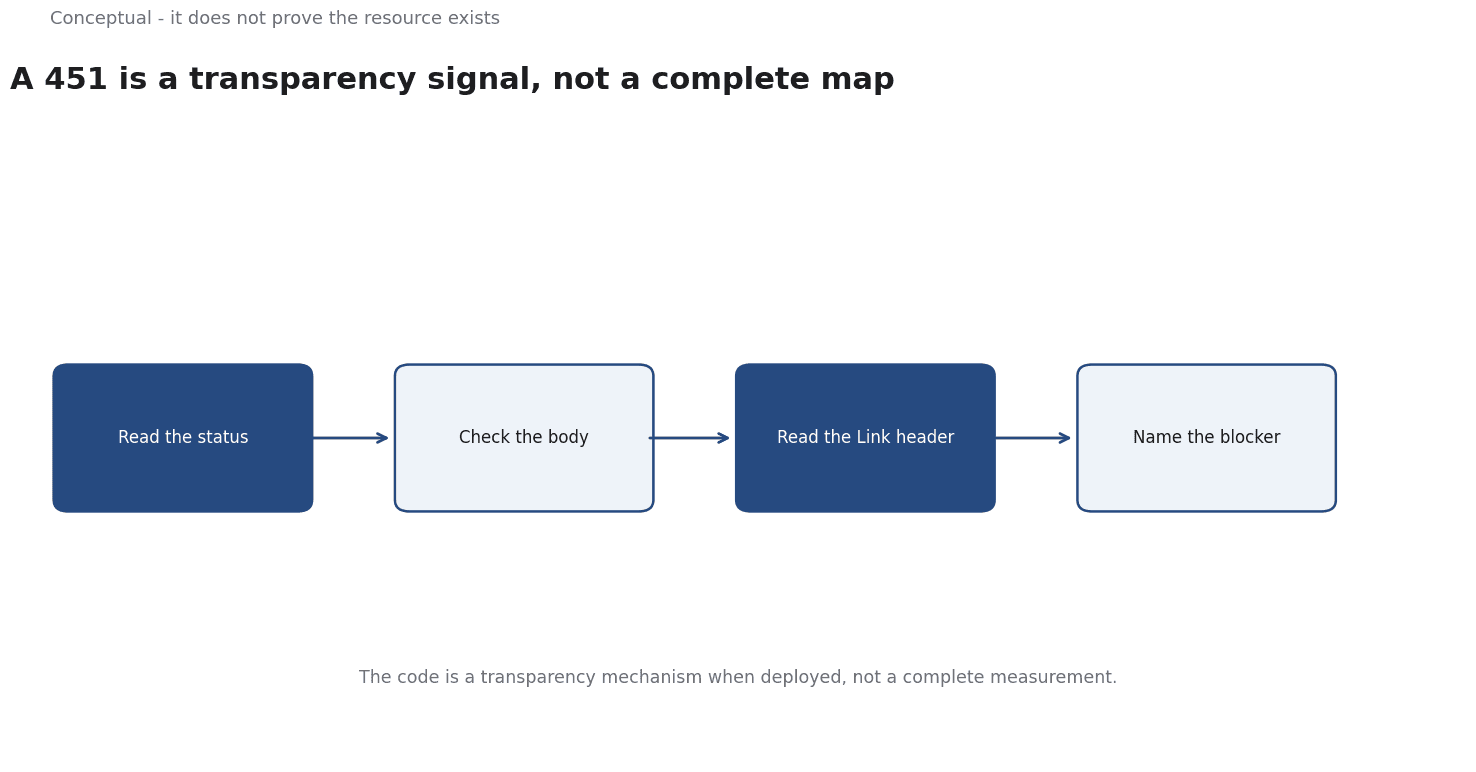
The code is a transparency mechanism when deployed, not a complete measurement of all restrictions on access.
The response also is not itself a legal opinion. Its body can describe the demand, relevant legislation or regulation, and the classes of people or resources affected, but the status code does not independently verify that explanation or settle a dispute about the legal basis.
Reading the transparency signals
RFC 7725 says the response SHOULD include an explanation in the body with details such as the party making the demand, applicable legislation or regulation, and the categories of people and resources affected. It also says the blocking entity SHOULD include a Link field identifying itself, with the relation blocked-by.
An illustrative response might contain:
HTTP/1.1 451 Unavailable For Legal Reasons
Link: <https://blocker.example/transparency>; rel="blocked-by"
Content-Type: text/html
The URI in the link is intended to identify the entity actually implementing the blockage. A separate human-readable body is the appropriate place to discuss the administrative or policy basis. These are recommendations in the RFC; their absence does not turn every other status into proof that no legal restriction exists.
How to investigate a 451 report
If a user reports that a URL returns 451, distinguish the response from a general origin error before drawing conclusions:
- Capture the complete response: status, headers, body, timestamp, request URL, and the network or region where it occurred.
- Inspect
blocked-by: if present, follow its URI as a lead to the blocking entity’s explanation; do not assume it names the legal authority. - Compare network vantage points: different intermediaries or jurisdictions may produce different responses. Such variation helps localize the path but is not, by itself, proof of the legal basis.
- Check the service architecture: determine whether the origin, ISP, CDN, cache, or another component generated the response using logs and request identifiers where available.
- Preserve provenance: distinguish the response’s stated reason from independently verified legal facts, and retain the date and exact URL because conditions can change.
Do not treat a 451 as equivalent to 404 Not Found, 403 Forbidden, or 503 Service Unavailable. Those statuses have different meanings. For other response-code distinctions relevant to crawling and indexing diagnostics, see HTTP Status Codes for SEO.
A transparency signal, not a complete map
HTTP 451 gives an operator a standard way to report a particular kind of access denial and a way to identify the blocking entity. Its value depends on accurate implementation and meaningful explanation. Because use is not guaranteed, the absence of 451 cannot establish that access has not been legally restricted.
A worked example
The following is hypothetical and illustrative. A user reports that a URL returns 451, and an investigator wants to distinguish a legal block from an origin error. Three checks follow from RFC 7725. First, was the complete response captured - status, headers, body, timestamp, request URL, and region - so the claim can be examined rather than inferred from a screenshot? Second, does a Link field with rel="blocked-by" identify the entity implementing the block, a lead to that entity's explanation rather than the party that made the demand? Third, do responses differ across vantage points or service layers, which helps localise whether the origin, an ISP, a CDN, or a cache produced the status, short of proof of the legal basis? If the response is bare, with no body or link, the transparency goal is unmet and the code reveals nothing beyond a refusal. If all three checks yield a documented, attributable response, the investigator has a traceable report, not a verified legal opinion. The outcome is bounded by the RFC: 451 implies neither that the resource exists nor that it does not.
A counterargument
A fair objection is that the article overstates 451's transparency value. RFC 7725 makes both the explanatory body and the blocked-by link recommendations rather than requirements, and it explicitly says clients cannot rely on the code being used at all, so an operator can emit a bare 451 that reveals nothing. The article itself notes that blocked-by names the entity implementing the block, not the party that made or issued the demand, which means even a fully compliant response may leave the most consequential question unanswered.
A critic could argue that a standardised code with optional disclosure risks looking more authoritative than the evidence behind it, inviting users to read a terse status line as a verified account of the legal basis.
On that view the RFC's transparency goal is only partly achievable through the status code alone.
References & Further Reading
- T. Bray, RFC 7725: An HTTP Status Code to Report Legal Obstacles, IETF Standards Track, February 2016. Defines 451, its legal-demand scope, limits on what the response implies, recommended explanatory content, and the
blocked-bylink relation. - R. Fielding, M. Nottingham, and J. Reschke, editors, RFC 9110: HTTP Semantics, IETF Standards Track, June 2022. Provides current shared HTTP status-code semantics and terminology.