The HTTP Priority Header: What Priority Signals Actually Do
RFC 9218 defines HTTP urgency and incremental hints, but servers may combine or ignore them. Learn what the Priority field signals and how to measure its effect.
When a page needs several resources, the order and pacing of their responses can affect when useful content becomes available. HTTP has a standard way to communicate priority preferences, but the signal is not a command that forces a server to send one response first. RFC 9218 defines an extensible prioritization scheme; its values are inputs that clients, servers, and intermediaries may use in scheduling decisions.
Direct answer: RFC 9218 defines the Priority HTTP field and protocol-specific PRIORITY_UPDATE frames for expressing response-priority information. Its initial parameters include u (urgency, 0 through 7, with lower numbers indicating higher precedence) and i (whether a response can be processed incrementally). A server may consider these signals alongside other information, but a client cannot depend on a particular transmission order or performance result. The effect must be measured on the actual delivery path.
Why response prioritization exists
HTTP/2 and HTTP/3 can carry concurrent responses on a connection. When several responses compete for limited bandwidth or server resources, a scheduler has to decide how to allocate transmission opportunities. A stylesheet that blocks rendering may matter earlier to a browser than an image that can appear later; a resource that can be consumed in chunks may benefit from incremental delivery.
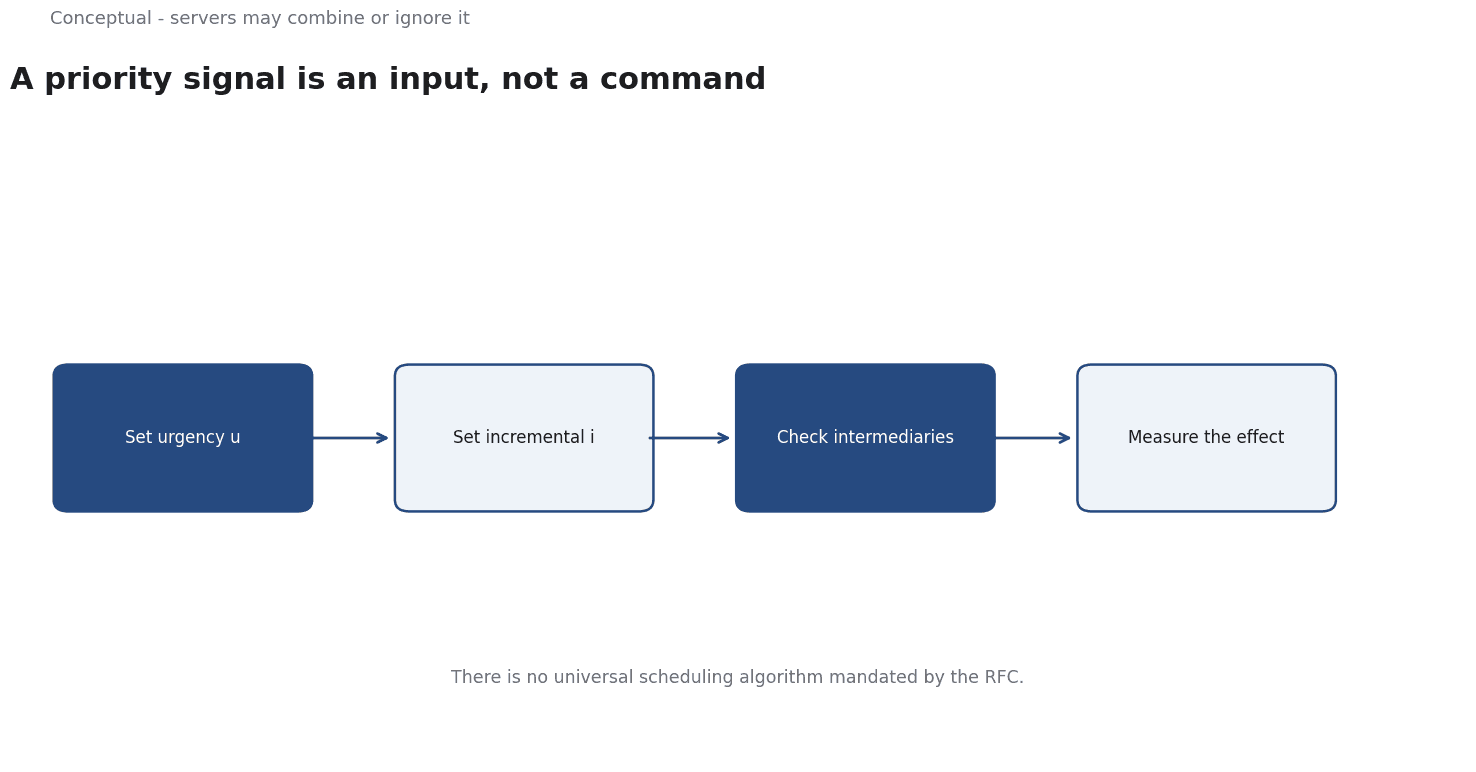
The server often has information about its own resources and workload, while the client has information about what it needs and can process. Priority signaling provides a way to communicate those preferences. RFC 9218 explicitly treats priority parameters as suggestions and notes that servers can combine them with other inputs or ignore them.
There is no universal scheduling algorithm mandated by the RFC.
What u and i mean
RFC 9218 defines two initial parameters:
- Urgency (
u): An integer from 0 to 7. Lower values mean higher precedence; the default is 3. It communicates relative urgency, not an absolute deadline or guaranteed time slot. - Incremental (
i): A Boolean indicating whether the client can make meaningful use of a response as chunks arrive. Its default is false. This describes a processing preference, not a promise that the server will stream or that every partial chunk is useful.
A request can express these parameters in the Priority field. For example, the field value can be:
Priority: u=0
This tells the receiver that the client views the response as high urgency. It does not make the request more important to the application in an authorization or business-policy sense, and it does not establish that the server accepted or acted on the preference.
Header field and update frames
The Priority field can be used across HTTP versions as an end-to-end signal. RFC 9218 also defines PRIORITY_UPDATE frames for HTTP/2 and HTTP/3, allowing a client to revise the priority after sending a request. These frames are scoped to a protocol hop, unlike the end-to-end field.
That distinction matters when intermediaries are involved. A proxy or CDN may interpret the client’s signal, alter scheduling for its own connections, or forward priority information to a backend.
Why a priority value is not a performance guarantee
The signal is only one input to scheduling. The server may be constrained by CPU, storage, congestion, application dependencies, backend latency, or other requests. The resource may be cached, the connection may not have competing responses, or a proxy may transform the request path. Under those circumstances, changing a priority value may have no measurable effect.
RFC 9218 also describes fairness trade-offs. Strictly serving every high-urgency response first can delay lower-priority work for a long time; implementations may allocate some bandwidth to other requests to avoid starvation. The prioritization scheme therefore offers a vocabulary for preferences, not a universal guarantee that the “most important” resource always finishes first.
This is separate from HTTP 103 Early Hints, which can tell a client about resources before the final response. Early Hints concerns when the client learns about a potential resource; priority signals concern how response delivery may be scheduled. One does not guarantee the other.
How to test a priority change
Treat a priority adjustment as a hypothesis. Use a controlled comparison that changes the signal while keeping page content, server configuration, cache state, and test conditions as comparable as possible.
- Choose a specific contention case: prioritization may be invisible when responses are not competing for constrained resources.
- Confirm the signal on the wire: inspect the request field and, where relevant, protocol frames or intermediary logs.
- Verify server behavior: determine whether the serving implementation supports and uses RFC 9218 signals; do not infer this from a browser setting alone.
- Measure response timing and user outcomes: compare resource start/finish timing and the relevant page experience metric across repeated runs or representative field data.
- Check for trade-offs: ensure the change did not starve other resources, increase completion times elsewhere, or affect other clients sharing an intermediary.
- Keep results scoped: report the tested browser, protocol, edge, and server configuration. Do not generalize one test into a universal HTTP/2 or HTTP/3 result.
A counterargument
A reasonable critic would push back on the article's recommendation to treat priority as a tunable that clients can adjust and measure. RFC 9218 permits servers to combine the u and i values with other inputs or ignore them outright, and RFC 9113 and RFC 9114 only define the frames that carry the signal, not any scheduling behaviour, so on a deployment that does not implement the scheme a header change is a guaranteed no-op. The article's fairness discussion points to the deeper issue: transmission order is decided by a server scheduler balancing starvation against urgency, which is an implementation property rather than something a request field can force.
A critic could argue that the useful question is whether the server and intermediaries honour RFC 9218 at all, and that framing the field as a per-resource lever risks sending teams deep into timing tests for a control the deployment never reads.
References & Further Reading
- K. Oku and L. Pardue, RFC 9218: Extensible Prioritization Scheme for HTTP, IETF Standards Track, June 2022. Defines
Priority, urgency and incremental parameters, update frames, and the non-guaranteed nature of scheduling signals. - M. Bishop, editor, RFC 9114: HTTP/3, IETF Standards Track, June 2022. Defines HTTP/3; RFC 9218 specifies the HTTP/3 priority-update frame in this protocol context.
- M. Thomson and C. Benfield, editors, RFC 9113: HTTP/2, IETF Standards Track, June 2022. Defines HTTP/2; RFC 9218 specifies its corresponding priority-update frame.