HTTP/3: What Changes When HTTP Runs over QUIC?
Understand HTTP/3’s QUIC transport, independent streams, UDP fallback, TLS integration, and the practical checks that show whether a connection actually used it.
HTTP/3 is often described as “HTTP/2, but faster.” That shorthand hides the main change: HTTP semantics remain familiar, while the transport underneath changes from TCP to QUIC over UDP. This affects stream behavior, connection setup, and network compatibility. It does not guarantee that every request becomes faster, or that a server supporting HTTP/3 will cause a browser to use it for a particular visit.
Direct answer: HTTP/3 maps HTTP semantics onto QUIC. QUIC provides encrypted, multiplexed streams with transport-level reliability and flow control; TLS 1.3 is integrated into its handshake. Unlike HTTP/2 over TCP, packet loss affecting one QUIC stream does not inherently block delivery on every other stream in the connection. But performance still depends on the path, endpoint implementation, workload, and whether the client can establish QUIC over UDP. RFC 9114 and RFC 9000 define the protocol behavior.
What stays the same—and what changes
HTTP/3 uses the same HTTP semantics: methods, status codes, fields, and resource representations remain part of HTTP. The framing and transport change. HTTP/3 carries messages in frames on QUIC streams; a request-response exchange uses a client-initiated bidirectional stream. QUIC can carry multiple streams concurrently over a connection.
HTTP/2 also multiplexes requests, but it typically runs over TCP. TCP presents an ordered byte stream to its application. If a TCP segment is lost, later bytes on that connection cannot be delivered to the application until the missing bytes are recovered. Since HTTP/2’s concurrent streams share that TCP connection, a loss can temporarily stall data across the connection.
QUIC instead provides ordered delivery independently for each stream. Loss on one stream does not require another stream’s bytes to wait for in-order delivery of the lost stream’s data. The connection still has congestion control and packet loss recovery, so loss can affect how much data the connection sends overall.
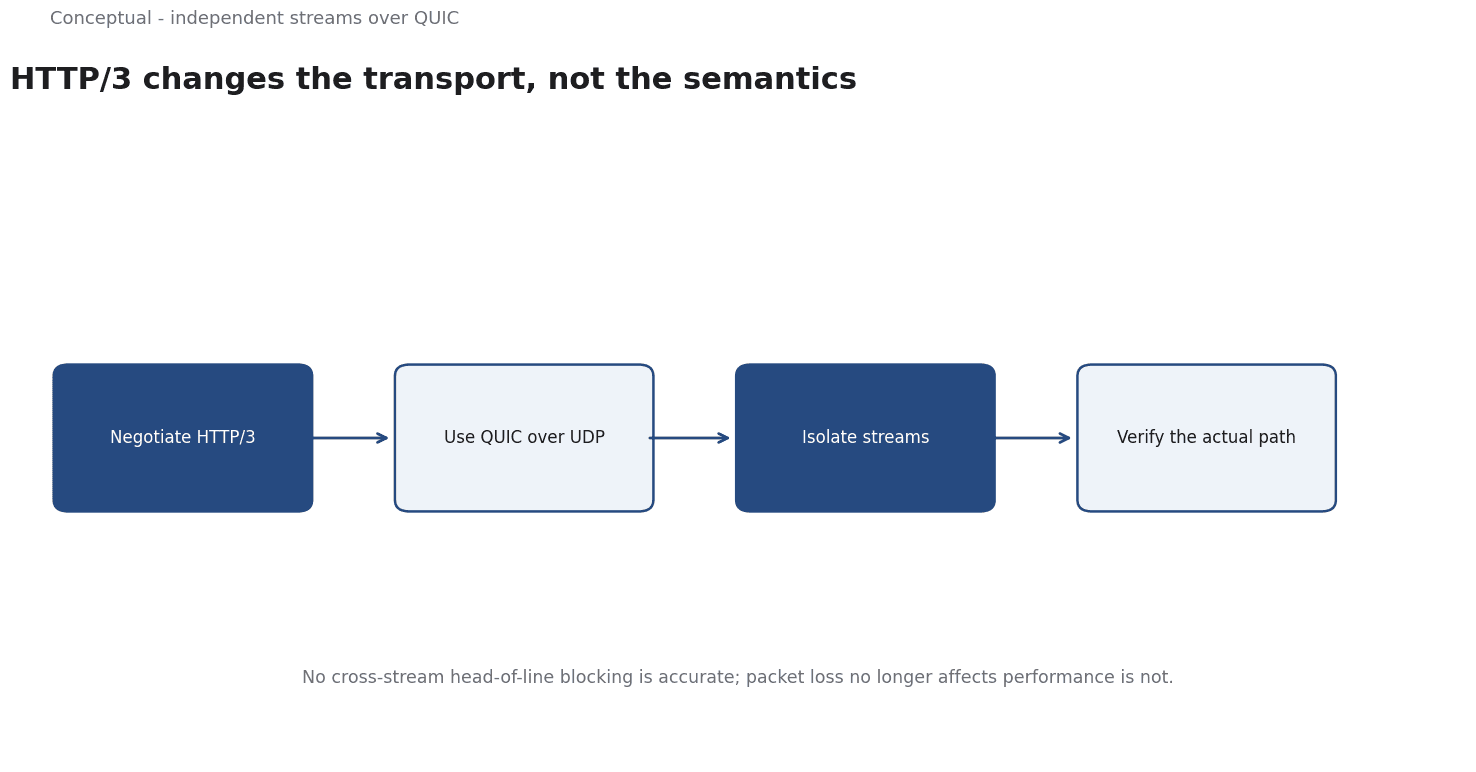
“No cross-stream head-of-line blocking from transport ordering” is accurate; “packet loss no longer affects performance” is not.
How HTTP/3 is discovered and negotiated
RFC 9114 describes advertising an alternative HTTP/3 endpoint using the Alt-Svc response header or an HTTP/2 ALTSVC frame. For example:
Alt-Svc: h3=":443"; ma=86400
The h3 token identifies HTTP/3, and the authority indicates the alternative service endpoint. A client may then try QUIC and negotiate HTTP/3 using the h3 ALPN identifier during the TLS handshake. Implementations can also use other discovery or configuration mechanisms.
QUIC uses UDP datagrams. Networks that block or impair UDP can prevent QUIC connection establishment; RFC 9114 says clients should attempt TCP-based HTTP versions in this case. As a result, a site can support HTTP/3 while some clients continue using HTTP/2 or HTTP/1.1. That is expected protocol fallback, not necessarily a broken deployment.
TLS is integrated, not removed
QUIC uses TLS 1.3 or later for its handshake and cryptographic key negotiation. TLS handshake messages are carried in QUIC CRYPTO frames; QUIC packet protection then uses keys derived through TLS. This differs from HTTP/2 over TLS, where TLS records are carried over TCP.
QUIC’s 0-RTT mode deserves a careful caveat. A client with suitable prior session state may send early application data before the handshake completes. The data can be replayed, so RFC 9001 warns that 0-RTT is unsuitable for actions whose replay could cause unwanted effects. Applications and servers must account for that risk; 0-RTT is not a blanket “free latency” switch.
A practical verification workflow
For a browser visit, use the browser’s developer tools and inspect the Protocol column in the Network panel (enable it from the column menu if hidden). A request marked h3 indicates the browser reports HTTP/3 for that request. This is a client-side observation, not a guarantee that every client, route, or resource uses HTTP/3.
You can also inspect response headers for an Alt-Svc advertisement, but that only shows the server offered an alternative service; it does not prove that the client connected over QUIC. To investigate an apparent failure:
- Confirm that the DNS name and certificate are valid for the intended origin.
- Check whether the response advertises an
h3alternative service, or whether the deployment has another documented discovery path. - Verify UDP reachability to the advertised host and port from the affected network.
- Compare requests from more than one network and client, since local filtering and client support vary.
- Check the server or edge telemetry for negotiated application protocol and connection errors.
- Confirm that a TCP-based fallback still serves the same content and status correctly.
The protocol-level specification does not prescribe a universal command that can prove what every browser negotiated. Use tooling that reports the negotiated ALPN or HTTP version for the actual connection; a generic curl invocation may use a different build, network path, or protocol preference than a user’s browser.
What HTTP/3 does not tell you about SEO
HTTP/3 is a delivery protocol, not an indexing directive. A successful HTTP/3 connection does not establish that a page is crawlable, indexable, useful, or eligible to rank. Likewise, a page delivered over HTTP/2 is not inherently excluded from search. Assess availability, response behavior, rendered content, and search indexing separately.
If you are evaluating adoption or performance, measure actual clients and representative paths. The HTTP Archive’s 2025 CDN chapter shows why protocol shares depend on the dataset and request category. For HTTP caching behavior that can be investigated independently of the transport version, see Cache-Control Is a Contract, Not a Suggestion. For the unreliable-datagram extension that sits alongside QUIC streams rather than replacing them, see QUIC DATAGRAMs.
A counterargument
A fair objection is that the article's emphasis on per-stream independence overstates what most users will feel. RFC 9000 gives each QUIC stream ordered delivery, but congestion control and recovery still operate at the connection level, and the article itself concedes that loss can reduce how much the whole connection sends.
A reasonable critic would push back that on a lossy, bandwidth-limited path the aggregate connection rate, not head-of-line blocking, is the binding constraint, so the headline advantage can shrink to near zero even though the mechanism is real.
The 0-RTT discussion points the same way: RFC 9001's replay warning means the latency win is unavailable for actions with side effects, which is precisely many of the requests a browser sends. The article's caution is well placed, but a critic could argue it still lets the transport story carry more weight than the measured end-to-end evidence warrants.
References & Further Reading
- M. Bishop, editor, RFC 9114: HTTP/3, IETF, June 2022. Defines HTTP semantics over QUIC, stream mapping, endpoint discovery,
h3negotiation, fallback considerations, and HTTP/3 framing. - J. Iyengar and M. Thomson, editors, RFC 9000: QUIC: A UDP-Based Multiplexed and Secure Transport, IETF, May 2021. Defines QUIC streams, flow control, connection behavior, and transport over UDP datagrams.
- M. Thomson and S. Turner, editors, RFC 9001: Using TLS to Secure QUIC, IETF, May 2021. Defines TLS integration, packet protection, and 0-RTT’s replay considerations.