Knowledge Graphs for Grounded AI Applications
A knowledge graph stores relationships explicitly. Read when that structure beats vector retrieval, a worked example, and the maintenance cost.
Vector retrieval finds passages that look similar to a query. It does not know that a particular person reports to a particular manager, or that one drug contraindicates another. When an application needs relationships rather than similarity, a knowledge graph can supply structure that embeddings cannot.
Direct answer:
A knowledge graph stores entities and the relations between them as triples, allowing queries that traverse connections rather than rank passages.
The knowledge-graph overview provides the structural reference, and the RAG article covers the retrieval pattern it can complement. The boundary: a graph is only as good as its data — building and maintaining the entities and relations is the real cost, and many applications need both a graph and vector retrieval.
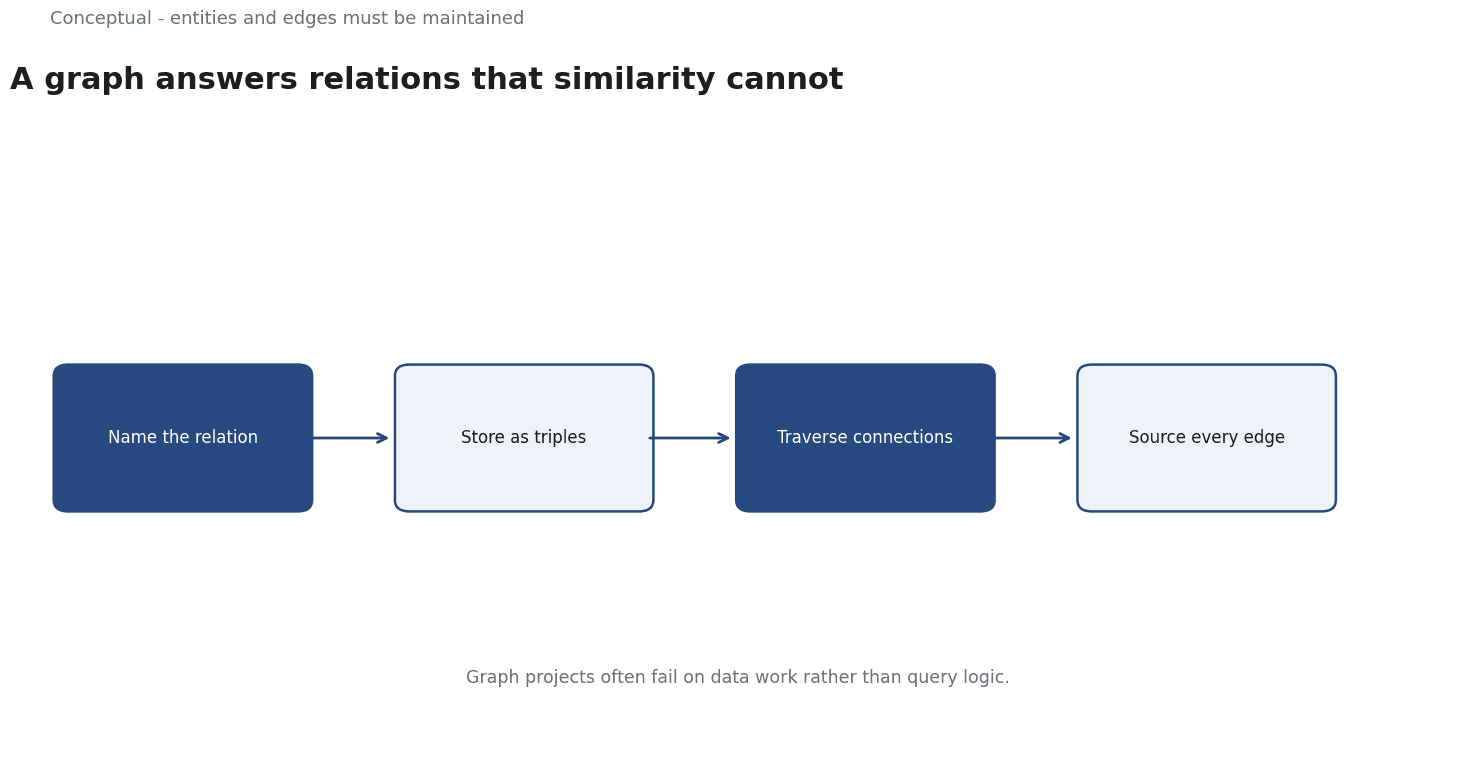
Structure versus similarity
Three differences matter:
Explicit relations. A graph states that A works for B. A vector index can find documents mentioning both, but it does not assert the relationship.
Traversal. You can ask "which projects report to this director through two levels of management?" — a question that is awkward to answer by similarity search.
Provenance. Each edge can carry a source and a date, which makes the answer traceable. That matters in regulated domains, as Data Governance: Managing Data as an Asset explains.
The complement is important: a graph is poor at open-ended similarity, and vectors are poor at exact relationships. Many systems use both.
A worked example of a graph query
The following is hypothetical and illustrative.
A company stores an organisational graph: people, teams, projects, and the relations "reports to", "member of", and "owns". A user asks: "Which projects are owned by teams whose lead reports to the CTO?"
A vector system retrieves documents mentioning the CTO and projects, then asks the model to infer the chain. It may return a plausible but incomplete list.
A graph system traverses: find people whose "reports to" is the CTO; find teams they lead; find projects those teams own. The result is exact given the graph, and each edge can be cited.
Three checks decide whether the result is trustworthy:
- Completeness. Are all relevant reporting relationships in the graph? A missing edge produces a missing project with no warning.
- Freshness. A reorganisation last week may not be reflected. Edges need dates and an update process, as Data Governance: Managing Data as an Asset explains.
- Entity resolution. Two records for the same person produce two partial answers. Deduplication is a graph problem before it is an AI problem.
Three decisions follow:
- Use the graph for exact relationships, not for general document search.
- Invest in entity resolution and provenance before adding clever query logic.
- Combine with vector retrieval for questions that mix structure and text.
When a graph pays
Multi-hop questions that traverse several relationships.
Regulated domains where the source of each claim must be shown.
Stable schemas where the entity types and relations are known in advance.
When it does not
Unstructured exploration where the reader does not know what to ask.
Rapidly changing domains where edges go stale faster than they can be maintained.
Small corpora where a passage search is sufficient and a graph is overhead.
The counterargument — that a model can infer relationships from text — is true for simple cases and unreliable for multi-hop ones.
A model that has to hold several relations in working memory can make mistakes that a traversal would not.
What a graph cannot do
It cannot be complete by accident.
It cannot answer without a schema. Someone must decide what an entity and a relation are, which is a modelling choice that can be wrong.
It cannot replace text. The graph tells you a project is owned by a team; the documents tell you why. Both are usually needed, as the RAG article explains.
A decision test
- Identify the questions that need relationships, not similarity.
- List the entity types and relations required to answer them.
- Check the data exists and can be kept current, with an owner.
- Resolve entities before adding edges.
- Store provenance on each edge.
- Combine with vector retrieval for mixed questions.
- Measure answer correctness on real queries before expanding the schema.
For the retrieval context, see Retrieval-Augmented Generation; for the maintenance discipline, see Data Governance.
References & Further Reading
- Wikipedia contributors, 2026. Knowledge graph - Wikipedia — The structure of entities, relations and triples in a knowledge graph; a secondary reference.
- Nils Reimers and Iryna Gurevych, 2019. Sentence-BERT: Sentence Embeddings using Siamese BERT-Networks — The bi-encoder recipe behind modern semantic search and RAG retrieval.