Keyword Research for AI Search Answers
Answer engines do not return ten links. Read what can be observed, what cannot, and a worked method for choosing topics you can defend.
Keyword research for traditional search relies on volume, difficulty, and a SERP you can inspect. In AI answer engines, the output is a generated answer with a handful of citations, and there is no reliable public volume data for the questions people ask. The honest approach is to work with what can be observed and to label the rest as a hypothesis.
Direct answer:
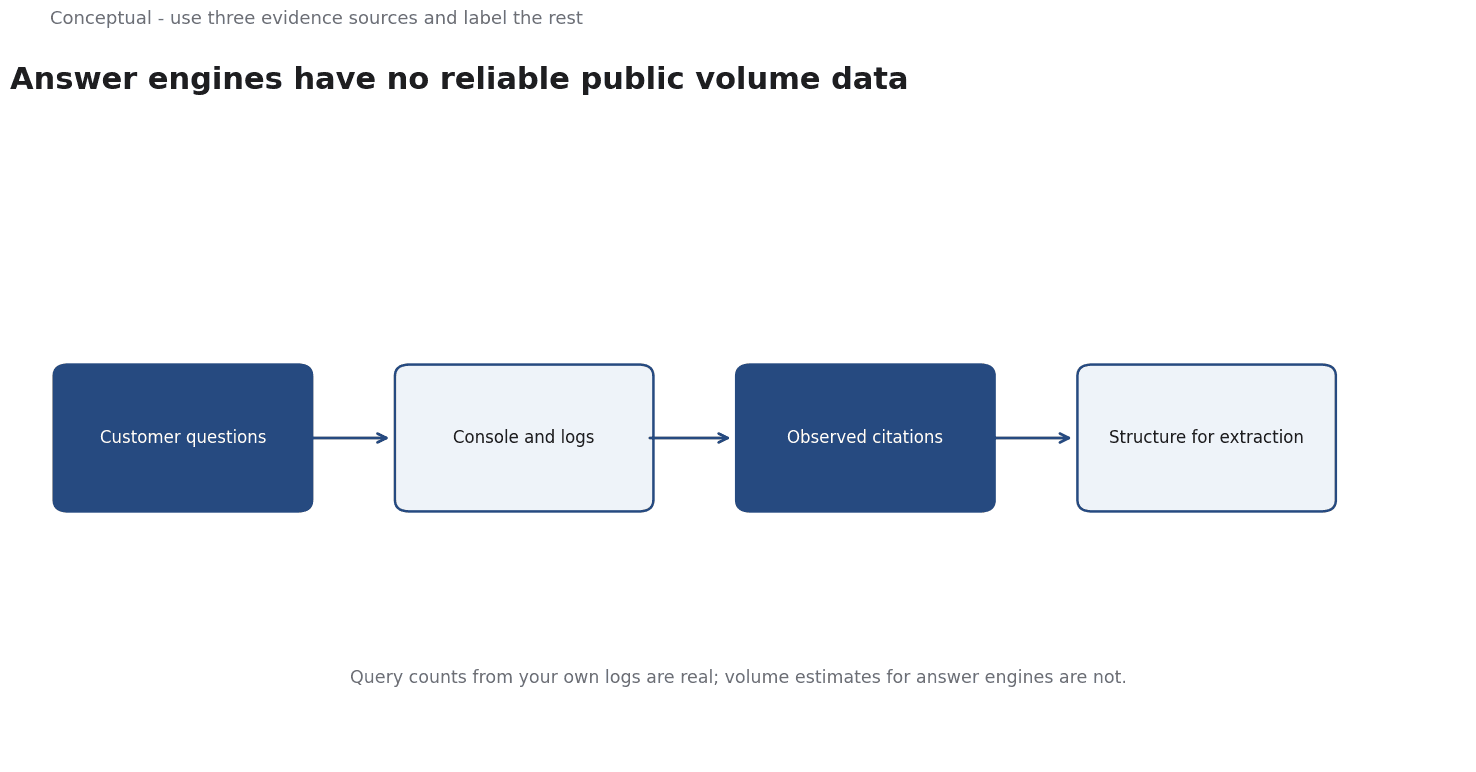
Use three evidence sources — questions your own customers ask, queries visible in search console or server logs, and the citation patterns you can observe in answer engines — then structure content so a specific claim is easy to extract and verify.
AAPOR's standards apply to any survey-based question research, and demand-generation principles still govern which decision a piece serves. The boundary: no tactic guarantees an AI citation, and no tool can currently give you a trustworthy volume number for answer-engine queries.
What can and cannot be observed
Observable: the questions that arrive in your support inbox, the queries that bring visitors to your site, the sources an answer engine cites when you ask a question, and changes in referral traffic from answer platforms.
Not observable with confidence: how many people asked a question inside an answer engine, which answers they saw, or whether a citation changed their behaviour. Any tool claiming precise numbers here deserves scrutiny. The measuring-GEO article covers what can actually be counted.
Three consequences follow:
- Use observed questions as the primary input. They are real, denominated by your own traffic, and tied to decisions your business cares about.
- Treat answer-engine citations as directional. A citation today does not imply one tomorrow, and the selection mechanism is not fully public.
- Do not invent volume figures. A keyword list with made-up numbers is worse than one with none.
A worked example of topic selection
The following is hypothetical and illustrative.
A company sells billing software. It gathers 300 questions from support tickets and 200 query strings from search console over a month. After removing duplicates, three candidate topics emerge:
- "How do I reconcile invoices with payments?" — 40 support tickets, 900 search queries.
- "Best billing software for small teams" — 5 support tickets, 2,000 search queries.
- "What is a credit note versus a refund?" — 60 support tickets, 300 search queries.
Three decisions follow:
- Weight by decision proximity, not volume alone. The comparison query has the highest volume and the lowest support frequency. It serves buyers already in a decision, which may be valuable — but it is also the most competitive and the least differentiated.
- Weight by evidence you can provide. The reconciliation question is one the company can answer with real product data and a worked example. That makes a defensible, extractable answer more likely.
- Check the answer-engine surface. Ask the question in the engines you care about and note which sources are cited. If authoritative accounting sites dominate, a vendor answer needs to be exceptionally specific to be chosen.
Three conclusions follow:
- Pick the reconciliation topic first. It has real demand, a decision context, and evidence you uniquely possess.
- Structure the answer for extraction — a direct answer, a worked example with numbers, and a clear statement of scope.
- Record the method, so the choice can be reviewed when the data changes.
Structuring for extraction
An answer engine is more likely to use a passage that is self-contained and specific. Four habits help:
Answer the question in the first sentence. A direct statement is easier to extract than a paragraph that builds to one.
Include sourced numbers with their context. A figure with a denominator, date, and unit is more defensible than a round claim.
State the boundary. "This applies to X, not Y" gives the engine a precise scope and gives a reader a reason to trust the answer.
Use clear headings that match the question. A heading phrased as the query helps both the engine and the reader locate the relevant passage.
None of these guarantees inclusion. They make the content easier to use if a system chooses to cite it, which is the honest claim.
What the method cannot promise
No citation guarantee. Answer-engine selection is not fully documented, and a tool that promises inclusion is promising something it cannot control.
No stable volume.
Keep the distinction explicit.
No lasting advantage. A format that works today may not work after the engine changes. Re-check the observable signals periodically.
The counterargument — that if it cannot be measured it should not be done — is too strong.
Content that answers real customer questions has value independent of AI citations.
The method simply prevents that value from being overstated.
A decision test
- Gather questions from your own channels with a stated time window.
- Weight by decision proximity and evidence availability, not volume alone.
- Inspect the answer-engine surface for the source types it cites.
- Answer directly in the first sentence of the relevant section.
- Include sourced numbers with denominators and dates.
- State the scope of the answer explicitly.
- Re-check the observable signals when the engine or your data changes.
For the limits of the metric, see Measuring GEO; for the crawler context, see AI Crawlers Are Not Googlebot.
References & Further Reading
- Wikipedia contributors, 2026. Demand generation - Wikipedia — An overview of demand generation as a marketing discipline distinct from lead generation; secondary reference used with the lead-generation entry.
- American Association for Public Opinion Research, 2026. AAPOR — The professional association for public opinion and survey research; its standards and resources underpin the survey-design discussion.