Last-mile Delivery Explained
The last mile is the most expensive leg. Read why, a worked example, and why a faster promise can cost more than it earns.
The last mile — the final leg from a local facility to the customer — is expensive because it is fragmented, time-sensitive, and hard to consolidate. The last-mile entry explains the structure, as Reverse Logistics Best Practices treats returns as a second flow back, as Supply Chains Metrics that Matter treats service level and cost as the operating metrics.
Direct answer:
Manage last-mile delivery by balancing speed, density, and cost per drop, with explicit rules for failed deliveries and returns.
The last-mile entry provides the structure, and reverse logistics covers the return flow. The boundary: this is educational orientation, not a guarantee — local conditions and carrier terms differ, as the industry lens requires scope and limits, as the publication standard forbids guaranteed outcomes.
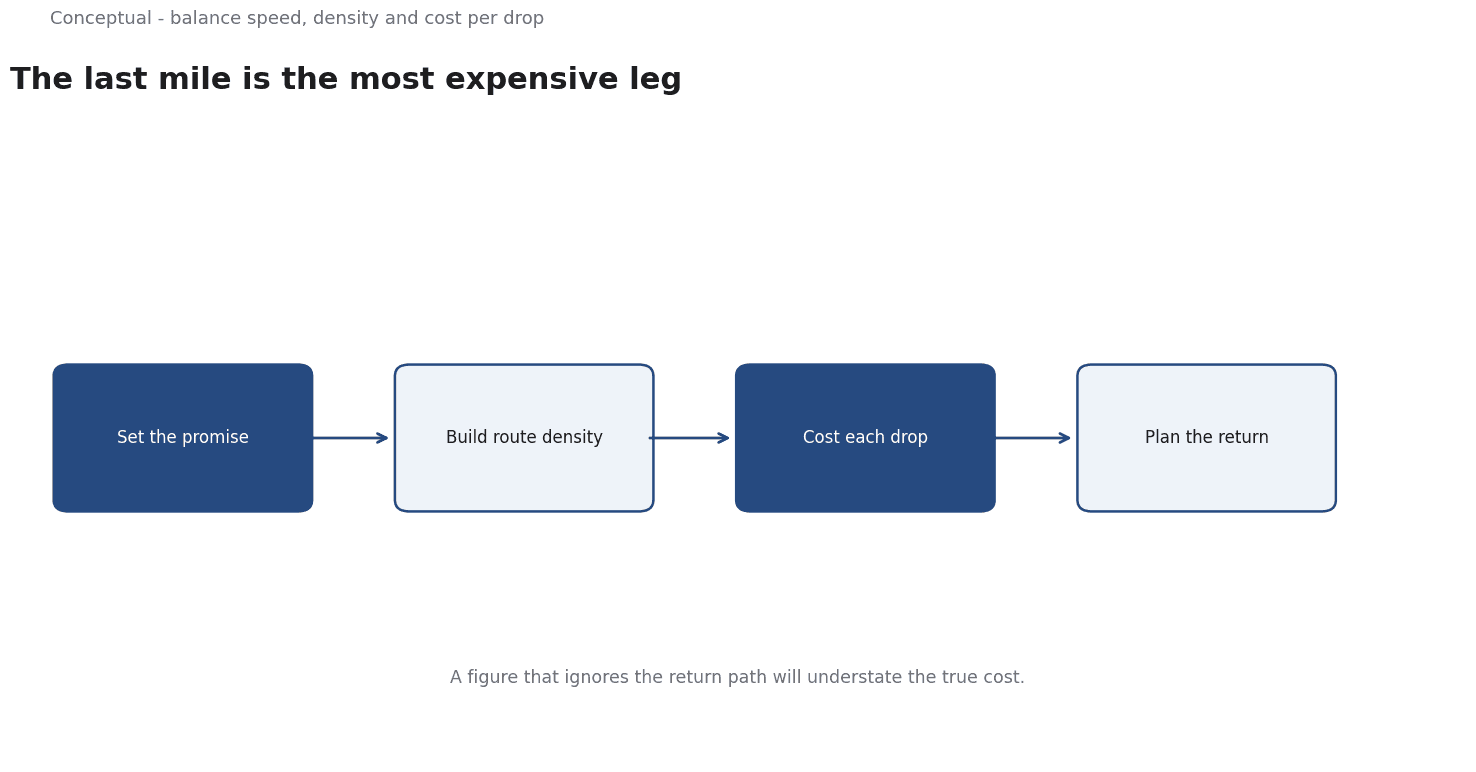
The economics
Cost per drop. Stop density determines how much time is spent driving versus delivering, which the last-mile entry treats as the core of the problem, as the unit-economics article requires for contribution, as the cash-flow article requires for the cash actually spent.
Failed delivery. A missed handoff repeats the trip, which the last-mile entry treats as a source of cost, as Reverse Logistics Best Practices describes the return path, as the service-level literature treats reliability as a metric.
Speed versus cost. A faster promise can reduce conversion friction and raise cost, which the value-proposition article treats as a buyer consideration, as the trade-off analysis requires, as the decision-memo article requires for a recorded judgement.
Returns. A return is a second journey, which reverse logistics describes, as the returns article treats the operational flow, as the inventory article treats the returned stock as cash.
Three consequences follow. The cost should be measured per drop and per successful delivery, as the unit-economics article requires, as Supply Chains Metrics that Matter advises for metrics. The return path should be designed, as Reverse Logistics Best Practices advises. And the service promise should be tested, as the evaluation-rubric article requires, as the monitoring article advises for review.
A worked example
The following is hypothetical and illustrative. An retailer offers same-day delivery in a city with sparse orders.
Three checks decide. First, what is the cost per successful delivery including failed attempts, as the last-mile entry and unit-economics article require, as the cash-flow article requires for cash spent? Second, how are returns handled, as the reverse-logistics and returns articles advise, with the stock treated as cash, as the inventory article requires? Third, does the speed promise change conversion enough to cover the cost, as the value-proposition and trade-off articles require, with a measured comparison, as the rubric article requires?
Three conclusions follow. Sparse density can make a fast promise expensive, which the cost check reveals. Returns need a designed path, as Reverse Logistics Best Practices advises. And the decision should be recorded with the trade-off, as the decision-memo article requires.
Why the measure changes the decision
A team that tracks average delivery time will optimise for the fastest routes, while a team that tracks cost per successful delivery will optimise for density and fewer failed attempts. These can point to different choices, which the unit-economics article treats as contribution, as the dashboard article argues for metrics tied to decisions, as the evaluation-rubric article requires for concrete criteria. The measure should follow the decision the business is trying to make, which the decision-memo article requires for a recorded judgement.
The same issue appears with returns. Counting returns as a service metric misses that each one is a second journey and a stock decision, which the reverse-logistics and inventory articles explain, as the cash-flow article requires for the cash involved.
What last-mile analysis cannot do
It cannot guarantee a delivery experience, which the publication standard forbids claiming, as the last-mile entry treats the conditions as local, as the risk-assessment article requires residual risk. It does not remove the need for demand signal, which the supply-chain article advises, as the demand-forecasting article treats as metric choice. And it cannot fix a weak value proposition, which the value-proposition article treats as prior, as the positioning article argues for direction.
The counterargument that faster is always better is fair for conversion and incomplete for cost, which the worked example shows, as the unit-economics article requires for contribution.
A decision test
- Measure cost per successful delivery, as the unit-economics article requires.
- Account for failed attempts, as the last-mile entry advises.
- Design the return path, as Reverse Logistics Best Practices advises.
- Test the speed promise against conversion, as the rubric article requires.
- Use dated local conditions, as data governance requires.
- Treat the service level as a metric, as Supply Chains Metrics that Matter advises.
- Record the decision and review on change, as the decision-memo article requires.
For the return flow, see Reverse Logistics Best Practices; for the metrics, see Supply Chains: Metrics That Matter.
References & Further Reading
- Wikipedia contributors, 2026. Last mile (transportation) - Wikipedia — The final leg of delivery to the end customer.
- Wikipedia contributors, 2026. Reverse logistics - Wikipedia — Overview of product returns, reusable packaging and unsold-goods flows; secondary reference used with NRF and Census data.