Reverse Logistics Best Practices
Returns are a second supply chain. Read the practices, a worked example, and why a refund is not the end of the process.
Reverse logistics is often treated as an afterthought to the sale, which ignores that it is a second supply chain with its own costs. The Wikipedia entry describes the flow of goods back from customers, and the inventory entry treats stock as cash. The practices start with knowing what comes back and why.
Direct answer: Manage returns with clear reasons, fast disposition, and a record of cost, then feed the reasons back into the forward chain. The sources describe the flow; the practices are a synthesis.
Delta: This article adds a claim-status table and a worked example, separating documented flow concepts from local choices about disposition.
The mechanism
The first practice is capturing reasons. The reverse-logistics entry describes goods moving back, but a return without a reason is a cost with no information. Structured reasons turn each return into evidence about sizing, quality, or expectation. A short set of categories, consistently applied, is more useful than a long free-text field nobody reads.
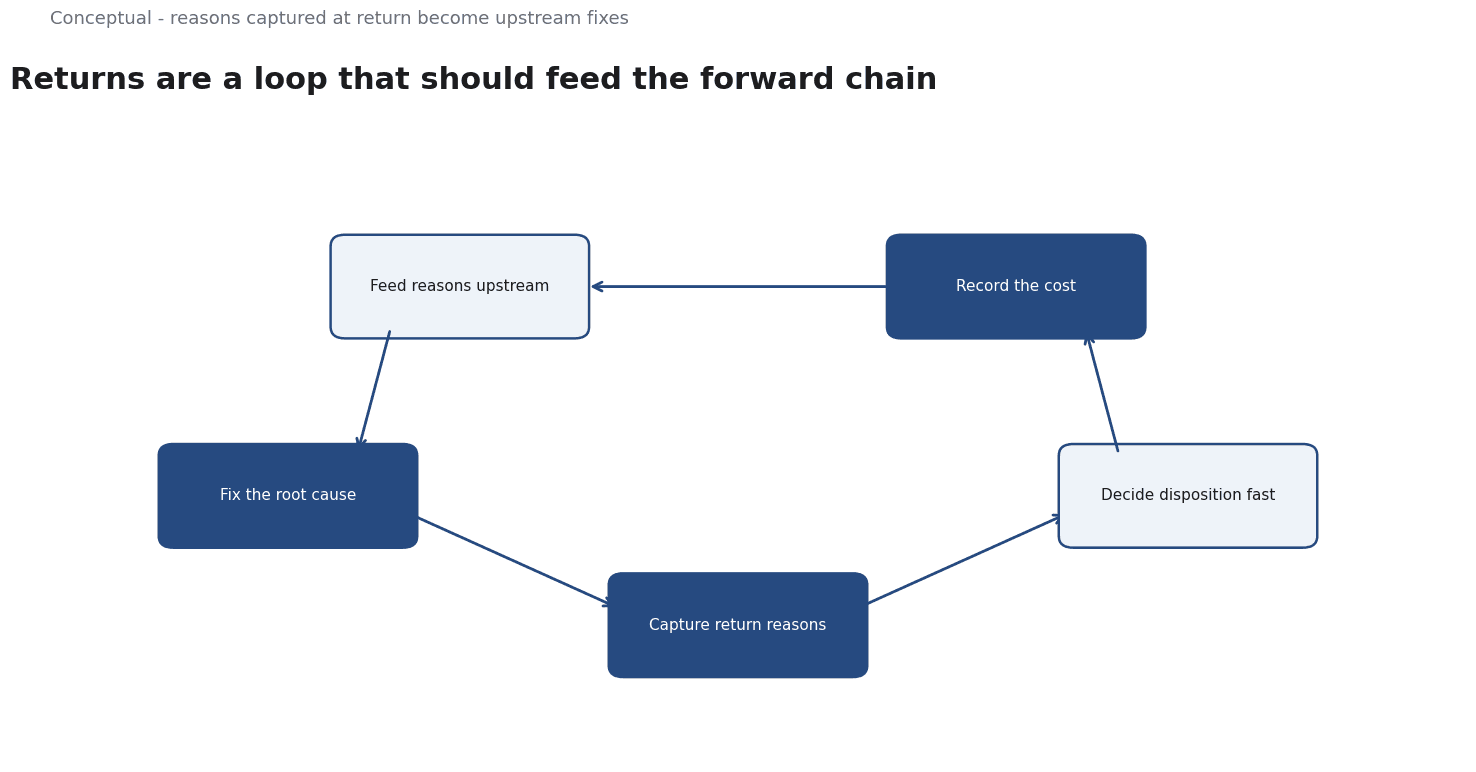
The second practice is disposition speed. A returned item that sits in a warehouse is cash tied up in the wrong place. The inventory entry treats stock as cash, which applies double to returned stock whose value is falling. Deciding quickly whether an item is resalable, refurbished, or disposed of is the operational lever.
The third practice is the feedback loop. Returns often reveal a problem upstream: a wrong size, a damaged package, or a misleading description. Feeding the reasons back to the relevant team is what prevents the same returns from recurring. Without that loop, reverse logistics is a cost centre rather than a source of learning.
The sequence is: capture reasons, decide disposition quickly, record the cost, then feed the reasons back.
Each step is local work, so the conclusions are inferred; the flow is source-reported.
A worked example
Illustrative. A retailer sees returns rise in one category.
Three checks decide. First, do the recorded reasons point to a specific cause, such as sizing or damage? Second, how quickly is returned stock dispositioned, and what is the carrying cost while it waits? Third, has the reason been fed back to the team that controls the cause?
The outcome is a targeted change rather than a general returns policy. The scenario is hypothetical; the method is the contribution.
Evidence status
| Claim | Status | Source | Verified | Recheck when |
|---|---|---|---|---|
| Reverse logistics is the flow of goods back | source-reported | Wikipedia, Reverse logistics | 2026-11-18 | Definition changes |
| Inventory ties up cash | source-reported | Wikipedia, Inventory | 2026-11-18 | Accounting changes |
| Capture reasons and feed them back | inferred | Derived from the flow | 2026-11-18 | Product changes |
Why the refund is not the end
A refund closes the customer's account of the transaction, but the item still has to be inspected, moved, and dispositioned. That second journey determines much of the cost, and it is invisible if the process is measured only by refund speed.
A final constraint is that returns data is often incomplete, because customers do not always give a reason and staff may categorise inconsistently.
The process should also be reviewed when products change. A category that previously had few returns can develop a problem after a design change, and a reason code that was rare can become common. Watching the trend by product is the control.
The disposition rule should be written where the returns team can apply it, not in a policy nobody reads.
A return can arrive long after the sale, which means the reason data must stay usable across that interval.
The cost of a return should include the time it spends waiting for a decision.
The flow back should be measured as carefully as the flow out, because the costs are just as real.
A return without a reason is a cost with no information.
What it cannot do
It cannot turn unsold returns into demand. It does not remove the need to fix the cause. And it cannot guarantee that a returned item retains its value.
The counterargument that a generous returns policy is always good for sales is fair for conversion and incomplete for the cost that follows.
A decision test
- Capture structured reasons.
- Decide disposition quickly.
- Record the cost.
- Feed reasons back upstream.
- Track recurrence.
- Record the decision and recheck date.
For the related view, see Supply Chain Metrics.
References & Further Reading
- Wikipedia contributors, 2026. Reverse logistics - Wikipedia — Overview of product returns, reusable packaging and unsold-goods flows; secondary reference used with NRF and Census data.
- Wikipedia contributors, 2026. Inventory - Wikipedia — The role of stock in operations and accounting.