LCP Optimization Pitfalls
LCP measures the largest paint, not the whole experience. Read the common traps, a worked diagnosis, and why a better score can miss the problem.
Largest Contentful Paint is often chased as a single number, which produces fixes that move the metric without improving the experience. The Web Vitals material defines the metric, as the font-display reference covers one common source of late painting, as the Core Web Vitals article treats the metrics as a set, as Web Performance from DNS to Browser: Find the Slow Layer advises on finding the slow layer, as the monitoring article advises for review.
Direct answer:
Diagnose LCP by identifying which element is the largest paint and what delays it, then fix that specific path and re-measure.
Web Vitals defines the metric, and MDN covers font loading. The boundary: a good score does not guarantee a fast experience in untested conditions, which the web-performance article warns about realistic connections, as the publication standard forbids performance guarantees.
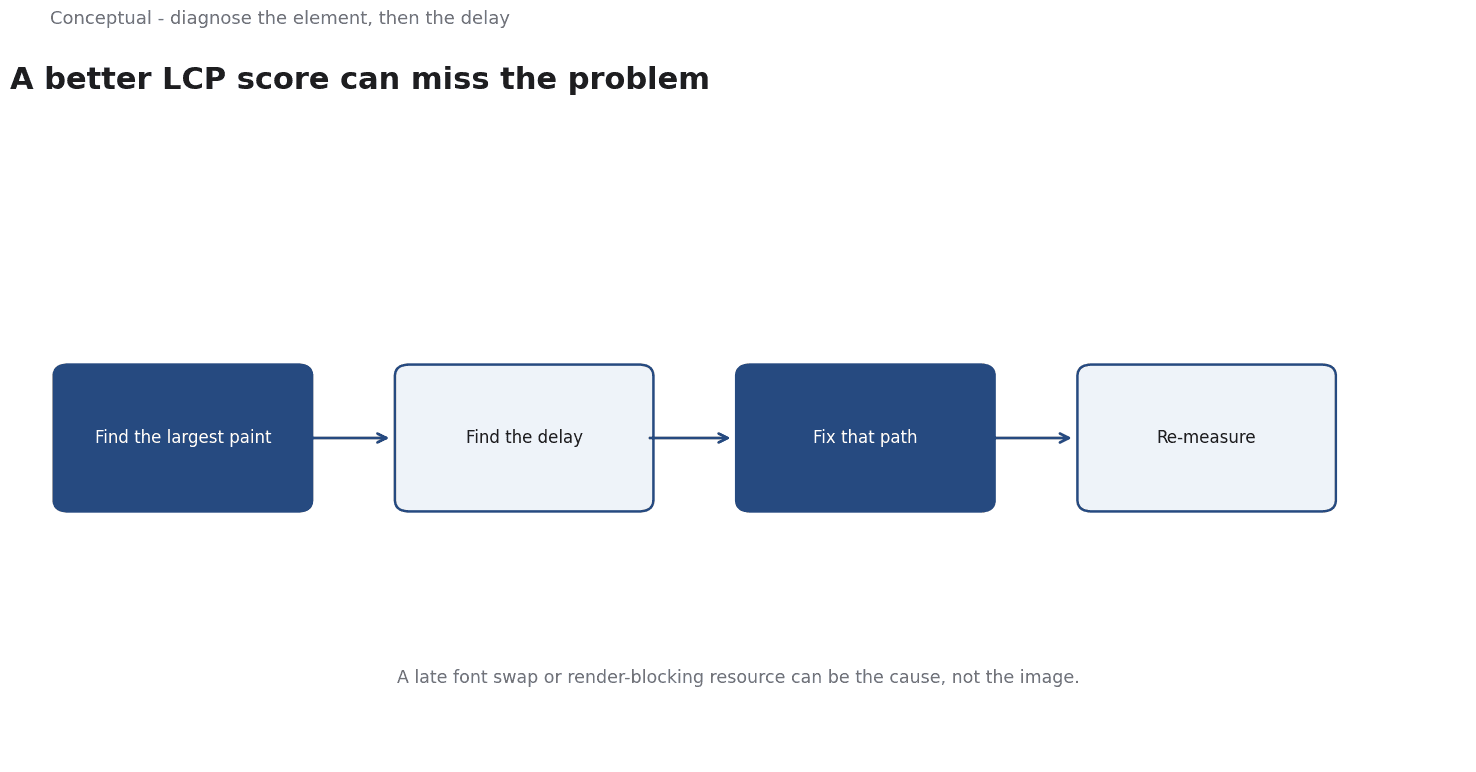
The pitfalls
Optimising the wrong element. The largest paint may be a hero image or a text block, which the Core Vitals article explains, as Web Performance from DNS to Browser: Find the Slow Layer advises for tracing, as the evaluation-rubric article requires for concrete criteria, as the decision-memo article requires for a recorded judgement.
Testing on a fast connection. Resources that arrive instantly locally may arrive late for users, which the web-performance article requires you to account for, as the mobile-first article explains device constraints, as the benchmarks article warns about conditions, as the data-governance article requires for dated context.
Chasing the aggregate. A single score hides which element and which connection, which the evaluation-rubric article warns about metrics without dimensions, as the dashboard article argues for metrics tied to decisions, as the observability article treats signals as evidence, as the monitoring article advises for review.
Three consequences follow. The element should be identified, as the Core Vitals article advises, as the tracing method recommends, as the rubric article requires. The fix should target the cause, as Web Performance from DNS to Browser: Find the Slow Layer advises, as the font-display and image articles explain, as the third-party-scripts article advises. And the result should be re-measured, as the monitoring article advises, as the decision-memo article requires for a record.
A worked diagnosis
The following is hypothetical and illustrative. A page has a high LCP and a large hero image that loads late.
Three checks decide. First, which element is the largest paint, as the Core Vitals article advises, with a trace, as the tracing method recommends, as the rubric article requires? Second, what delays it — image loading, font swap, or a third-party script, as the image, font-display, and third-party-scripts articles advise, with the slow layer, as Web Performance from DNS to Browser: Find the Slow Layer advises? Third, does the fix improve the score on a realistic connection, as Web Performance from DNS to Browser: Find the Slow Layer requires, with a re-measurement, as the monitoring article advises, as the decision-memo article requires for a record?
Three conclusions follow. The element and cause come from the trace, which the checks reveal. A font or script can be the real cause, as the font-display and third-party articles advise. And the result should be recorded, as the decision-memo article requires, as the monitoring article advises for review.
What LCP diagnosis cannot do
It cannot guarantee a score under other conditions, which the publication standard forbids claiming, as Web Performance from DNS to Browser: Find the Slow Layer warns about realistic connections, as the benchmarks article warns about broad results. It does not measure the whole experience, which the Core Vitals article treats the metrics as a set, as the CLS and INP articles cover other dimensions, as the rubric article requires for concrete criteria. And it cannot replace the trace, which the tracing method advises, as the observability article treats signals as evidence, as the diagnostic article advises for verification.
The counterargument that the score is the whole story is fair as a summary and incomplete as a diagnosis, which the worked example shows, as the Core Vitals and tracing articles advise.
A decision test
- Identify the largest paint element, as the Core Vitals article advises.
- Trace what delays it, as the tracing method recommends.
- Check image, font, and script causes, as those articles advise.
- Test on a realistic connection, as Web Performance from DNS to Browser: Find the Slow Layer requires.
- Re-measure after the fix, as the monitoring article advises.
- Record the decision, as the decision-memo article requires.
- State residual uncertainty, as the risk article requires.
For the metric set, see Core Web Vitals; for the method, see Web Performance.
References & Further Reading
- web.dev, 2026. Web Vitals — The Core Web Vitals thresholds and what each metric measures.
- MDN Web Docs, 2026. font-display CSS at-rule descriptor - CSS | MDN — Reference for the font-display descriptor and its effect on text rendering during font loading.