Lead Scoring Explained
A lead score ranks attention, not intent. Read how scoring works, a worked example, and why a model can encode the past's mistakes.
Lead scoring assigns a number to a prospect so a sales team can decide where to spend time. The lead-generation entry describes the stages before a purchase, and the CRM entry covers systems that hold customer records. The difficulty is that a score is a prediction built from past behaviour, not a measurement of current intent.
Direct answer:
Score leads against a defined outcome, using only signals available at scoring time, and verify the ranking against later results.
The sources describe the stages and the system; the verification rule is a synthesis.
Delta: This article adds a claim-status table and a worked calibration example, separating the documented purpose of scoring from the local choices that decide whether it works.
The mechanism
Three properties shape a scoring system:
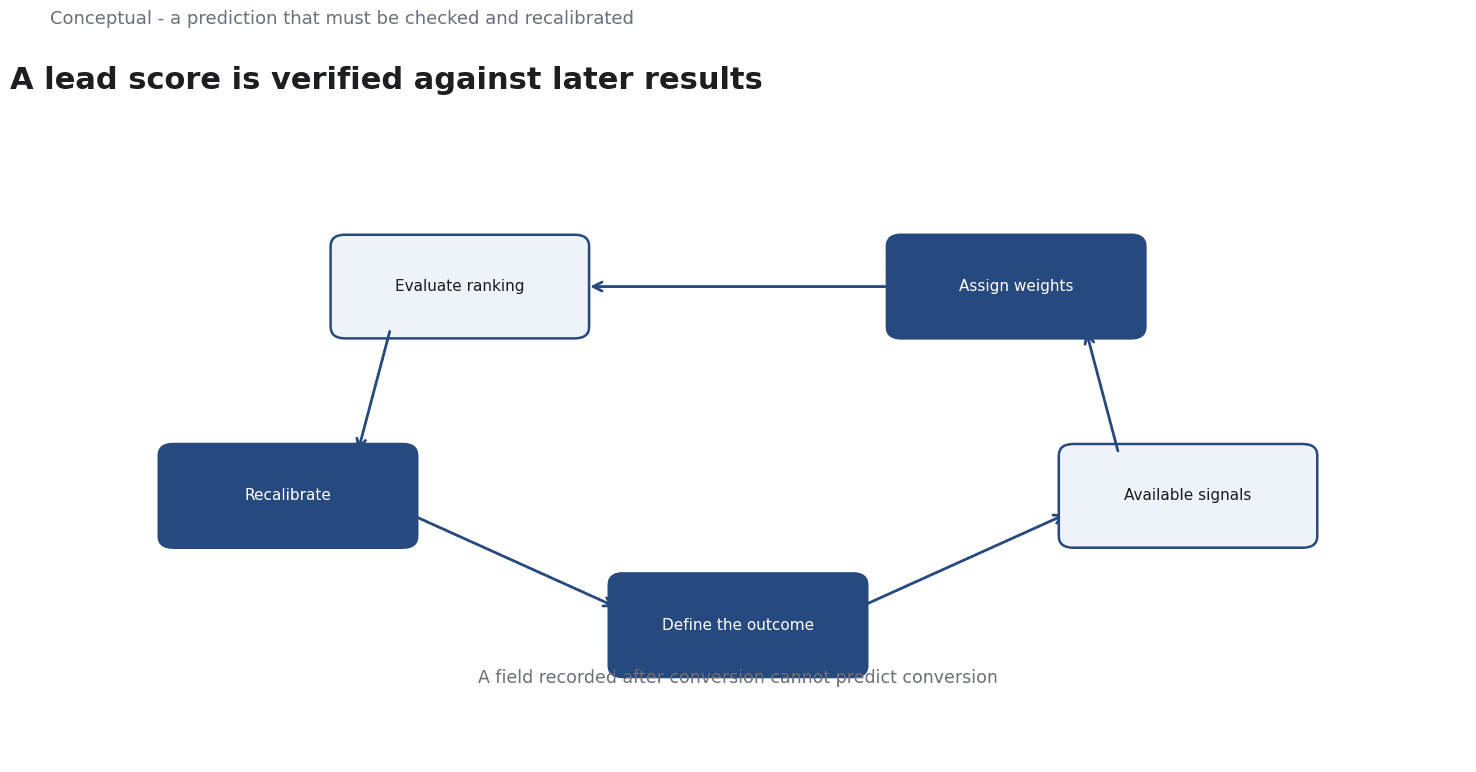
- The target must be defined. A score that predicts "engagement" is not the same as one that predicts a closed deal. The lead-generation entry describes the stages; the choice of stage is local.
- Features must be available at the time of scoring. A field recorded after conversion cannot be used to predict conversion. This is a leakage problem, not a modelling detail.
- The ranking must be checked. A score is useful only if high scores correspond to better outcomes. Checking that correspondence requires later results joined back to earlier scores.
The sequence is: define the outcome, choose available signals, assign weights, then evaluate the ranking. Choosing the outcome is judgement, so it is inferred; the existence of stages and records is source-reported.
A worked example
Illustrative. A team scores leads using email opens, company size, and a form field.
Three checks decide. First, is the target a completed purchase or a meeting, and was it recorded consistently? Second, were all three signals available before a salesperson contacted the lead, or did one of them come from later activity? Third, when the scores are compared with outcomes from the previous quarter, do the top-ranked leads actually convert more often?
The outcome is a recalibration decision, not a new tool. The numbers are hypothetical; the verification method is the contribution.
Why a score needs a target before a model
A scoring model is only as good as the outcome it was built to predict. Teams often begin with the signals they already have — opens, clicks, company size — and then look for an outcome that correlates with them. That order invites self-fulfilling scores: the model learns who replied to email, not who became a customer.
Starting with the outcome forces a different conversation. A meeting is easier to predict than a closed deal, and it is also easier to act on, because a salesperson can do something with it. If the goal is revenue, the score must be evaluated against revenue, with a window long enough for deals to close. Choosing a shorter proxy without saying so makes the model look accurate while leaving the business question unanswered.
The timing of signals is the second discipline. Every input must be available at the moment the score is used. A field filled in by a salesperson after a discovery call is a result, not a predictor. Removing these fields usually lowers the reported accuracy, which is a useful sign that the previous number was measuring the future rather than forecasting it.
Evaluation should be a regular event. Scores drift when the product, pricing, or market changes. A simple check — does the top-scored group convert better than the bottom-scored group this quarter — is often enough to detect a problem before it becomes expensive. The result belongs in the same record as the model definition, with a date and a recheck condition.
Evidence status
| Claim | Status | Source | Verified | Recheck when |
|---|---|---|---|---|
| Lead generation describes stages before purchase | source-reported | Wikipedia, Demand generation | 2026-11-18 | Definition revised |
| CRM systems hold customer records | source-reported | Wikipedia, CRM | 2026-11-18 | System changes |
| Verify the score against later outcomes | inferred | Derived from prediction logic | 2026-11-18 | Target changes |
Why scores drift
A model trained on past conversions learns the patterns of that period. When the product, pricing, or market changes, the patterns change with them. A score that was well calibrated last year can rank the wrong leads today, and nothing in the interface will signal the drift.
Leakage is the other common failure.
Removing such fields usually lowers the apparent accuracy and improves the real decision.
What it cannot do
It cannot create intent. It does not replace a salesperson's judgement about fit. And it cannot guarantee that a high-scoring lead will buy.
The counterargument that a complex model is more accurate is fair on historical data and incomplete when the underlying market moves.
A decision test
- Define the outcome.
- List signals available at scoring time.
- Remove post-outcome fields.
- Check ranking against later results.
- Recalibrate on a schedule.
- Record the target and the recheck date.
For the system context, see CRM Marketing Trade-offs.
References & Further Reading
- Wikipedia contributors, 2026. Lead generation - Wikipedia — The definition of lead generation, inbound versus outbound methods, and the role of content and forms; secondary reference.
- Wikipedia contributors, 2026. Customer relationship management - Wikipedia — Systems for managing customer relationships.