Media Planning: Common Questions
A media plan allocates attention across channels. Read the common questions, a worked plan, and why reach is not the same as effect.
Media planning is often reduced to buying reach, which ignores the audience and the outcome. The Wikipedia entry describes selecting channels and scheduling, and the demand-generation entry covers the stages before purchase. The plan should follow the decision it supports.
Direct answer: Build a media plan from the audience, the outcome, and a measurement design, then allocate across channels with a stated reason. The sources describe the channel and the stages; the planning rule is a synthesis.
Delta: This article adds a claim-status table and a worked plan, separating documented channel facts from local choices about allocation.
The mechanism
Three points matter:
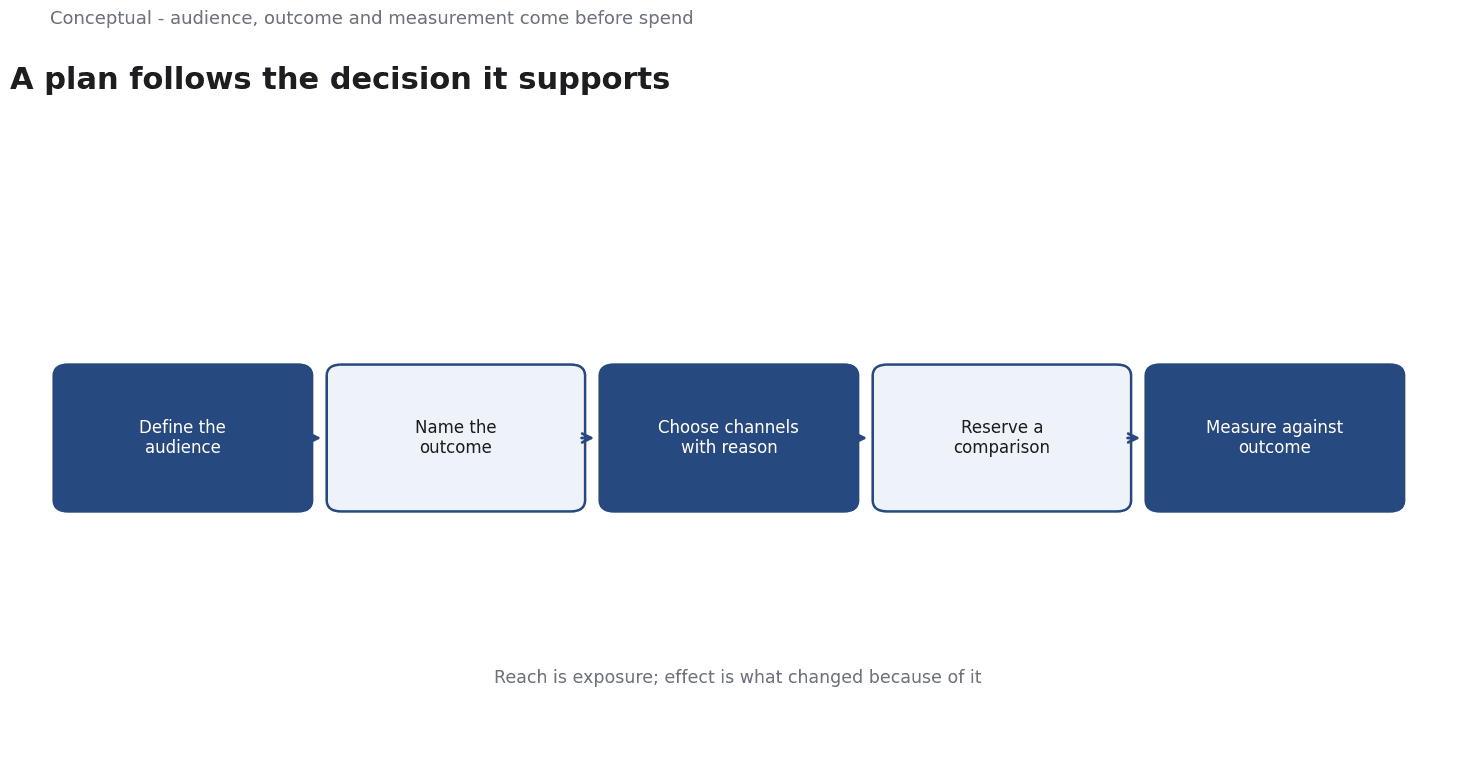
- Audience before channel. The media-planning entry describes selecting channels. A channel with broad reach may not contain the people the plan needs.
- Outcome before metric. The demand-generation entry describes stages. Awareness and conversion require different channels and different measures.
- Measurement before spend. A plan without a comparison cannot tell whether the campaign worked. The causal-inference distinction applies here.
The sequence is: define the audience, name the outcome, choose channels, then design the measurement.
The choices are local judgement, so they are inferred; the channel description is source-reported.
A worked plan
Illustrative. A product launch wants qualified visits, not just impressions.
Three checks decide. First, which channels contain the intended audience? Second, what outcome defines success, and how will it be separated from background demand? Third, what share of the budget is reserved for a comparison rather than spent on reach?
The outcome is an allocation with a measurement rule. The scenario is hypothetical; the method is the contribution.
Why the audience definition drives the plan
Defining the audience first reverses that logic. It also makes the channel choice explainable: a channel is selected because it reaches the people who matter, not because it has a large number attached to it.
What comparison means in a plan
A plan that spends its entire budget on exposure has no way to tell whether the exposure changed anything. Reserving a portion for a comparison — a holdout, a different period, or a matched group — is the cost of learning. It reduces reach in the short term and improves the next plan, which is the trade the measurement budget buys.
Evidence status
| Claim | Status | Source | Verified | Recheck when |
|---|---|---|---|---|
| Media planning involves channel selection and scheduling | source-reported | Wikipedia, Media planning | 2026-11-18 | Practice changes |
| Demand generation describes stages before purchase | source-reported | Wikipedia, Demand generation | 2026-11-18 | Definition revised |
| Allocate from outcome and measurement | inferred | Derived from the planning purpose | 2026-11-18 | Goal changes |
Why reach is not effect
Reach describes how many people were exposed. Effect describes what changed because of the exposure. A plan that reports only reach cannot answer the second question, which is the one the budget was meant to buy.
A final consideration is that channel performance is not stable. A channel that works at a small budget can saturate as spend grows, and the marginal return falls. A plan based on early results can therefore overcommit to a channel that looked excellent only at low volume. Testing at the intended scale, or at least modelling saturation, is part of a defensible allocation.
The plan also needs a review condition. Audience behaviour, platform rules, and prices change, and a plan that is never revisited becomes a habit. Recording when the allocation was decided and what would trigger a review keeps the plan connected to its purpose.
Another constraint is that attribution windows differ across platforms, which makes their reports hard to compare. A sale credited within a day on one platform and within a week on another will produce different totals for the same campaign. Aligning windows before comparing is a small technical step that prevents a large interpretive error.
The plan should also name who owns its revision. A document with no owner will be reused after its assumptions have expired, which is how a sound plan becomes an obsolete one. Assigning responsibility is part of planning, not an afterthought once the budget is spent.
A plan that is never revised is a record of an old decision rather than a guide to current spending.
What it cannot do
It cannot guarantee that a channel will perform. It does not remove the need for creative quality. And it cannot prove causation from a credit rule.
The counterargument that maximum reach is safest is fair for broad awareness and incomplete for a specific outcome.
A decision test
- Define the audience.
- Name the outcome.
- Choose channels with a reason.
- Reserve budget for comparison.
- Measure against the outcome.
- Record the plan and recheck date.
For the measurement, see Campaign Measurement.
References & Further Reading
- Wikipedia contributors, 2026. Media planning - Wikipedia — Selecting channels and scheduling advertising.
- Wikipedia contributors, 2026. Demand generation - Wikipedia — An overview of demand generation as a marketing discipline distinct from lead generation; secondary reference used with the lead-generation entry.