Meeting Culture for Beginners
A meeting is a way to do work together, not a calendar obligation. Read the basics, a worked example, and why a status update is not a meeting.
Meeting culture is often inherited rather than designed, which is why teams accumulate recurring events nobody can justify. The Wikipedia entry describes meetings as structured gatherings, and re:Work treats team practices as something to examine. The question is what a meeting does that writing cannot.
Direct answer: Keep a meeting only when it changes a decision or resolves a conflict in real time; move status and information to written artefacts. The sources define meetings and team practice; the rule is a synthesis.
Delta: This article adds a claim-status table and a worked review, separating the documented format from the local decision about what belongs in a meeting.
The mechanism
Three tests matter:
- Decision. The decision-making literature describes an owner and evidence. A meeting that ends without either has not done its job.
- Interaction. A meeting is useful when the exchange itself matters — disagreement, ambiguity, or a decision that needs several people present.
- Record. A written artefact can carry status and context. Moving that content out of the meeting frees the time for interaction.
The sequence is: name the purpose, test whether writing would do, then define the outcome and the owner.
The test is local judgement, so it is inferred; the meeting format is source-reported.
A worked example
Illustrative. A team has a weekly meeting where each person reports what they did.
Three checks decide. First, is anyone's decision changed by the reports? Second, could the same information be written and read? Third, is there a real conflict or ambiguity that needs a conversation?
If the first two answers are yes and no, the meeting should become a written update, with a short meeting reserved for decisions. The outcome is a redesign, not a cancellation. The scenario is hypothetical; the test is the contribution.
Why the purpose has to be named
A recurring meeting usually begins with a reasonable purpose and outlives it. The format persists because cancelling it feels risky, not because anyone can say what it does. Naming the purpose forces the question: if the purpose cannot be stated in one sentence, nobody can judge whether the meeting is working.
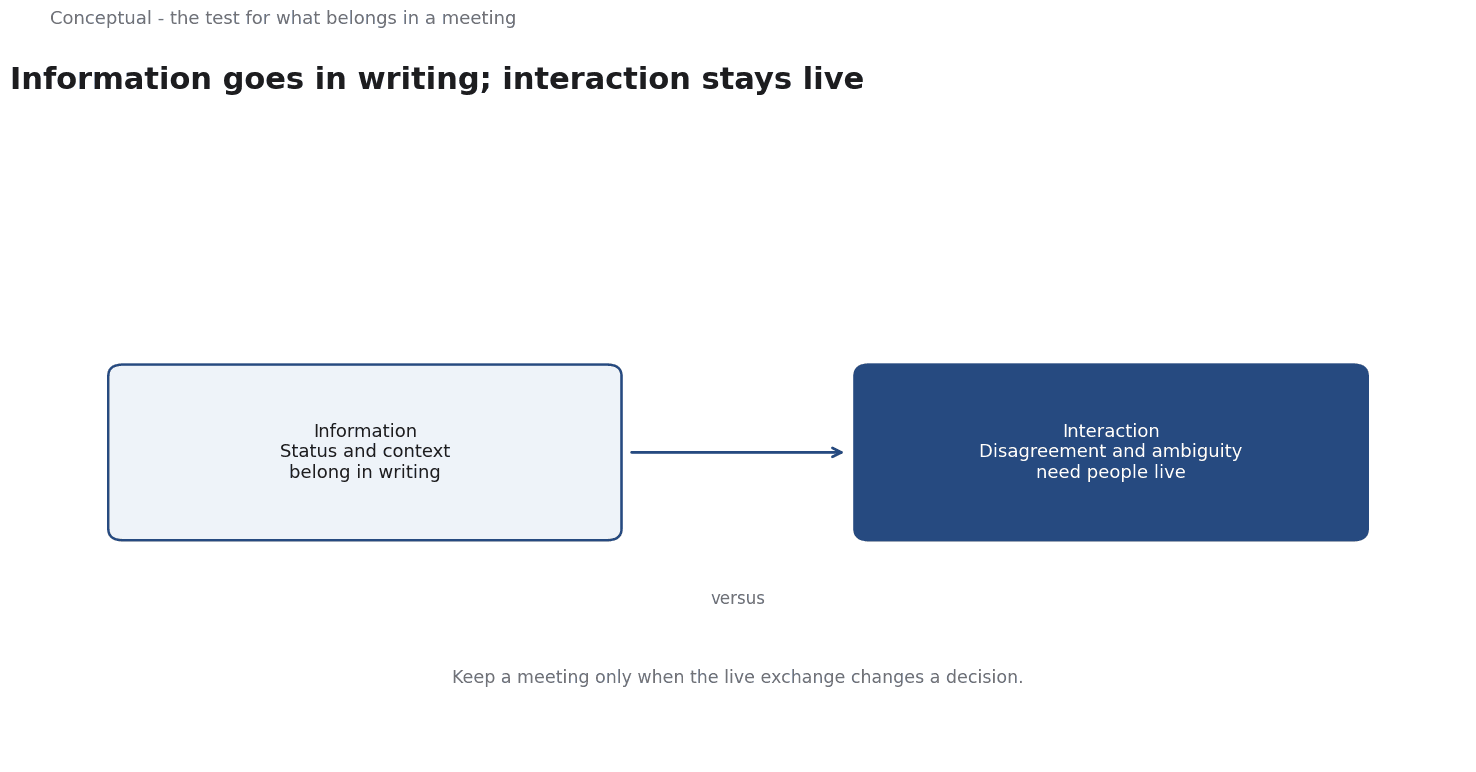
The distinction between information and interaction is the most useful one. Information can be written, read asynchronously, and searched later. Interaction — disagreement, ambiguity, a decision that needs several people — benefits from being live. A meeting that contains only information wastes the live time; a meeting that contains only interaction can be short.
What a good meeting leaves behind
A useful meeting ends with a decision, an owner, and a record. The decision may be to investigate further, which is still a decision. The owner is the person who will act, not everyone present. The record lets someone who was absent understand what happened, which is the test of whether the meeting produced anything durable.
Evidence status
| Claim | Status | Source | Verified | Recheck when |
|---|---|---|---|---|
| Meetings are structured gatherings | source-reported | Wikipedia, Meeting | 2026-11-18 | Definition revised |
| Team practices can be examined | source-reported | Google re:Work | 2026-11-18 | Practice changes |
| Keep meetings for decisions and conflict | inferred | Derived from the two sources | 2026-11-18 | Team changes |
Why status is the wrong content
Status is information, and information travels better in writing, where it can be read at the right time and searched later.
Moving it to a document is not a loss of communication; it is a better match between content and medium.
A final consideration is the cost of context switching. Even a short meeting interrupts the work around it, and several short meetings in one day can remove the possibility of sustained concentration. This is why the decision to keep a meeting should consider not just its duration but where it sits in the day. Moving decisions into a single block can protect the rest of the schedule without cancelling anything.
None of this requires eliminating meetings. It requires treating them as a scarce resource with a purpose, an owner, and a result. Teams that do this often find that the remaining meetings are shorter and more useful, because the content that did not need a room has moved elsewhere.
What it cannot do
It cannot remove the need for human contact. It does not guarantee that a meeting is well run. And it cannot fix a team with no decisions to make.
The counterargument that meetings build trust is fair for a team that never meets and incomplete for a team that meets only to report.
A decision test
- Name the meeting's purpose.
- Test whether writing would do.
- Identify the decision and owner.
- Move status to a document.
- Record the outcome.
- Review the meeting after a change.
For the management context, see Engineering Management.
References & Further Reading
- Wikipedia contributors, 2026. Meeting - Wikipedia — The structure and purpose of meetings.
- Google, 2026. Google re:Work — A large company's published people practices, including hiring and growth frameworks.