Merchandising for Beginners
Merchandising decides what a shopper sees and chooses. Read the basics, a worked example, and why a full display is not a good one.
Merchandising is often treated as making a display attractive, which ignores that it is a decision about what a shopper can find. The Wikipedia entry describes the presentation and promotion of products, and the planogram entry covers shelf placement. The beginning is understanding the choice being influenced.
Direct answer: Merchandise around the decision a shopper makes, with a clear role for each product shown and a measure of whether the arrangement helps. The sources describe the practice; the method is a synthesis.
Delta: This article adds a claim-status table and a worked example, separating documented practice from local choices about assortment.
The mechanism
The first consideration is the shopper's decision. The merchandising entry describes presentation and promotion, which only matter if they affect a choice. A display that looks good but does not help a shopper compare or decide is decoration, and the difference is visible in sales by position.
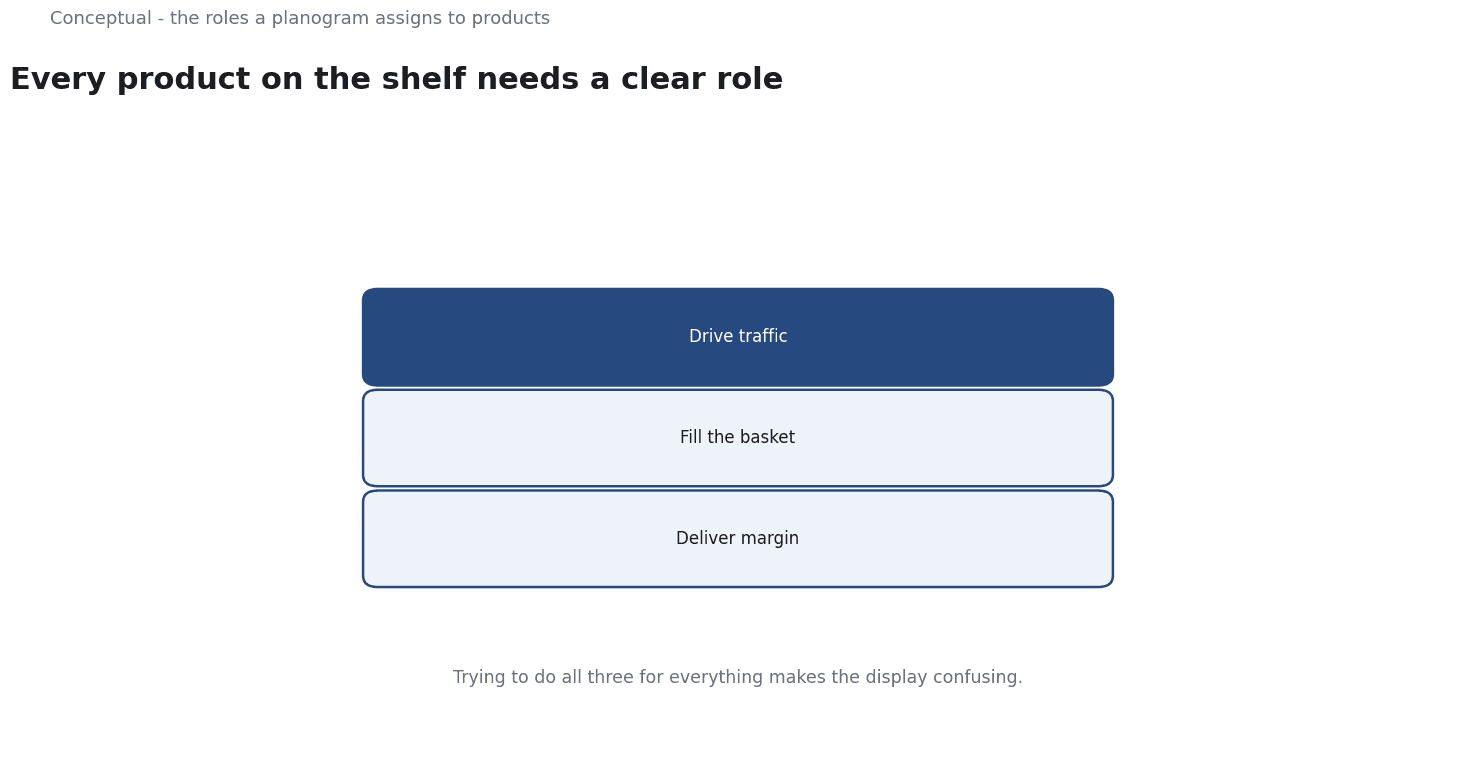
The second consideration is the role of each product. The planogram entry describes shelf placement, which is a scarce resource. A product can be there to drive traffic, to fill a basket, or to deliver margin, and a display that tries to do all three for everything becomes confusing.
The third consideration is availability. An arrangement that assumes products are in stock will fail when they are not, and the shopper's decision is made from what is actually there. Checking availability before judging a display is the practical step.
The sequence is: define the decision, assign roles, arrange, then measure by position.
The choices are local, so the conclusions are inferred; the practice is source-reported.
A worked example
Illustrative. A shop rearranges a category and sees no change in total sales.
Three checks decide. First, did the arrangement make the intended choice easier, measured by what sold from each position? Second, did every product have a clear role, or did the display try to promote everything? Third, were the featured products available throughout?
The outcome is a specific revision rather than a complete redesign. The scenario is hypothetical; the method is the contribution.
Evidence status
| Claim | Status | Source | Verified | Recheck when |
|---|---|---|---|---|
| Merchandising presents and promotes products | source-reported | Wikipedia, Merchandising | 2026-11-18 | Definition changes |
| Planograms specify shelf placement | source-reported | Wikipedia, Planogram | 2026-11-18 | Practice changes |
| Assign roles and measure by position | inferred | Derived from the practice | 2026-11-18 | Assortment changes |
Why a full display can underperform
A smaller set with clear roles reduces the decision cost, which is why more products can produce fewer sales in a category.
A further issue is that merchandising decisions are often copied between stores without checking whether the customers differ. A layout that works in one location can fail in another where the shopping mission is different, and the failure appears as a quiet drop in conversion rather than an obvious error.
The display also has to survive a peak. A category that works on a quiet day can be emptied quickly during a busy one, after which the arrangement no longer represents the intended choice. Planning for availability under load is part of the work, not an afterthought.
A beginner should also recognise that a good result in one period may reflect a promotion rather than the arrangement. Reading the two together is the way to tell whether the merchandising decision or the discount produced the sales.
A display should be judged by the decision it helps, not by how complete it looks.
Availability should be checked before judging a display, since a shopper chooses from what is actually present.
A category should be reviewed by position, since an average can hide a failing shelf.
A display that looks complete can still make the shopper's decision harder.
The roles assigned to each product should be reviewed when the range changes.
Sales by position is the most direct evidence about whether a display helps.
What it cannot do
It cannot create demand for a product nobody wants. It does not fix availability. And it cannot guarantee that a result transfers between stores.
The counterargument that more choice is always better is fair for breadth and incomplete for the decision a shopper must make.
A decision test
- Define the shopper's decision.
- Assign a role to each product.
- Arrange with those roles in mind.
- Check availability.
- Measure by position.
- Record the decision and recheck date.
For the layout, see Planograms.
References & Further Reading
- Wikipedia contributors, 2026. Merchandising - Wikipedia — Presentation and promotion of products in retail.
- Wikipedia contributors, 2026. Planogram - Wikipedia — The placement of products on shelves.