Planograms: a Decision Framework
A planogram is a hypothesis about shopper choice. Read the framework, a worked example, and why a tidy shelf can still underperform.
A planogram specifies where products sit on a shelf. The Wikipedia entry describes the practice, and the inventory entry treats stock as cash. The decision is not tidiness; it is which products a shopper can find and choose.
Direct answer: Build a planogram from a defined objective, verify it with sales by position, and treat each revision as a test rather than a redesign. The source describes the artefact; the test rule is a synthesis.
Delta: This article adds a claim-status table and a worked review, separating the documented practice from the local choices about layout and measurement.
The mechanism
Three points matter:
- Visibility is a resource. The planogram entry describes product placement. Shelf positions differ in how many shoppers see them.
- Stock is a constraint. The inventory entry treats stock as cash. A planogram that assumes unavailable products is a drawing, not a plan.
- Sales by position is the evidence. A layout change should be judged by what moved, not by how the shelf looks.
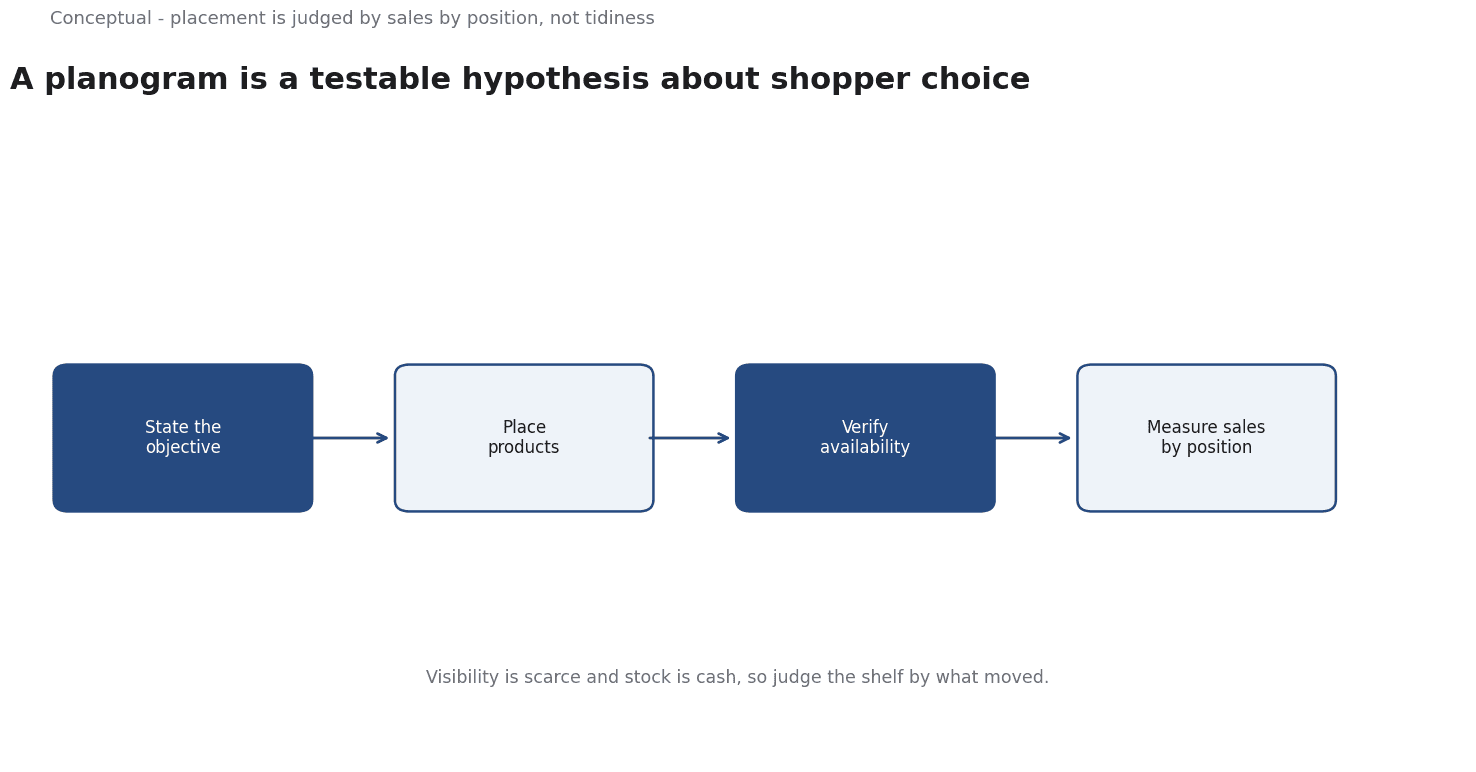
The sequence is: state the objective, place products, verify availability, then measure by position.
The objective is local judgement, so it is inferred; the practice is source-reported.
A worked review
Illustrative. A category is rearranged to give a new product eye-level space.
Three checks decide. First, what was the objective — total category sales or the launch of one product? Second, were the advertised products actually available throughout the test? Third, did the change lift the category, or merely move sales from one shelf position to another?
The outcome is a decision to keep, revise, or revert. The numbers are hypothetical; the test method is the contribution.
Why availability comes before layout
A planogram assumes that the products shown are present.
Checking availability before a layout test is therefore a precondition, not an optional step.
The second precondition is a clear objective. A layout can increase the sales of one product while reducing the category total, and both outcomes are easy to describe as a success if the objective is not stated. Choosing whether the test is about total sales, a launch, or basket size determines what the measurement will be.
Why revisions should be small
A large redesign changes many variables at once, which makes it impossible to attribute the result. A small revision to one shelf section gives a clearer signal and can be reverted cheaply. Over several revisions, the cumulative effect is often larger than a single redesign because each step is informed by evidence.
Evidence status
| Claim | Status | Source | Verified | Recheck when |
|---|---|---|---|---|
| Planograms specify product placement | source-reported | Wikipedia, Planogram | 2026-11-18 | Practice changes |
| Inventory ties up cash | source-reported | Wikipedia, Inventory | 2026-11-18 | Accounting changes |
| Measure by position against an objective | inferred | Derived from the practice | 2026-11-18 | Category strategy changes |
Why a tidy shelf is not a result
A planogram can be executed perfectly and still fail if the underlying assumption about shopper choice is wrong. Measuring by position is the correction, because it shows whether the placement produced the intended behaviour. Without that measurement, a layout change is judged by appearance, which is easy to make attractive.
A related constraint is seasonality. A layout that works during a normal week may fail during a peak, when shoppers substitute more readily and shelves empty faster. Testing across at least one busy period prevents a conclusion drawn from quiet weeks from being applied everywhere.
The human factor is also relevant. A planogram is executed by people who may face time pressure and incomplete stock. A design that depends on perfect execution is fragile; one that tolerates small deviations is more likely to produce the intended result. Including the execution reality in the framework is what separates a useful plan from a tidy drawing.
A review that records what was changed, and why, makes the next revision easier to judge. Without that record, each layout change starts from memory and the same mistakes recur under different names. Keeping the record small is enough; it does not require a formal system, only a dated note attached to the shelf section that changed.
What it cannot do
It cannot create demand for a product nobody wants. It does not fix stock availability. And it cannot guarantee that a result in one store transfers to another.
The counterargument that a standard planogram saves effort is fair for consistency and incomplete for local differences in demand.
A decision test
- State the objective.
- Check availability before changing layout.
- Measure sales by position.
- Compare with a baseline period.
- Keep, revise, or revert.
- Record the decision and the recheck date.
For the assortment question, see Product Assortment.
References & Further Reading
- Wikipedia contributors, 2026. Planogram - Wikipedia — The placement of products on shelves.
- Wikipedia contributors, 2026. Inventory - Wikipedia — The role of stock in operations and accounting.