Naming Strategy for Small Teams
How small teams can approach naming and brand architecture without overbuilding, mapped to concrete decisions with explicit claim status.
Small teams tend to do one of two things with names: they over invest in a naming exercise before there is much to name, or they reuse one label for everything until the portfolio becomes confusing. The real problem is that a name behaves like a long-lived asset, and early choices quietly constrain what can be added later. Without a strategy, teams end up renaming at the worst possible moment, usually when customers are already attached to the old label.
Direct answer: Brand management treats a brand as a set of associations and value that must be managed over time, while private label shows how one owner can carry many products under a single banner. For a small team, the bounded answer is to pick a naming architecture that fits the current number of offerings and the likely growth path, then document the rule. The consequence is fewer forced renames and clearer communication with customers.
Delta: This article adds a decision map beyond the sources: it maps brand architecture and private-label ideas to a small-team naming decision, with claim status explicit.
The mechanism
The source on brand management frames the brand as more than a logo or a name: it is a bundle of associations, expectations, and perceived value that has to be built and maintained.
The practical consequence is that naming is an investment in recall and meaning, so consistency usually matters more than cleverness.
A distinctive, repeatable name accumulates recognition with every use, while frequent renaming resets that accumulation and forces the team to explain itself again.
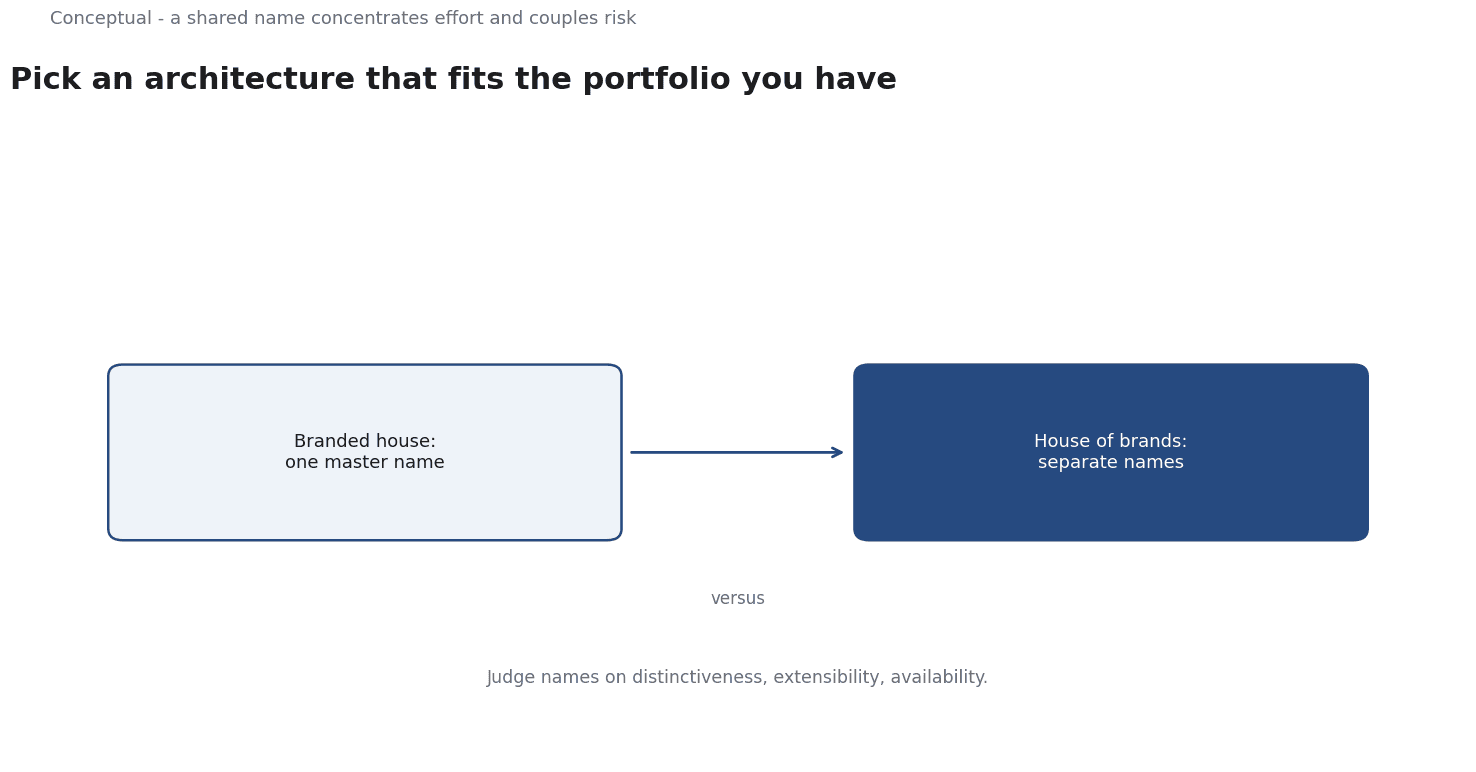
Two broad architectures follow from that idea. In a branded house, one master name extends across several offerings; in a house of brands, each offering gets its own identity. The private label source illustrates a related pattern, where a retailer offers products across categories under its own banner and controls presentation and margin. The consequence for a small team is a clear tradeoff: a single umbrella concentrates limited marketing effort into one name and lowers launch cost, but it also couples the offerings together so that one bad experience can taint the rest.
For small teams the binding constraint is budget and attention. Building awareness for several separate names is expensive, and each one needs its own story, presence, and upkeep. A branded house concentrates those limited resources, letting each new offering borrow recognition from the master name. The cost is that reputation is shared, so quality problems are shared too, and the master name can become associated with a narrow product that blocks later expansion.
A name should be judged on distinctiveness, extensibility, and availability. Distinctiveness helps customers remember and recommend it; extensibility means it still makes sense when a third or fourth offering appears; availability means a domain and trademark search will not force a late change. Documenting the chosen rule turns a one-time decision into a reusable guide, so future offerings follow a pattern instead of reopening the whole debate.
A worked example
The following is hypothetical and illustrative. A two-person team is launching an analytics product and a downloadable template pack, with a possible third offering later. Three checks guide the naming decision. First, the team asks whether one master name can cover both current offerings without confusing customers about what each one does. Second, the team checks distinctiveness and basic availability, including whether the name is easy to say and spell and whether the domain can be secured. Third, the team tests extensibility by imagining the name attached to a future offering in a different category. The master name passes all three when paired with short descriptive sub-labels, while a clever separate name for the template pack fails the availability check. Outcome: the team adopts a branded house, records the naming rule in one short note, and avoids building a second identity.
Evidence status
| Claim | Status | Source | Verified | Recheck when |
|---|---|---|---|---|
| Brand management treats the brand as a managed asset built from associations | source-reported | Wikipedia Brand management | 2026-11-18 | the framing of brand equity changes |
| Private label places multiple products under a single retail banner | source-reported | Wikipedia Private label | 2026-11-18 | retail practices shift materially |
| A branded house lowers launch cost but couples reputation across offerings | inferred | Derived from the sources | 2026-11-18 | the portfolio or market context changes |
The reported rows capture the framing in the two sources and are relatively stable, though the terminology can evolve. The inferred row applies the shared-banner idea to a small-team tradeoff and depends on the team's actual portfolio size and market. It should be revisited when the number of offerings or the brand's reputation changes, because the balance between shared recognition and shared risk is not fixed.
What it cannot do
A naming strategy does not repair a weak product or unclear positioning. A memorable name can make a good offering easier to find and recommend, but it cannot compensate for a vague promise or poor delivery. Teams sometimes treat naming as a shortcut for strategy, spending weeks on a word while the underlying value proposition stays undefined. The result is a well-chosen label attached to something customers still cannot explain.
There are real hidden costs. Trademark searches, domain purchases, and design work consume time and money that a small team may not have. Maintaining multiple names multiplies those costs because each identity needs its own presence and upkeep. Rebranding later is more expensive than getting the structure roughly right early, but over investing in legal perfection before there is product-market fit can also drain focus from more useful work.
A master name stretched into unrelated categories loses meaning, and customers stop knowing what it stands for. The opposite failure is premature separation: splitting offerings into distinct brands before any has awareness fragments limited effort and leaves each one weak. Both errors come from choosing an architecture for an imagined future rather than the current stage.
The boundary is worth stating clearly. Naming is not a substitute for market research, and it does not provide legal clearance without a proper search and, where needed, professional advice. It also cannot predict how customers will actually use a name in speech, which is why informal testing with real people is more useful than internal debate. A documented rule helps, but it cannot cover every edge case.
Because the context changes, the decision needs periodic review. A team that starts with one offering may need a different structure after adding several, and a name that was extensible at launch may become restrictive later. Availability should also be rechecked before major investment, since trademark and domain landscapes change. Reviewing the rule on a cadence keeps naming from becoming an accidental constraint.
Counterargument: "The counterargument that a documented naming rule is fair for a growing portfolio is incomplete for a single experimental product, where forcing structure early can cost more than it saves."
A decision test
- List current offerings and realistic additions over the next planning horizon.
- Decide whether one master name or separate names better fit that portfolio.
- Test candidate names for distinctiveness, spelling, and ease of recommendation.
- Check extensibility by attaching the name to a future offering in another category.
- Run a basic availability check on domains and trademarks before committing.
- Try the name aloud with a few people outside the team and note misunderstandings.
- Record the chosen rule in one short document and set a date to revisit it.
The test keeps naming proportional to the team's stage. A structure chosen for the portfolio that exists today, with a documented rule and a scheduled review, is more useful than an elaborate identity system built for a future that may not arrive. The goal is a decision the team can explain and reuse, not a name that wins an internal argument.
For further reading, see Voice of Customer: Turning Feedback into Decisions.
References & Further Reading
- Wikipedia contributors, 2026. Brand management - Wikipedia — The discipline of maintaining a brand across touchpoints; secondary reference used for channel consistency.
- Wikipedia contributors, 2026. Private label - Wikipedia — Retailer-owned brands and their economics.