Postmortems without the Hype
A postmortem is a learning artefact, not a ceremony. Read what it should contain, a worked example, and why a blame-free review still needs an owner.
Postmortems are often treated as a ritual that follows every incident, which produces documents nobody reads. The SRE material describes postmortems as part of an incident culture, and NIST's handling guide treats review as part of the lifecycle. The question is what the document changes.
Direct answer: Write a postmortem that states the cause, the contributing conditions, and the actions with owners, then verify that the actions were completed. The sources describe the practice; the usefulness test is a synthesis.
Delta: This article adds a claim-status table and a worked example, separating documented practice from the local judgement about what counts as a cause.
The mechanism
Three points matter:
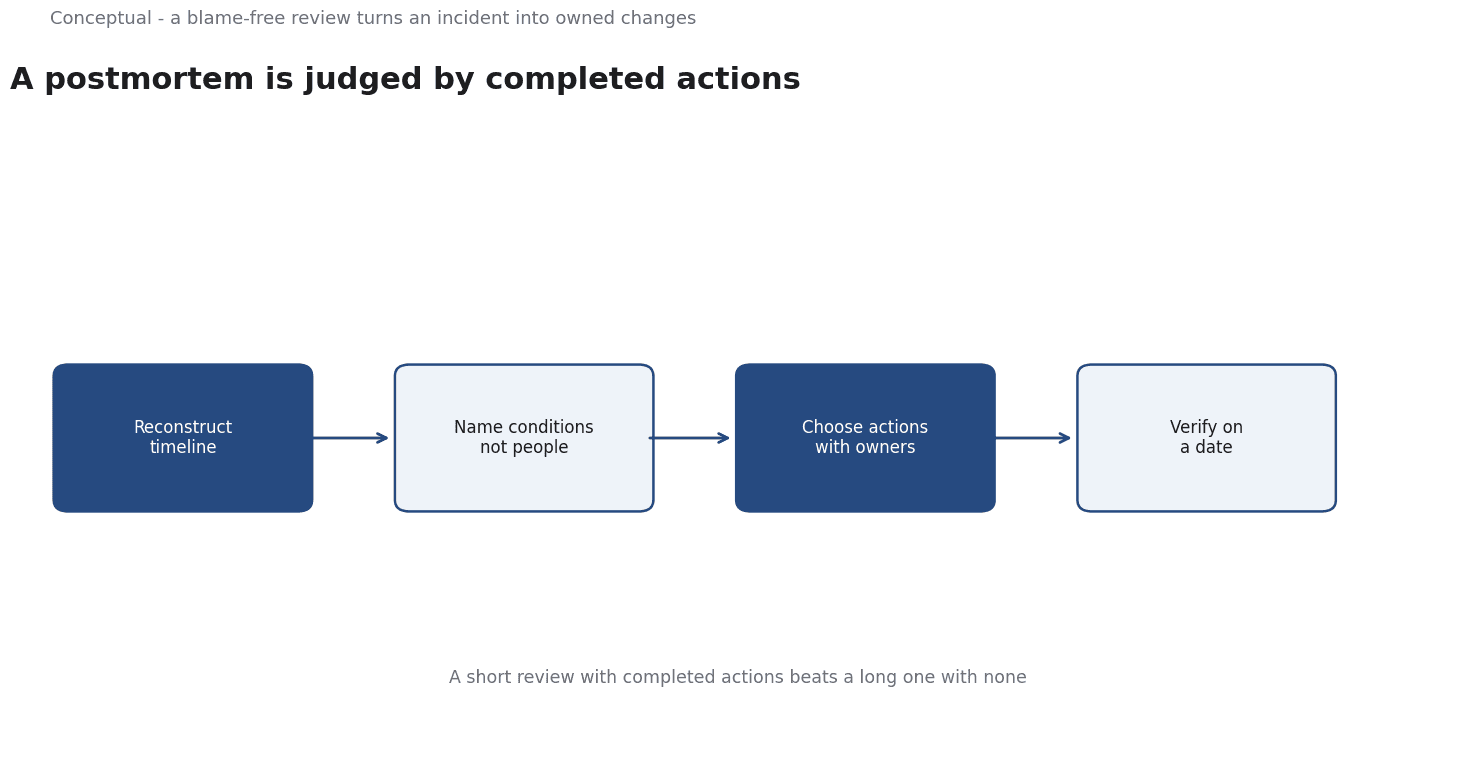
- Cause is not a person. The SRE material argues for a blame-free review. A cause is a condition that made the failure possible.
- Contributing conditions matter. The NIST lifecycle includes preparation and recovery. A review that looks only at the trigger misses those layers.
- Actions need owners. An action without an owner is a suggestion. The review is not complete until someone is accountable.
The sequence is: reconstruct the timeline, name the conditions, choose actions, then verify them.
Choosing actions is local judgement, so it is inferred; the practice is source-reported.
A worked example
Illustrative. A deploy caused a prolonged outage, and the team holds a review.
Three checks decide. First, does the timeline distinguish the trigger from the conditions that allowed it — a missing rollback test, an alert without an objective? Second, is each action tied to one of those conditions rather than to a person? Third, who owns each action, and when will completion be verified?
The outcome is a short document with owners. The scenario is hypothetical; the review method is the contribution.
Why the timeline comes first
Reconstructing the timeline first keeps the discussion closer to what happened, because each event must be placed in order before it can be interpreted. This is also where the distinction between trigger and condition becomes visible.
A trigger is the event that started the failure. A condition is what made the system unable to absorb it. Both matter, but they call for different actions. A review that only removes the trigger leaves the condition in place, which is how the same class of incident recurs with a different immediate cause.
Why completion belongs in the review
An action item that is never completed is a record of intention. Checking completion on a later date is what turns the review into learning. The date should be set during the review, when attention is available, rather than left to a future reminder that nobody will act on.
Evidence status
| Claim | Status | Source | Verified | Recheck when |
|---|---|---|---|---|
| Postmortems are part of an incident culture | source-reported | Google SRE book | 2026-11-18 | Practice changes |
| Review is part of the incident lifecycle | source-reported | NIST SP 800-61 | 2026-11-18 | Guidance updated |
| Actions need owners and verification | inferred | Derived from the practice | 2026-11-18 | Process changes |
Why ownership matters more than length
A long postmortem with no owned actions has changed nothing. A short one with two completed actions has improved the system. The usefulness test is therefore completion, not document length. Recording the verification date turns the review into evidence rather than intention.
A final consideration is the audience for the review. A document written only for the people involved will repeat the same assumptions that led to the incident. Including someone who was not in the room, or who will read it months later, encourages the clarity that makes the artefact useful.
The review also has a limit in time. A finding that is not acted on within a reasonable period is unlikely to be acted on later, which is why the verification date matters more than the number of items in the action list. A short list that gets completed is a better outcome than a thorough list that does not.
The review should record which evidence was missing at the time, since a decision made with incomplete information is different from a decision made carelessly. That distinction is what makes a blame-free review honest.
The distinction keeps the review focused on the system rather than on the people in it.
A review that records only what went wrong will be read once; one that records what will change is read again.
What it cannot do
It cannot guarantee that a failure will not recur. It does not replace monitoring. And it cannot fix a system that was designed without reversibility.
The counterargument that a short review misses detail is fair for complex incidents and incomplete when the detail never becomes an action.
A decision test
- Reconstruct the timeline.
- Name conditions, not people.
- Choose actions tied to conditions.
- Assign one owner per action.
- Set a verification date.
- Record what remains unresolved.
For the lifecycle, see Incident Response.
References & Further Reading
- Betsy Beyer et al., 2016. Google SRE - Site Reliability Engineering book Google Index — The book that defined SRE practice, including SLOs and error budgets.
- Paul Cichonski, Thomas Millar, Tim Grance, Karen Scarfone (NIST), 2012. SP 800-61 Rev. 2, Computer Security Incident Handling Guide — The incident-response capability lifecycle: preparation, detection and analysis, containment/eradication/recovery, and post-incident activity.