Precedent Transactions at Scale
Precedent transactions price a deal from what buyers paid before. Read how comparable prices are discovered, a worked example, and where the method breaks.
Valuation teams often quote a precedent multiple as if a prior deal price settled the question of what a company is worth today. The real problem is that a transaction price is a product of its own moment, shaped by the buyer, the market, and the terms of that specific deal. Treated as a universal number, the multiple quietly inherits conditions that no longer hold.
Direct answer:
A precedent transaction values a company from the prices buyers actually paid for comparable businesses, usually expressed as a multiple of earnings or revenue.
Wikipedia's commodity-market entry shows how a transacted price is discovered under defined contract and timing conditions, and Damodaran's public valuation resources supply the industry multiples and averages that make such comparisons meaningful. The boundary: a precedent is a dated observation of what one buyer paid, not an intrinsic value or a forecast.
Delta: This article adds a decision framing beyond the sources: it maps the price-discovery concept and the public valuation data to the specific question of when a precedent multiple is usable, with claim status explicit.
The mechanism
The commodity-market entry describes venues where standardized products trade and a price emerges from the interaction of buyers and sellers at a point in time, tied to a defined grade, location, and delivery term. The mechanism is price discovery under specific conditions. The practical consequence is that a transacted price is never free-floating; it belongs to a particular contract at a particular moment. A precedent transaction is the same kind of object. It is the price at which a specific acquirer and seller agreed, under a specific market and with specific terms, and the multiple derived from it inherits all of those conditions.
Damodaran Online maintains public datasets covering industry averages, valuation multiples, and cost of capital. The mechanism here is a benchmark distribution rather than a single point: a comparable is only meaningful against the range typical for its sector and period. The practical consequence is that a precedent multiple should be read against that backdrop. A ratio that is ordinary in one industry can be extreme in another, and the benchmark data is what makes the difference visible. Without it, a multiple is a number without a reference frame.
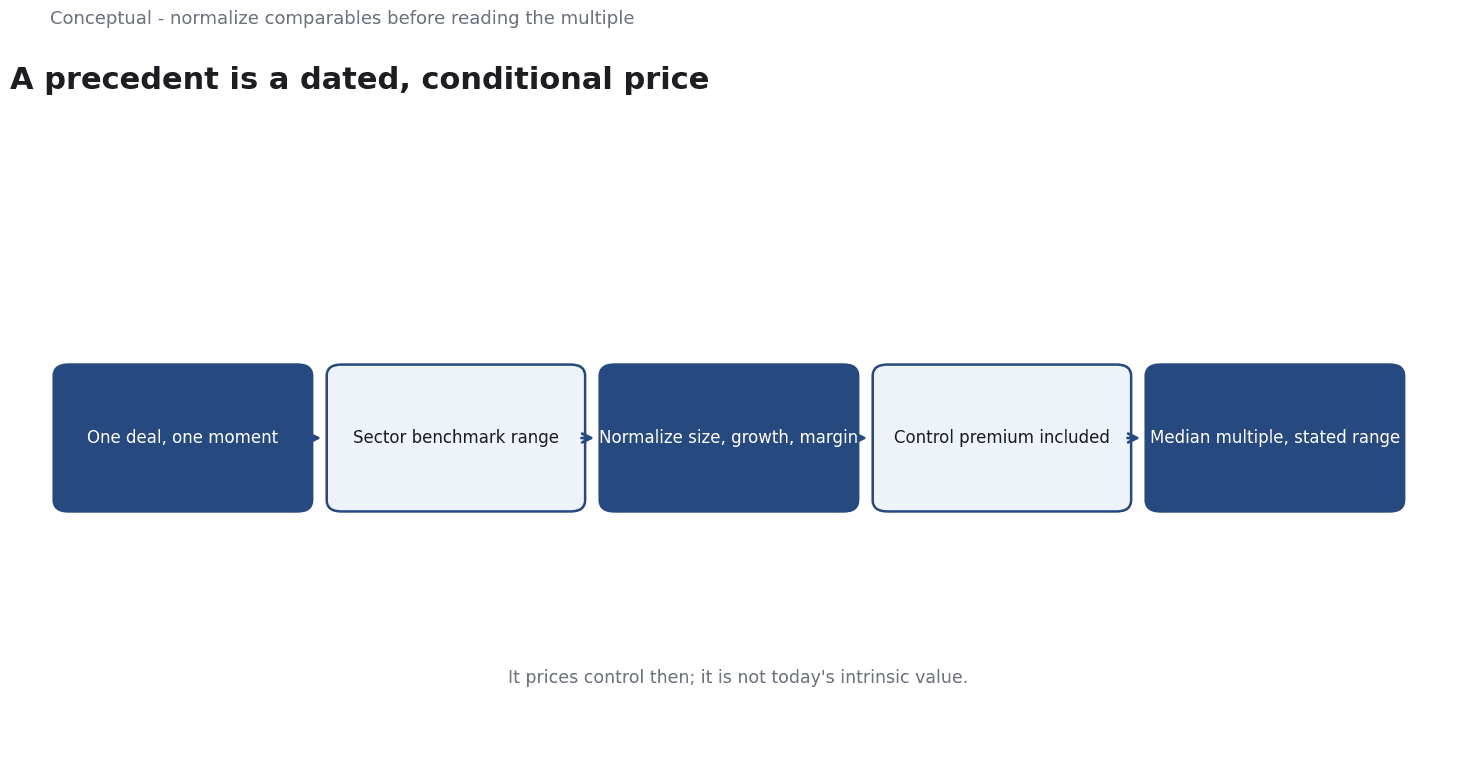
Comparability is what turns a collected price into an estimate. A precedent is informative only to the extent the compared deals share the features that drove price: size, growth, margins, and the presence or absence of a control premium. The mechanism is normalization, adjusting each observed multiple so that remaining differences reflect business fundamentals rather than deal noise. The practical consequence is that a larger sample improves the estimate only when the deals are genuinely alike. Adding more transactions that differ in kind does not sharpen the median; it conceals the dispersion that the analyst should be reporting.
One more condition matters at scale. Precedent transactions usually involve a change of control, so the price includes a premium for control that a minority-share comparison would not contain. The practical consequence is that the multiple answers a narrow question: what did an acquirer pay to control a business like this, then? It does not state what the business is worth in isolation today, and keeping that question explicit is what prevents the figure from being used beyond its proper scope.
A worked example
The following is hypothetical and illustrative. An analyst is valuing a mid-market software company and has gathered four prior deals in the same sector from the past three years. Three checks decide whether their median revenue multiple is usable. First, the comparability check: do the acquired companies share the growth and margin profile of the subject, so the multiple reflects business differences rather than deal noise? Second, the vintage check: were the deals struck under financing conditions and buyer appetite similar to today, using dated public data to anchor the period? Third, the control check: are all four change-of-control prices with the premium that implies, rather than a mix that includes minority stakes? The outcome is a median multiple with a stated range and a note that it prices control under past conditions. The limitation is that four deals sample a narrow slice of the market and say nothing about the subject's current prospects.
Evidence status
| Claim | Status | Source | Verified | Recheck when |
|---|---|---|---|---|
| Commodity prices are discovered for defined contracts at a point in time | source-reported | Commodity market - Wikipedia | 2026-11-18 | when the entry's account of market structure changes |
| Damodaran publishes public datasets covering industry averages and multiples | source-reported | Damodaran Online | 2026-11-18 | when the site's data coverage or dates change |
| A precedent multiple is usable only when compared deals share material conditions | inferred | Derived from the sources | 2026-11-18 | when transaction-comparability standards shift |
The first two rows report what the sources state and can be checked directly against them. The third is an inference from combining a dated, conditional view of transacted prices with a benchmark-based view of valuation; neither source presents it as a valuation rule. The recheck conditions point back to the sources or to changing practice, which keeps each row's status explicit rather than assumed.
What it cannot do
A precedent transaction cannot produce a current intrinsic value. It records what was paid, not what should be paid now. Market conditions, interest rates, and buyer appetite all move between the deal date and the valuation date, and the multiple carries the old conditions unless someone explicitly adjusts for them.
An analyst who presents a three-year-old multiple as today's answer is reporting history under the label of valuation.
A hidden cost is the work of normalization. Collecting deal data, verifying terms, and adjusting each multiple take time and judgment that teams under deadline pressure routinely skip. The cheap path is to quote a single headline multiple from the nearest deal, and it looks precise precisely because it avoids the awkward work of adjustment. The cost is paid in accuracy: an unadjusted figure hides the very differences that determine whether the comparison is valid, so the convenience of the shortcut is purchased with the reliability of the conclusion.
Deals that look alike by sector label can differ sharply in growth, margin, geography, or one-off circumstances such as a distressed sale or a strategic buyer paying for synergies. Averaging them produces a tidy median sitting on top of wide hidden dispersion. The method is also easy to game, because selecting only the precedents that support a desired answer is simpler than defending a full and honestly assembled set. Scale amplifies this: a large but biased deal set looks more authoritative than a small honest one.
The boundary is that these sources provide a picture of price formation and a body of public valuation data, not a selection rule or an adjustment formula. The commodity-market entry explains how a price is discovered for a standardized product; it does not tell an analyst which mergers to include. Damodaran's resources supply benchmarks and frameworks; they do not certify any particular deal set as correct. Using them responsibly means borrowing the discipline of dated, conditional prices and the habit of checking against sector data, while refusing to claim that the result is a validated answer.
Because deal multiples age, the method needs scheduled review. A dataset that was current last quarter may no longer describe the market, and a comparable set assembled for one transaction may be stale for the next. The practical requirement is to recheck the vintage, refresh the deal list, and record which multiple drove which conclusion, so a later reviewer can see the conditions the number assumed rather than reconstructing them from memory.
The counterargument that precedent transactions are too backward-looking to price a company is fair for fast-changing businesses and incomplete for mature ones where recent deals reflect durable economics.
A decision test
- Define the specific question the multiple is meant to answer.
- Gather dated deals from the same sector and a comparable market period.
- Verify each deal's terms, including size and whether control changed hands.
- Normalize the multiples so remaining differences reflect business fundamentals.
- Compare the resulting range against public industry benchmark data.
- Record the range and the market conditions the multiple assumes.
- Revisit the comparable set whenever those conditions materially change.
These steps turn a loose comparison into a decision with visible inputs and stated limits. The mapping from price discovery to dated, conditional deal data is what makes a precedent multiple defensible. A passed test leaves a record of which deals were selected, how they were adjusted, and what the number was used to decide, rather than a bare multiple that nobody can reconstruct.
For further reading, see Cash Flow Forecasting: A 13-Week Operating Model.
References & Further Reading
- Wikipedia contributors, 2026. Commodity market - Wikipedia — Structure of markets for raw materials and commodities.
- Aswath Damodaran, 2026. Damodaran Online: Home Page for Aswath Damodaran — Publicly maintained datasets for industry averages, WACC, and valuation.