Privacy Sandbox without the Hype
Privacy Sandbox replaces third-party cookies with browser-mediated signals. Learn what GDPR actually governs, a worked evaluation, and the limits of the approach.
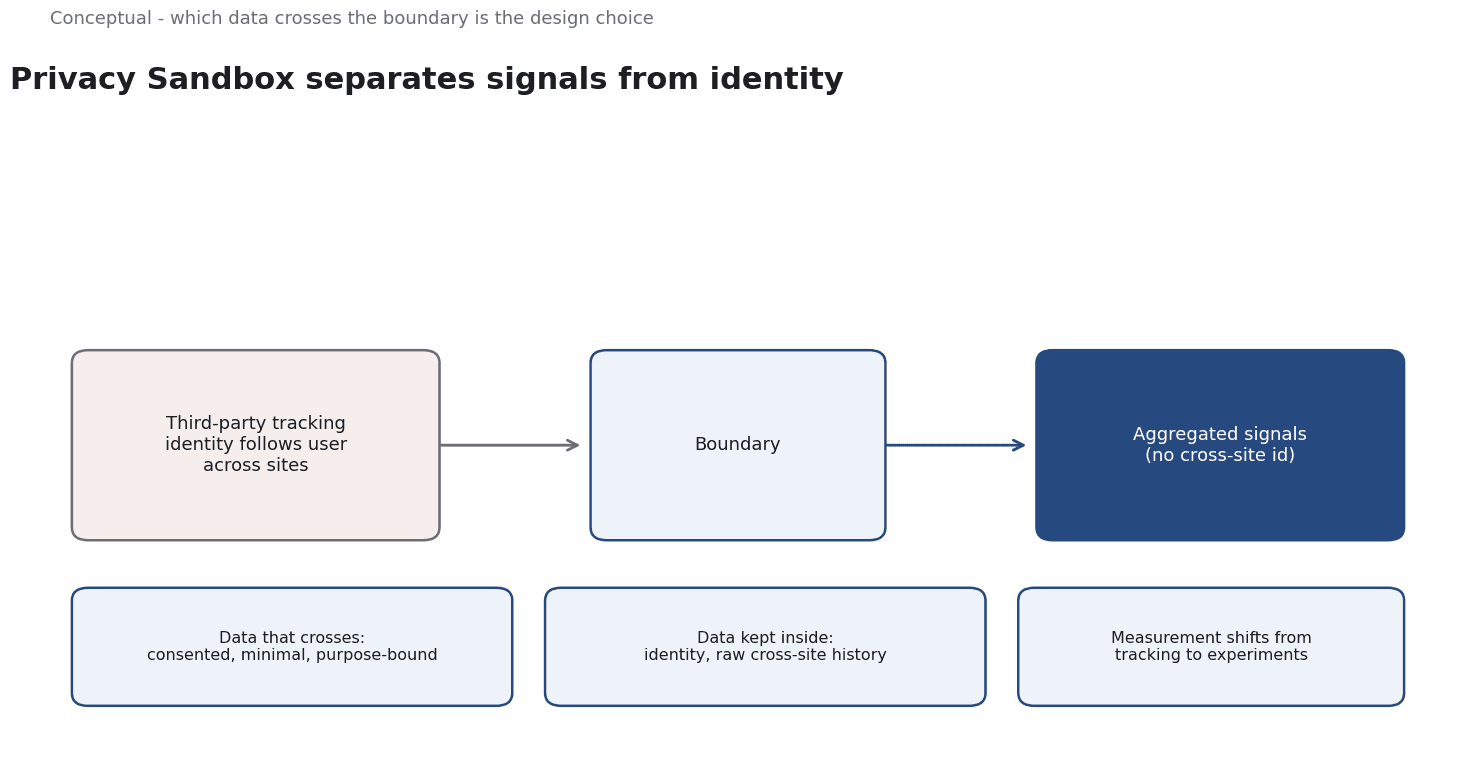
Teams evaluating Privacy Sandbox often treat it as a like-for-like replacement for third-party cookies. The Privacy Sandbox entry describes browser-mediated alternatives for advertising, while the GDPR legal text sets obligations for personal data. The real problem is that a tracking mechanism and a legal basis are different things, and conflating them leads to faulty compliance claims.
Direct answer:
Privacy Sandbox is a set of browser technologies for measuring and targeting ads without third-party cookies; GDPR is a regulation governing how personal data may be processed.
The first changes what signals are available, and the second sets the lawful basis for using them. Neither substitutes for the other.
Delta: This article adds a signal-to-obligation map beyond the sources: it maps each advertising signal to the compliance decision it triggers, with claim status explicit.
The mechanism
Privacy Sandbox is a collection of browser technologies intended to support advertising while reducing reliance on third-party cookies. The entry describes mechanisms that let a browser hold information about user interests or attribute conversions without handing a static identifier to every site. The practical consequence is that the location of the data shifts: signals that once lived in a shared cookie now live inside the browser and are exposed through controlled interfaces. A team that previously read a cookie directly must now reason about what the browser chooses to reveal and to whom. That shift changes the engineering question from where to store an identifier to which interface the design is allowed to call.
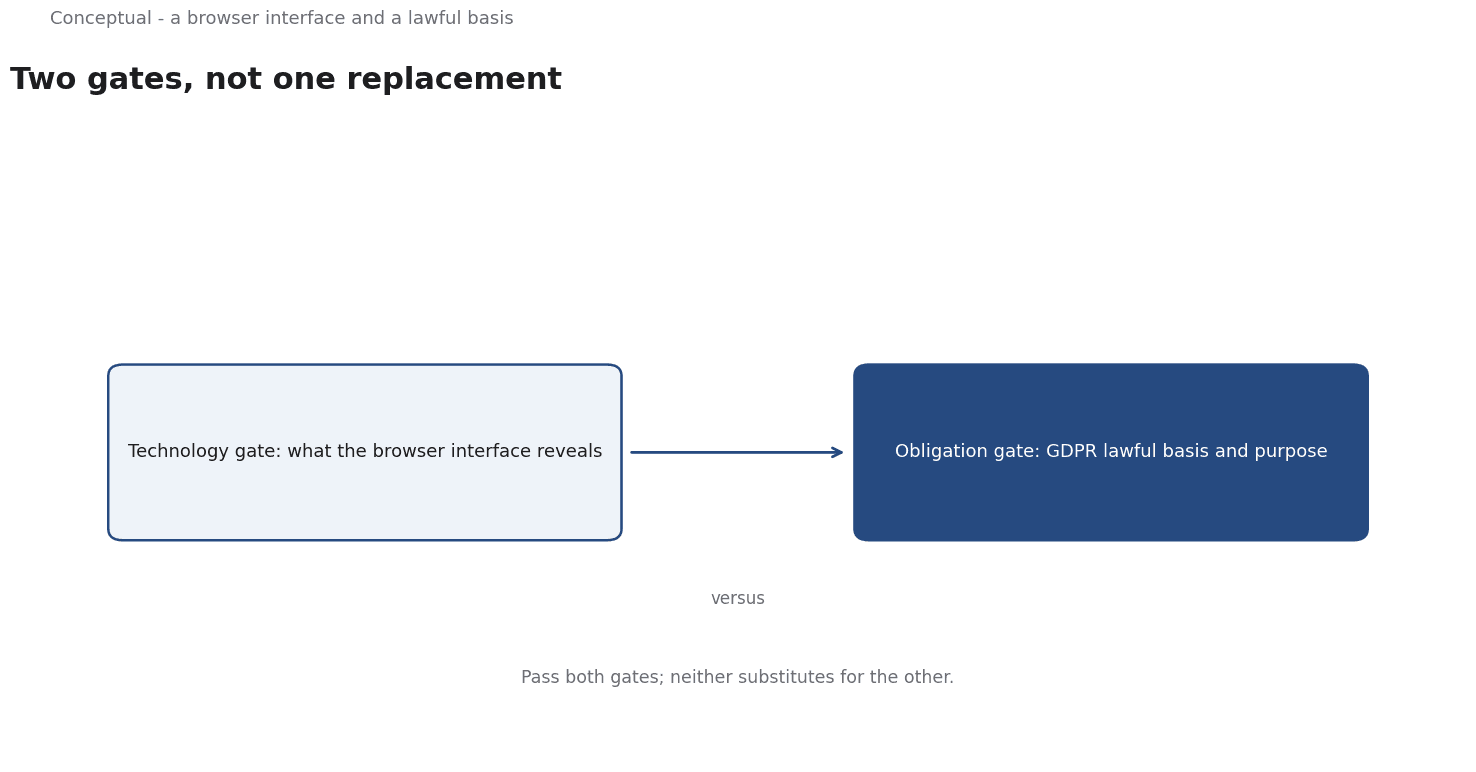
GDPR operates at a different layer. The legal text sets principles for processing personal data, including lawfulness, fairness, transparency, purpose limitation, data minimisation, accuracy, storage limitation, integrity, confidentiality, and accountability. It also defines lawful bases for processing and rights for data subjects. The practical consequence is that a technical design does not settle legality: an ad signal collected through a privacy-preserving interface can still be personal data, and processing it still needs a lawful basis and a stated purpose. The regulation asks why and on what authority, questions a browser API cannot answer.
The two sources meet at a boundary neither draws explicitly. Privacy Sandbox constrains how a signal is obtained; GDPR constrains whether and on what basis that signal may be used. A privacy-preserving delivery mechanism can reduce exposure, but it does not by itself supply a lawful basis, and a lawful basis does not make a particular tracking design acceptable to a browser. Treating either as a substitute for the other is the source of most hype. The defensible position is to handle them as two separate gates that a design must pass, each with its own evidence and its own reviewer.
The output is a mapping from each advertising signal to the interface that supplies it, the purpose it serves, and the lawful basis relied on. That mapping is the decision instrument: it shows where a design is blocked by technology and where it is blocked by obligation, and it keeps the two reasons distinct for later review.
A worked example
The following is hypothetical and illustrative. A publisher considers replacing a third-party cookie with a browser-mediated interest signal to target ads. Three checks decide the path. First, does the browser expose the signal through a supported interface, and what does it disclose to the site? Second, is the resulting value personal data under the GDPR principles, and what lawful basis and purpose are recorded? Third, does the design follow data minimisation, collecting only what the stated purpose needs? The review finds that the interface is available but the team has recorded no lawful basis for the new use. A second pass confirms the attribution signal is retained only as long as the stated purpose requires. The outcome is that the technical migration pauses until a purpose and basis are documented. The numbers are hypothetical; the verification method is the contribution.
Evidence status
| Claim | Status | Source | Verified | Recheck when |
|---|---|---|---|---|
| Privacy Sandbox offers browser-mediated ad technologies | source-reported | Wikipedia, Privacy Sandbox | 2026-11-18 | Browser APIs change |
| GDPR sets principles and lawful bases for personal data | source-reported | GDPR, Legal text | 2026-11-18 | Regulation amended |
| Map each signal to a lawful basis before adoption | inferred | Derived from the sources | 2026-11-18 | Purpose or API changes |
The first two rows restate what the two sources describe: the browser technologies and the regulation's principles. The third row is an inference, because neither source links a particular signal to a particular lawful basis. Recheck the technology row when browser APIs change, the legal row when the regulation or guidance is amended, and the inferred row when the purpose of processing changes.
What it cannot do
A privacy-sandbox evaluation does not certify compliance. It describes what browser-mediated advertising technologies do and what GDPR requires, but it does not determine whether a specific deployment is lawful. Lawfulness depends on facts the sources do not contain: the purpose of processing, the legal basis chosen, the categories of data, and the expectations of the people concerned. A reviewer who treats a passing technical check as a legal sign-off has confused mechanism with obligation. The check can show which questions remain open, but it cannot answer them.
The hidden cost is the loss of direct measurement. Browser-mediated signals are coarser and controlled by a party the business does not own, so experiments take longer to design and results are harder to compare with historical cookie-based data. There is also a maintenance cost: the interfaces and their rules change, and each change can invalidate an earlier evaluation. Teams that budget only for a one-time migration tend to discover the recurring cost later, when a metric drifts and the cause is an interface change rather than a campaign decision.
Both moves collapse two independent gates into one. A signal can be collected through an approved interface and still lack a documented purpose; a purpose can be legitimate and still be implemented in a way a browser blocks. Because the two sources do not share a vocabulary for this boundary, the failure is easy to miss in a review: each team checks its own gate and assumes the other passed.
The scope is also bounded. The Privacy Sandbox entry concerns advertising technologies, not general web tracking or first-party analytics. The GDPR text is a regulation, not implementation guidance for a particular API. Nothing here resolves jurisdiction questions, consent mechanics, or the rights of specific individuals, and none of it constitutes legal advice. The method only organises a decision: which signal, which interface, which purpose, which basis. A question outside that frame needs a different source.
Because both sources change, the mapping needs a refresh condition on every row. An interface deprecation changes the technology column; an amendment or new guidance changes the obligation column. A reviewer should be able to see when a decision was made and which version of each source it relied on. Without that record, a future audit cannot distinguish a deliberate choice from a default that was never revisited. The decision remains valid only for the version of the world in which it was made.
The counterargument that browser-mediated signals are fair for reducing third-party tracking is incomplete when teams treat the mechanism as a compliance certificate rather than one input to a separate legal decision.
A decision test
- List each advertising signal the design relies on.
- Identify the browser interface that supplies it.
- State the purpose the signal serves.
- Record the lawful basis and the data categories involved.
- Check minimisation: is only the needed signal collected?
- Mark which gate blocks the design, technology or obligation.
- Set a recheck condition tied to an API or rule change.
A privacy-sandbox decision is defensible only when the technical and legal gates are recorded separately. The test turns a marketing claim into a short chain of decisions with a visible owner for each gate, so a reviewer can see whether a design failed because the browser withheld a signal or because no lawful basis was documented. For further reading, see Data Governance.
References & Further Reading
- Wikipedia contributors, 2026. Privacy Sandbox - Wikipedia — Browser proposals to limit tracking while supporting advertising.
- European Union, 2016. General Data Protection Regulation (GDPR) - Legal Text — Full text of the EU data protection regulation.