Private Label: a Decision Framework
A private label is a bet on the retailer's relationship with the shopper. Read the framework, a worked example, and why margin is not the whole case.
Private label is often discussed as a margin play, which ignores what it does to the retailer's role. The Wikipedia entry describes retailer-owned brands, and the retail-media entry covers the channel in which they compete. The decision is whether the retailer can own the relationship with the shopper.
Direct answer:
Decide on a private label by defining the shopper problem, checking the supply and quality capability, and measuring the effect on the category rather than margin alone.
The sources describe the structure; the decision rule is a synthesis.
Delta: This article adds a claim-status table and a worked review, separating documented channel facts from the local strategic judgement.
The mechanism
Three points matter:
- Ownership of the relationship. The private-label entry describes brands owned by the retailer. That changes who owns the shopper's trust.
- Supply is a capability. A retailer must source, quality-check, and stand behind the product. The retail-media entry describes the channel, not that capability.
- Category effect matters. A private label can grow margin while shrinking the category if it displaces volume without adding value.
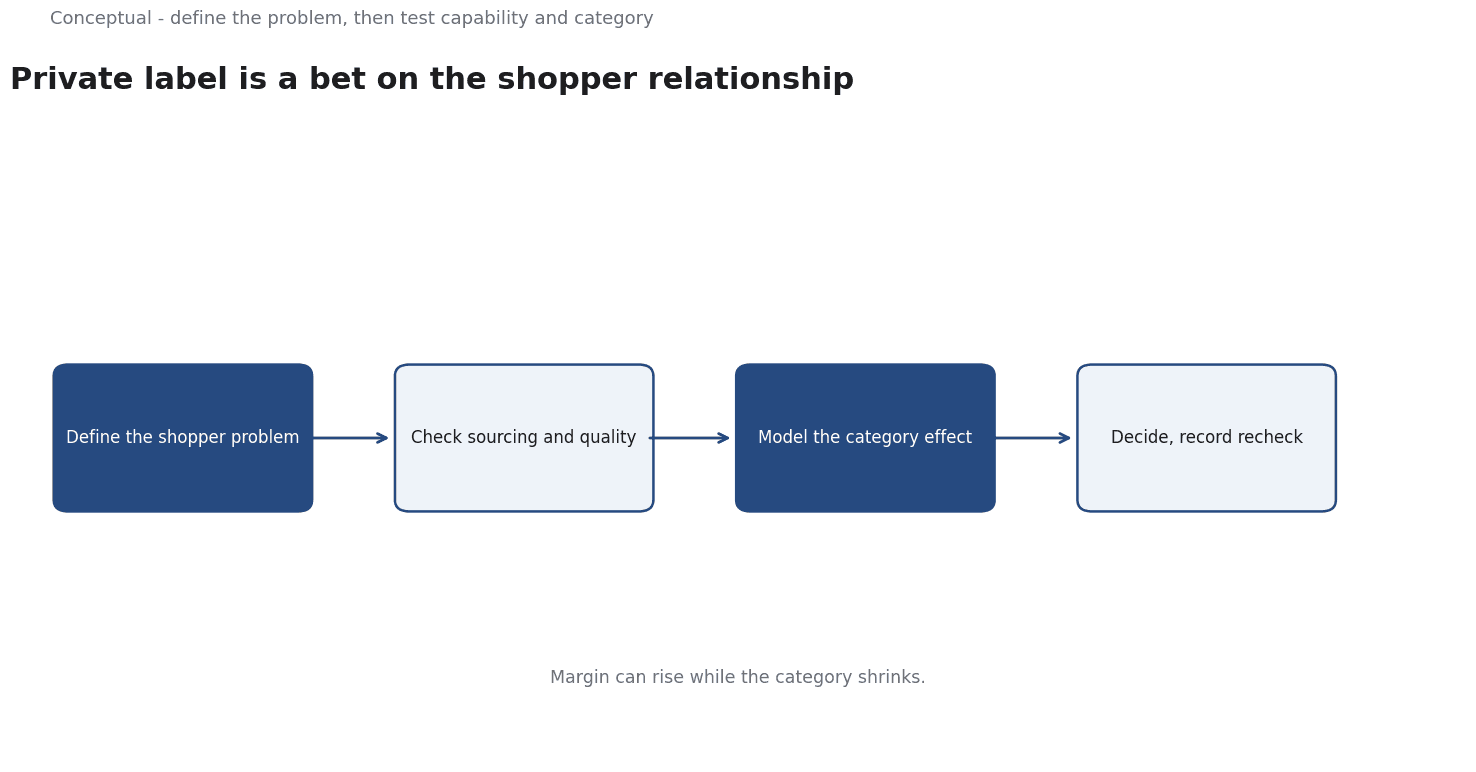
The sequence is: define the shopper problem, check capability, model the category effect, then decide. The shopper problem is local judgement, so it is inferred; the channel facts are source-reported.
A worked review
Illustrative. A retailer considers a private label in a category with strong national brands.
Three checks decide. First, what shopper problem would the new brand solve that the existing options do not? Second, can the retailer source and quality-check the product consistently? Third, what happens to total category sales if the new brand takes share from existing products rather than growing the category?
The outcome is a decision with a recorded rationale. The numbers are hypothetical; the review method is the contribution.
Why the shopper problem comes first
A private label that exists only to capture margin is fragile, because it offers the shopper no reason to switch. A brand that solves a specific problem — consistent quality at a lower price, or a product the national brands do not offer — has a reason to be chosen. Naming that problem before the range is designed is the difference between an assortment decision and a positioning decision.
Why the category is the unit of measurement
The relevant question is whether the total value created in the category increased, because that determines whether the retailer gained or merely moved sales between suppliers. A category view also reveals whether the new brand is attracting new shoppers or just reallocating existing ones.
What the supply check includes
The ability to source a product once is not the ability to sell it consistently. Quality variation, delivery reliability, and the capacity to handle returns are part of the promise the retailer makes. A private label that fails on these dimensions damages the retailer's relationship with the shopper, which is the asset the strategy was meant to build.
Evidence status
| Claim | Status | Source | Verified | Recheck when |
|---|---|---|---|---|
| Private labels are retailer-owned brands | source-reported | Wikipedia, Private label | 2026-11-18 | Definition revised |
| Retail media is a distinct channel | source-reported | Wikipedia, Retail media | 2026-11-18 | Channel changes |
| Judge by category effect, not margin alone | inferred | Derived from channel structure | 2026-11-18 | Category strategy changes |
Why margin is not the whole case
A higher margin on a smaller volume can be a worse outcome, particularly if the private label displaces products that brought shoppers into the category. Measuring total category performance before and after launch is the correction. It also reveals whether the new brand is adding value or merely transferring margin from an existing supplier.
A final consideration is the signal sent to existing suppliers. A private label that copies a supplier's product and competes on price can damage a relationship that was useful for other parts of the range. The decision therefore has consequences beyond the category being considered, and those consequences belong in the review.
The strategy also takes time. Shoppers need repeated exposure before they trust a new brand, and a short evaluation can mistake slow adoption for failure. Setting the measurement period in advance prevents an impatient conclusion.
The review should state what evidence would reverse the decision.
What it cannot do
It cannot guarantee shopper acceptance. It does not remove the need for quality control. And it cannot replace a clear value proposition, which the shopper evaluates.
The counterargument that a private label always improves margin is fair for the unit economics and incomplete for the category effect.
A decision test
- Define the shopper problem.
- Check sourcing and quality capability.
- Model the category effect.
- Check the channel implications.
- Use dated data.
- Record the decision and the recheck condition.
For the competitive context, see Private Label Retailers.
References & Further Reading
- Wikipedia contributors, 2026. Private label - Wikipedia — Retailer-owned brands and their economics.
- Wikipedia contributors, 2026. Retail media - Wikipedia — Overview of retail media channels, first-party data and the reported ~21% share of global digital ad spend in 2024; secondary reference used with IAB and NRF material.