Reranking Examples
A first retriever finds candidates; a reranker orders them. Read worked examples, a worked evaluation, and why relevance is not the same as usefulness.
Retrieval systems often stop at the first list of candidates, which leaves the ordering to a similarity score. The Cohere reranking material describes a second stage that reorders candidates, and web analytics covers measurement of what users actually use. The examples show what the extra stage can and cannot do.
Direct answer:
Add a reranker when the first-stage results are mostly relevant but poorly ordered, then evaluate the final answer rather than the intermediate list.
The sources describe the mechanism; the decision rule is a synthesis.
Delta: This article adds a claim-status table and a worked evaluation, separating documented retrieval behaviour from local judgements about usefulness.
The mechanism
The first point is division of labour. The reranking material describes a second model that scores candidate documents for relevance to the query. A first stage that retrieves broadly and a second stage that orders precisely is a common design, and it only helps when the first stage found the right documents.
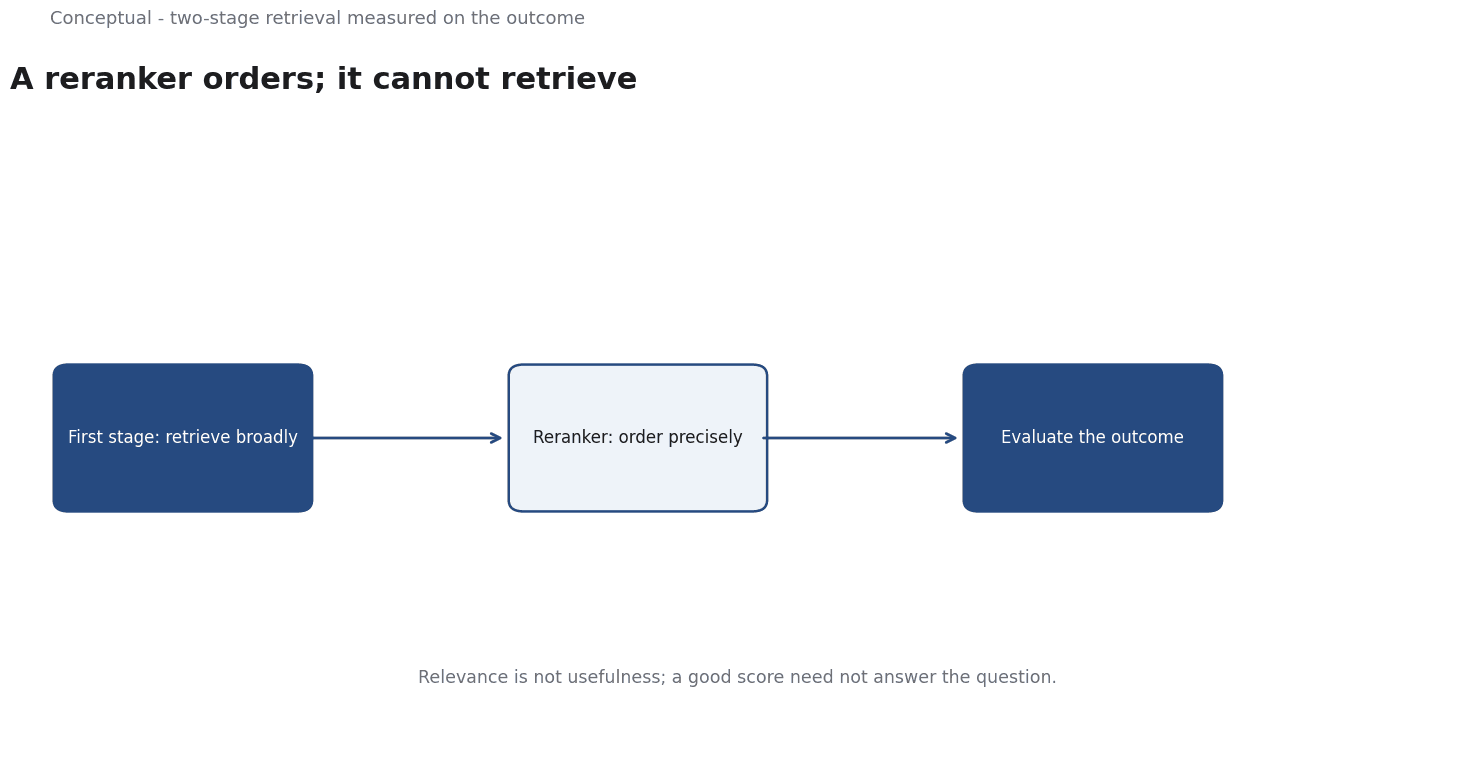
The second point is measurement. The web-analytics entry describes collection and interpretation as separate, which applies here. A better ordering is not the same as a better outcome, and the useful measure is whether the system's answer or the user's decision improved.
The third point is cost. A reranker adds latency and expense to every query, and that cost should be compared with the value of the improvement. A system that is already good enough may not benefit enough to justify it.
The sequence is: measure the first stage, test whether ordering is the problem, add the second stage, then evaluate the outcome. The decisions are local, so the conclusions are inferred; the mechanism is source-reported.
Worked examples
Illustrative. A support search returns ten documents and users rarely click the first one.
Three checks decide. First, are the relevant documents in the first ten at all? Second, does reordering put the most useful one first, measured on real queries? Third, does the change reduce time to resolution, or only improve a relevance score?
A second example: a system retrieves the right document but answers incorrectly. The problem is generation, not ranking, and a reranker will not fix it.
The outcome is a decision about which stage needs work. The scenarios are hypothetical; the method is the contribution.
Evidence status
| Claim | Status | Source | Verified | Recheck when |
|---|---|---|---|---|
| Reranking reorders retrieved candidates | source-reported | Cohere reranking docs | 2026-11-18 | Product changes |
| Analytics separates collection from interpretation | source-reported | Wikipedia, Web analytics | 2026-11-18 | Definition changes |
| Evaluate the outcome, not the list | inferred | Derived from both | 2026-11-18 | Goals change |
Why relevance is not usefulness
A document can be relevant to a query and still not help the user decide. Usefulness includes timing, trust, and completeness, which are not fully captured by a relevance score. Measuring the decision rather than the ranking is the correction.
A further consideration is that a reranker adds latency to every query, and the benefit must be weighed against that cost on the queries that matter. A system that is already good enough may not need the extra stage, and measuring the gap before adding it avoids work that does not pay.
The first stage also has to be measured on its own. A reranker cannot recover a document that was never retrieved, and a low recall will limit any improvement. Checking recall before ordering is the sequence that makes the evaluation interpretable.
Finally, a relevance score is a proxy. A document can score highly and still not answer the question, which is why the final answer or decision deserves its own measure.
The decision to add a stage should be revisited when traffic changes, since a cost that was acceptable at one volume may not be at another.
What it cannot do
It cannot retrieve a document the first stage missed. It does not fix a bad answer from a good document. And it cannot guarantee that users notice the change.
The counterargument that a better score is always better is fair for ranking and incomplete for outcomes.
A decision test
- Measure first-stage recall.
- Test whether ordering is the problem.
- Add a reranker to a fixed test set.
- Evaluate the final outcome.
- Count latency and cost.
- Record the decision and recheck date.
For the pipeline context, see Reranking in Retrieval Pipelines.
References & Further Reading
- Cohere, 2026. An Overview of Cohere Rerank Model | Cohere — How a second-stage reranker scores query-document pairs after an initial retrieval pass.
- Wikipedia contributors, 2026. Web analytics - Wikipedia — Collection and interpretation of website behaviour data.