Reskilling Explained
Reskilling prepares someone for a different role. Read how it works, a worked plan, and why a course is not a new capability.
Reskilling is often treated as completing a course, which ignores that the goal is doing a different job. The reskilling entry describes learning new skills for a different role, and O*NET's task descriptions help define what those roles involve. The plan starts with the target work.
Direct answer:
Reskill by defining the target tasks, identifying the gap, and practising those tasks with evidence of capability.
The sources describe the concept and the roles; the method is a synthesis.
Delta: This article adds a claim-status table and a worked plan, separating documented concepts from local judgements about readiness.
The mechanism
The first point is the target. The reskilling entry describes preparing for a different role, which means the role has to be defined before the learning starts. A general intention to learn a field produces a broad set of courses, while a specific target produces a specific gap.
The second point is the gap. O*NET's task descriptions help state what a role actually involves, which makes it possible to compare current capability with what the new work requires. A gap defined in tasks is testable; a gap defined in confidence is not.
The third point is evidence. A course completion is not a demonstration of capability, and the difference matters when a manager decides whether someone is ready. Practising real tasks, with a record of the result, is the stronger evidence.
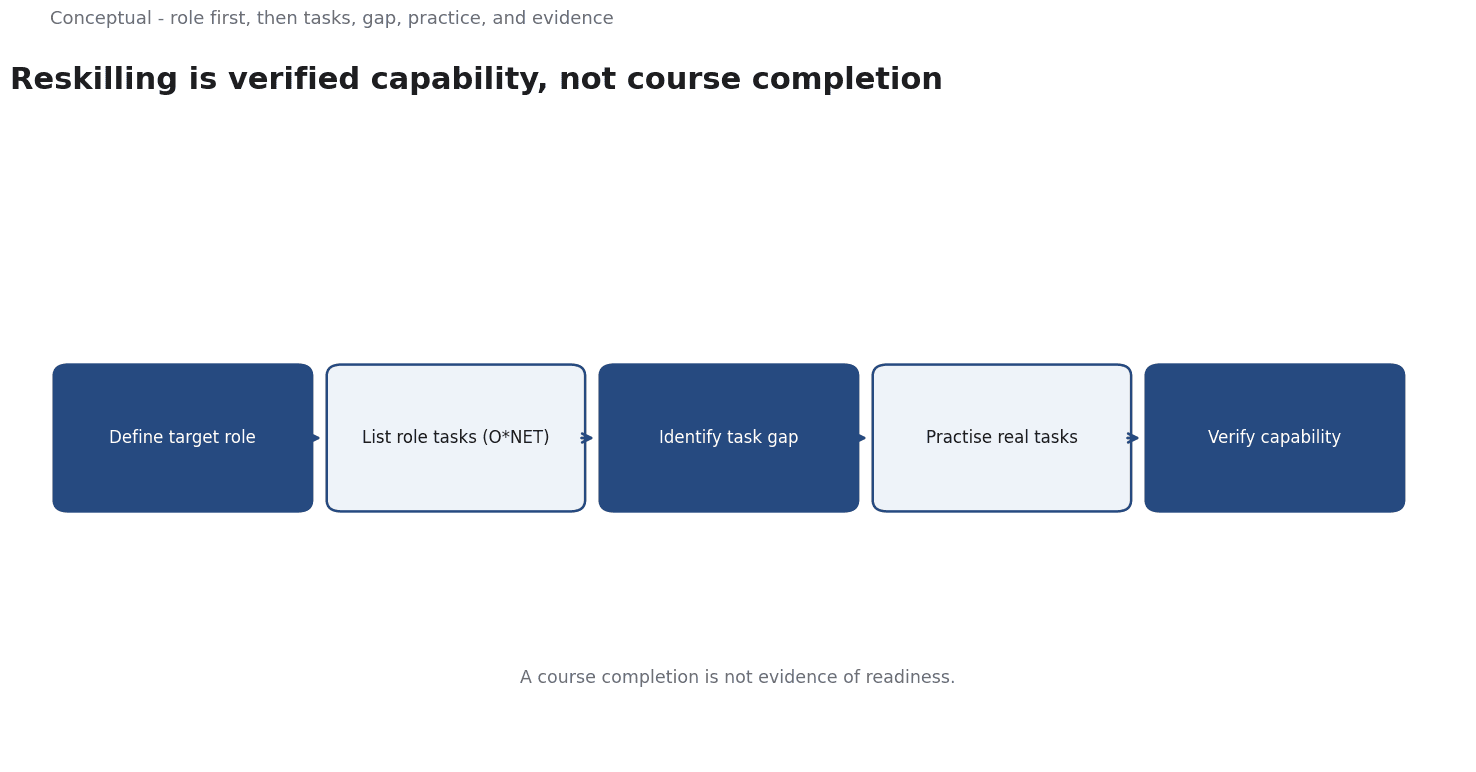
The sequence is: define the role, list the tasks, identify the gap, practise on real work, then verify. The choices are local, so the conclusions are inferred; the concepts are source-reported.
A worked plan
Illustrative. An analyst wants to move into a data engineering role.
Three checks decide. First, which tasks define the new role, using task descriptions as a guide? Second, which of those tasks can the analyst already perform, and which are genuinely new? Third, is there a real project that can demonstrate the new tasks, with a review of the result?
The outcome is a plan with evidence rather than a list of courses. The scenario is hypothetical; the method is the contribution.
Evidence status
| Claim | Status | Source | Verified | Recheck when |
|---|---|---|---|---|
| Reskilling prepares for a different role | source-reported | Wikipedia, Retraining | 2026-11-18 | Definition changes |
| Roles can be described by tasks | source-reported | O*NET | 2026-11-18 | Role changes |
| Demonstrate the target tasks | inferred | Derived from both | 2026-11-18 | Role changes |
Why a course is not capability
The distinction matters at the point of hiring or reassignment, where the decision depends on demonstrated tasks rather than attendance.
A further issue is that the target role changes as the work changes. A plan built for today's tasks may be partly obsolete by the time it is finished, and reviewing the role during the transition is part of the work. Learning that can be applied in several roles is more robust than a narrow qualification.
The evidence also has to be recognised by someone else. A project that demonstrates capability is useful only if the person assessing it understands what was done, which is a reason to keep a short record of the task, the contribution, and the result.
Finally, reskilling cannot guarantee a position. It prepares someone for a different kind of work, and the decision to hire remains separate. Stating that boundary honestly is better than promising an outcome the learner does not control.
A plan should be reviewed while the target role is still changing, since the tasks may shift.
Demonstrated tasks are stronger evidence than a completed course.
The target role should be revisited during the plan, not only at the beginning.
A qualification is a signal, while demonstrated work is the stronger evidence.
Readiness is demonstrated in tasks, not inferred from a certificate.A task that cannot be demonstrated remains a claim, whatever the course says.
The plan should survive a change in the target role, which is why it needs review.
What it cannot do
It cannot guarantee a new role. It does not remove the need for practice. And it cannot make the transition instant.
The counterargument that a qualification is the clearest signal is fair for screening and incomplete for readiness.
A decision test
- Define the target role.
- List its tasks.
- Identify the real gap.
- Practise on real work.
- Record the evidence.
- Review readiness and recheck date.
For the related question, see Upskilling Checklist.
References & Further Reading
- Wikipedia contributors, 2026. Retraining - Wikipedia — Learning new skills for a different role.
- U.S. Department of Labor, 2026. O*NET OnLine — The standard occupational taxonomy used to compare roles across industries.