Review Management Pitfalls
Managing reviews means improving the experience and responding with resolutions. See the response workflow, a worked reply, and where legal boundaries require a dated check.
Review management is often treated as reputation engineering: ask for good reviews, respond to bad ones, and push the average up. The customer-review entry treats reviews as a public record, which changes the logic — a manipulated record loses the trust that made it valuable, as the marketing-communications entry treats a message as something received, as Online Reviews and Reputation Management treats reputation as earned, as the advocacy article argues for genuine voices.
Direct answer: Manage reviews by improving the underlying experience, inviting honest feedback from all customers, and responding to negative reviews with a resolution rather than a defence. The customer-review entry provides the structure, and marketing communications covers reception. The boundary: this is educational orientation, not legal advice — platform rules and consumer law differ by jurisdiction, as the legal and privacy articles require a dated check, as the publication standard forbids guaranteed outcomes.
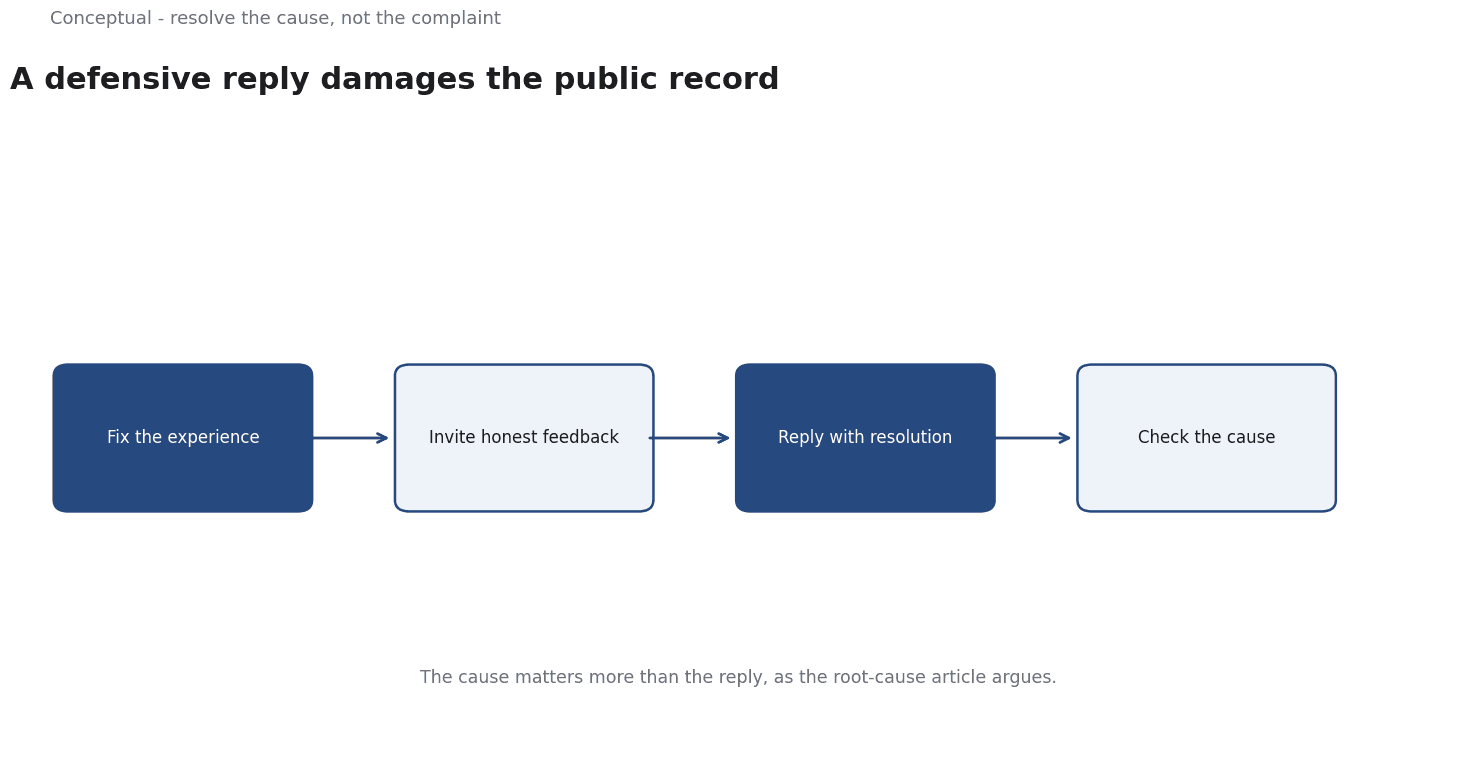
The pitfalls
Asking only for positive reviews. Selecting happy customers biases the record and can breach platform rules, which the referral article treats as an incentive design problem, as Online Reviews and Reputation Management warns about distorted evidence, as AAPOR's standards require for transparent sampling where a survey is used.
Treating the average as the goal. A higher average can hide a worse pattern, which the dashboard article warns about metrics without dimensions, as the evaluation-rubric article requires for concrete criteria, as the retention-analytics article advises for grouping feedback over time.
Responding defensively. A response is visible to future readers, which the customer-review entry and crisis article treat as a public record, as the value-proposition article argues for claims that hold, as Voice of Customer: Turning Feedback into Decisions treats feedback as a signal for decisions.
Ignoring the cause. A response does not fix the problem that produced the review, which the root-cause article treats as distinct from the symptom, as the incident article requires for containment, as the decision-memo article requires for a recorded judgement.
Three consequences follow. The invitation should be neutral, as AAPOR's standards and the survey-design article advise. The responses should be recorded, as the data-governance article requires, as the decision-memo article requires. And the underlying cause should be addressed, as the root-cause article advises, as the monitoring article treats as a follow-up.
A worked response
The following is hypothetical and illustrative. A product receives a negative review about a delayed delivery.
Three checks decide the response. First, what is the underlying cause, as the root-cause article asks, with evidence from the delivery record, as the data-governance article requires? Second, does the public response acknowledge the issue and offer a resolution, as the customer-review entry and crisis article advise, rather than defend, as the value-proposition article argues for credible claims? Third, has the cause been fixed and the outcome recorded, as the incident and decision-memo articles require, as the monitoring article advises for review?
Three conclusions follow.
The cause matters more than the reply, as the root-cause article argues.
And the decision should be recorded with the evidence, as the decision-memo article requires.
What review management cannot do
It cannot manufacture trust, which the online-reviews and advocacy articles treat as earned, as the value-proposition article argues for truth. It does not guarantee a higher rating, which the publication standard forbids claiming, as the risk-assessment article requires residual risk. And it cannot replace a fix, which the root-cause and incident articles require, as the customer-review entry treats the record as public.
The counterargument that a high average is what customers look at is fair for a quick scan and incomplete because a record that is visibly manipulated loses credibility, which the customer-review entry and online-reviews article advise, as the worked response shows.
A decision test
- Invite honest feedback from all customers, as AAPOR's standards advise.
- Treat the review as a public record, as the customer-review entry advises.
- Find the underlying cause, as the root-cause article requires.
- Respond with a resolution, as the crisis article advises.
- Record the response and the evidence, as data governance requires.
- Check current platform rules, as the legal article requires.
- Review after a fix, as the monitoring article advises.
For the reputation basis, see Online Reviews and Reputation Management; for the signal, see Voice of Customer.
References & Further Reading
- Wikipedia contributors, 2026. Customer review - Wikipedia — How online reviews form a public reputation record.
- Wikipedia contributors, 2026. Marketing communications - Wikipedia — The coordination of messages across channels and the distinction between consistent and identical communication.