Risk Taking Trade-Offs
Risk taking is shaped by bias as well as arithmetic. Read the source concepts, a worked decision example, and where a risk score stops being useful.
Risk taking is often presented as a calculation of odds and payoffs, which leaves out the behaviour of the person making the choice. The behavioural finance entry describes how psychology affects financial decisions, and Damodaran Online presents frameworks for valuation and risk. The real problem is that a decision can look sound on a spreadsheet while the biases behind it distort the input.
Direct answer: Risk taking trades expected return against the biases that shape how odds and losses are perceived. The sources describe behavioural influences and valuation frameworks; the decision check is a synthesis. A risk number describes exposure, not the quality of the reasoning that produced it.
Delta: This article adds a claim-status table and a bias-to-decision test beyond the sources: it maps each behavioural tendency to a decision check, with claim status explicit.
The mechanism
Behavioural finance studies how psychological factors influence financial decisions and market outcomes. The entry covers ideas such as loss aversion and overconfidence, which describe systematic ways that judgement departs from a simple expected-value calculation. Damodaran Online supplies the complementary frame: risk is assessed in the context of valuation and the cost of capital, where expected returns are weighed against uncertainty. Together the sources separate two questions that are often merged. One is what the exposure is worth under a valuation frame. The other is whether the decision maker is reading that exposure accurately.
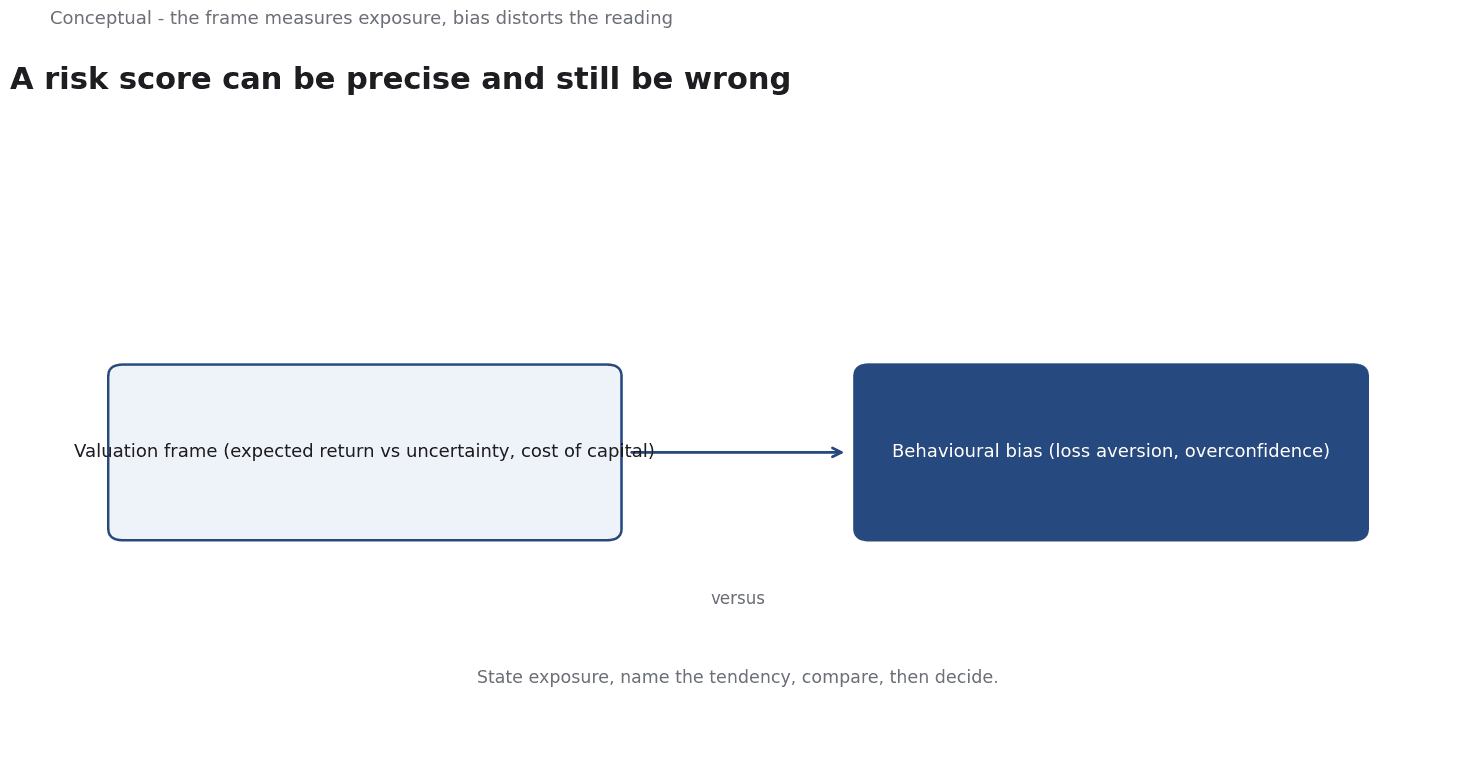
The practical consequence is that the same numerical risk can be accepted or rejected depending on how it is framed. A person who is loss averse may reject a fair bet because the pain of a loss outweighs the pleasure of an equivalent gain. An overconfident person may accept more risk than the arithmetic justifies because they overstate their own information. The valuation framework does not remove those tendencies; it gives a reference point against which they can be detected. The decision instrument is the gap between the assessment the frame produces and the choice the person actually wants to make. A large gap is a signal to slow down and examine the input.
The sources define the concepts and the frameworks, not a decision rule. Neither endorses a particular bias test, a threshold for acceptable risk, or a fixed allocation. Those are local choices and should be marked as inferred. Keeping that boundary visible lets a reviewer see which part of the assessment came from an established concept and which part was a judgement made by the team.
A risk score that ignores the behavioural input can be precise and still be wrong, because it measures exposure while leaving the distortion in the assumptions untouched.
The output is a comparison between the exposure under a valuation frame and the tendencies that may colour the reading of it. That comparison, rather than a single score, is the decision instrument. It shows where a choice may be driven by framing rather than by the underlying odds. The value lies in the sequence: state the exposure, identify the relevant tendency, compare, then decide. A decision made in that order can be explained later, because the evidence and the choice are recorded separately.
A worked example
The following is hypothetical and illustrative. An investor considers a concentrated position in a single company. Three checks decide the review. First, does the valuation frame support the expected return, or is the case built on a recent run of good news? Second, would the same position be accepted if it were presented as a likely small loss rather than a possible large gain? Third, is the confidence in the position proportionate to the information actually gathered? The review shows the case rests mostly on recent news and that the framing changes the answer. The investor reduces the position and records the reason. The outcome is a decision-quality improvement, not a prediction that the company will fall. The numbers are hypothetical; the verification method is the contribution.
Evidence status
| Claim | Status | Source | Verified | Recheck when |
|---|---|---|---|---|
| Behavioural finance studies psychological effects on decisions | source-reported | Wikipedia, Behavioural finance | 2026-11-18 | Definition revised |
| Valuation frames weigh risk against expected return | source-reported | Damodaran, Damodaran Online | 2026-11-18 | Framework updated |
| Framing can change acceptance of the same exposure | inferred | Derived from the sources | 2026-11-18 | Decision context changes |
The first two rows are factual claims drawn directly from the sources. The third is an inference about the effect of framing, because neither source prescribes a bias test for a specific decision. Recheck the definitions when the source entries change, and the inferred claim when the decision context changes.
What it cannot do
A risk assessment does not predict the outcome of a decision. It describes exposure and the tendencies that may colour the reading of it. A well-framed assessment can still be wrong because the future is uncertain, and a biased one can still turn out well by luck. The sources describe concepts and frameworks, not forecasts. Treating a risk score as a prediction is a category error; it answers how much exposure is present under a given frame, not what will happen. A reader who needs a forecast must look elsewhere, and the sources do not supply one. Confusing the two is the most common way that a careful analysis gets misused.
The hidden cost is that examining biases takes time and can be uncomfortable. A structured check asks the decision maker to consider that their confidence may be misplaced, which is easy to endorse in principle and hard to apply under pressure. The sources describe the tendencies but do not make them cheap to correct. That cost is paid in attention and in the willingness to revise a preferred choice. Teams often skip the check precisely when it matters most, because a strong prior feels like certainty. Making the check a routine step, rather than an optional reflection, is what keeps it from being dropped.
Saying that a decision is overconfident explains nothing unless the confidence is compared with the evidence that supports it. A vague label can be applied after the fact to any outcome, which makes it unfalsifiable. The relevant question is what evidence would change the assessment, and whether that evidence was sought. Without a stated check, the concept becomes a way of narrating a result rather than improving a decision. A useful review names the specific tendency and the specific correction, so that a reviewer can test the claim.
There is a boundary around the method. It covers the decision as framed, not the market or the organisation around it. It does not model liquidity constraints, mandate restrictions, or the behaviour of other participants. It does not replace a valuation, because it draws on one rather than substituting for it. A bias check cannot tell an investor which asset to hold; it can only show whether the path to that choice was distorted. That is a narrower contribution than it is often made out to be, and it should be stated plainly.
Because the frameworks and the source entries evolve, the check needs a refresh and the assumptions need periodic review. Each assumption should be recorded with a recheck condition, and the threshold for acceptable risk should be treated as a local policy decision rather than a number the sources supply. Without that record, a future reviewer cannot tell which judgements were deliberate and which were habits. The decision will still be there; the reasoning behind it is what makes the review possible.
The counterargument that a valuation frame is fair for sizing exposure is incomplete when the input to that frame is shaped by unchecked bias.
A decision test
- State the exposure in valuation terms.
- Name the tendency most likely to affect the reading.
- Identify what evidence would change the assessment.
- Check whether that evidence was actually sought.
- Reframe the choice in opposing terms and compare the answer.
- Decide, and record the reason for the choice.
- Record the owner and the recheck condition.
A risk assessment is useful only when the frame and the bias check are both owned. The test turns an exposure into a sequence of decisions with a visible rationale, so a reviewer can see which tendency was tested and when the choice must be revisited. For further reading, see AI Risk Assessment: A Pre-Deployment Checklist.
References & Further Reading
- Wikipedia contributors, 2026. Behavioural finance - Wikipedia — Psychology applied to financial decisions.
- Aswath Damodaran, 2026. Damodaran Online: Home Page for Aswath Damodaran — Publicly maintained datasets for industry averages, WACC, and valuation.