Risk Taking Best Practices
Risk taking is disciplined only when compensated factor exposure is separated from uncompensated concentration. Read the source concepts, a sizing example, and a decision test.
Risk taking is often framed as a matter of conviction: take bold positions where the payoff is large. The factor investing entry describes systematic sources of return, and the diversification entry describes how a mix of holdings reduces risk. The real problem is that a concentrated bet can look like disciplined risk taking when it is simply uncompensated exposure.
Direct answer: Best practice is to separate risk that is compensated from risk that is not, then size positions so that no single outcome dominates the result. The sources describe factors and diversification; the sizing rule is a synthesis. Factor exposures are rewarded over long horizons, while the idiosyncratic risk of concentration is not.
Delta: This article adds a claim-status table and a factor-to-decision test beyond the sources: it maps each risk concept to a sizing decision, with claim status explicit.
The mechanism
Factor investing holds that returns can be explained by exposure to systematic factors such as value, momentum, size, and quality, rather than by security selection alone. The entry presents these as persistent return drivers documented across markets. The practical consequence is that a position can earn a return either because it carries a rewarded factor exposure or because it is an uncompensated gamble. Distinguishing the two is the first discipline of risk taking: a return that comes from a factor can be expected to persist, while a return from a single company's good news is a one-off that is just as likely to reverse.
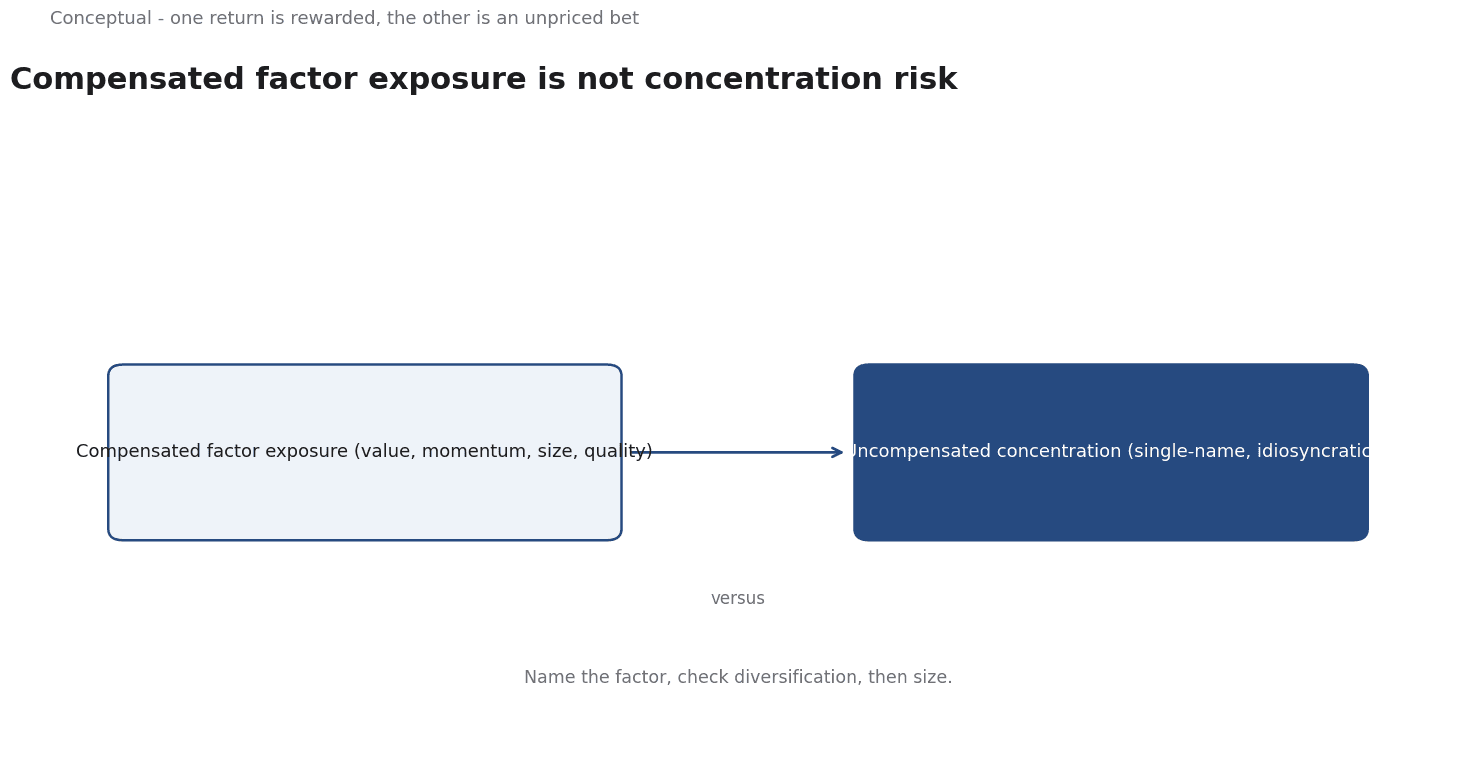
Diversification addresses the second half of the problem. The entry describes how combining holdings whose returns are not perfectly correlated reduces the variance of the whole without proportionally reducing expected return. The mechanism is that idiosyncratic shocks cancel across many positions. The practical consequence is that concentration concentrates risk that the market does not pay for. An investor holding ten unrelated positions is exposed to far less single-name risk than one holding a single large position, even if both have the same expected return. Risk taking that ignores this trade-off is not bold; it is inefficient.
The two concepts together produce a decision rule that neither source states on its own. A risk-taking practice should ask whether each position carries a compensated factor exposure and whether the portfolio is diversified enough that no single outcome drives the result. Neither source prescribes a position size, a correlation threshold, or a target number of holdings. Those are local choices and must be marked as inferred. Keeping that boundary visible lets a reviewer see which part of the assessment came from an established concept and which part was a judgement made by the team.
The output is a comparison between the factor exposure a position carries and the concentration risk it adds.
That comparison, rather than a single conviction score, is the decision instrument.
It shows where a choice is driven by a rewarded factor and where it is driven by an unrewarded bet. The value lies in the sequence: name the factor, check the diversification, then decide. A decision made in that order can be explained later, because the evidence and the choice are recorded separately.
A worked example
The following is hypothetical and illustrative. An allocator considers a large position in a single stock that has recently outperformed. Three checks decide the review. First, does the position carry a documented factor exposure, or is the case built on recent momentum alone? Second, how much of the portfolio's variance would come from this one holding? Third, would the position still be attractive if its recent run were removed? The review shows the case rests on momentum and that the holding would dominate portfolio variance. The allocator reduces the position and records the reason. The outcome is a decision-quality improvement, not a prediction that the stock will fall. The numbers are hypothetical; the verification method is the contribution.
Evidence status
| Claim | Status | Source | Verified | Recheck when |
|---|---|---|---|---|
| Factor investing links return to systematic factors | source-reported | Wikipedia, Factor investing | 2026-11-18 | Definition revised |
| Diversification reduces risk across holdings | source-reported | Wikipedia, Diversification | 2026-11-18 | Definition revised |
| Size positions by compensated exposure and concentration | inferred | Derived from the sources | 2026-11-18 | Mandate changes |
The first two rows are factual claims drawn directly from the sources. The third is an inference about sizing, because neither source sets a position limit or a concentration threshold. Recheck the definitions when the source entries change, and the inferred claim when the investment mandate or the investable universe changes.
What it cannot do
A risk-taking assessment does not predict returns. It classifies exposure and concentration, not outcomes. A well-diversified, factor-aware portfolio can still lose money because factors can underperform for long periods and diversification does not protect against a broad market decline. The sources describe concepts, not forecasts. Treating a factor label as a promise of return is a category error: it answers what exposures are present, not what will happen next. A reader who needs a forecast must look elsewhere, and the sources do not supply one.
The hidden cost is that factor and diversification discipline can cap upside. A portfolio built to avoid single-name concentration will not capture the full gain from the one stock that doubles. That is the price of the approach, paid in foregone tail outcomes. The sources describe the risk reduction but do not make the opportunity cost disappear. Teams often abandon the discipline after a concentrated bet pays off, because the realised gain feels like evidence that the rule was wrong. Making the rule a standing policy, rather than a case-by-case choice, is what keeps it intact.
Saying that a position is a value play explains nothing unless the exposure is measured and compared with the intended benchmark. A vague label can be applied to any holding, which makes it unfalsifiable. The relevant question is what the position's factor loadings actually are and whether they match the thesis. Without that measurement, the concept becomes a way of narrating a result rather than improving a decision. A useful review names the specific exposure and the specific comparison, so that a reviewer can test the claim.
There is a boundary around the method. It covers the portfolio as constructed, not the investor's liquidity needs, tax position, or time horizon. It does not model transaction costs, crowding, or the behaviour of other participants. It does not replace a valuation, because it draws on exposures rather than estimating intrinsic worth. A factor-and-diversification check cannot tell an investor which asset to hold; it can only show whether the risk being taken is compensated and whether it is concentrated. That is a narrower contribution than it is often made out to be, and it should be stated plainly.
Because factor definitions and source entries evolve, the check needs a refresh and the assumptions need periodic review. Each assumption should be recorded with a recheck condition, and the acceptable level of concentration should be treated as a local policy decision rather than a number the sources supply. Without that record, a future reviewer cannot tell which judgements were deliberate and which were habits. The decision will still be there; the reasoning behind it is what makes the review possible.
The counterargument that concentration is fair for generating outsized returns is incomplete when the extra risk is uncompensated and no factor exposure supports it.
A decision test
- Name the factor exposure the position is meant to carry.
- Measure whether the position actually has that exposure.
- Check how much portfolio variance the holding contributes.
- Compare the risk taken with the compensation expected.
- Reframe the case without its best recent outcome and compare.
- Decide, and record the reason for the choice.
- Record the owner and the recheck condition.
A risk-taking practice is useful only when the exposure and the concentration check are both owned. The test turns a conviction into a sequence of decisions with a visible rationale, so a reviewer can see which factor was claimed and when the choice must be revisited. For further reading, see Decision Memos.
References & Further Reading
- Wikipedia contributors, 2026. Factor investing - Wikipedia — The rationale and main categories of factor-based investing.
- Wikipedia contributors, 2026. Diversification (finance) - Wikipedia — Risk reduction through a mix of holdings.