Rollback Strategies Trade-Offs
A rollback restores an earlier state, with its own risks. Read the trade-offs, a worked example, and why forward fixes sometimes win.
Rollback is often treated as the automatic response to a bad release, which ignores that reverting is itself a change. The GitHub Actions documentation describes automation for deployment, and NIST's incident-handling guide covers recovery. The trade-off is between returning to a known state and moving forward with a fix.
Direct answer: Choose rollback when the change is reversible and the risk is immediate; choose a forward fix when reverting would create a worse state. The sources describe tooling and lifecycle; the decision rule is a synthesis.
Delta: This article adds a claim-status table and a worked example, separating documented tooling from local judgements about reversibility.
The mechanism
The first consideration is reversibility. The automation entry describes how a deployment can be repeated, but a change that includes a data migration cannot always be undone by redeploying old code.
Knowing which parts of a release are reversible is the precondition for choosing rollback.
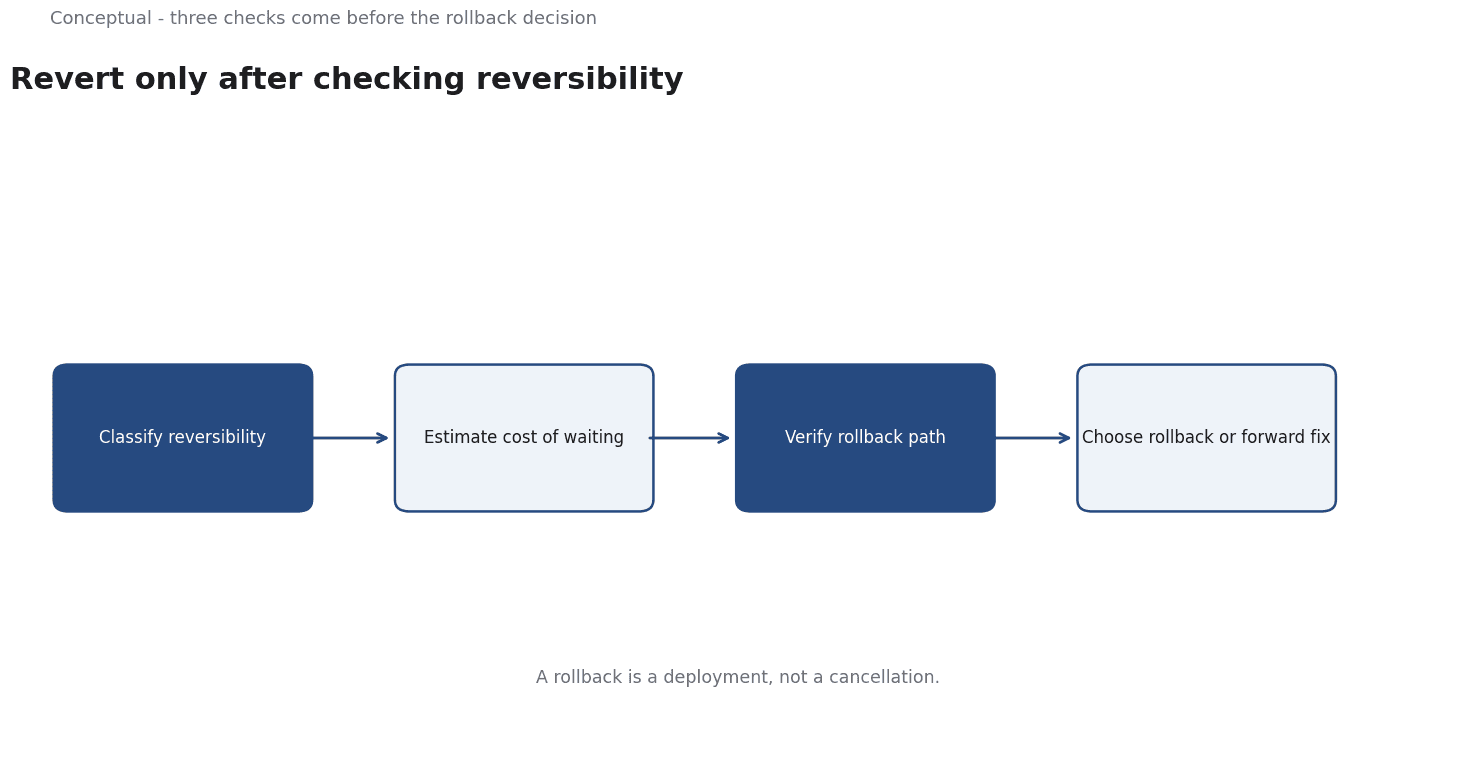
The second consideration is time. A rollback returns to a previous state quickly, which is valuable when users are affected now. A forward fix may take longer but avoids the risk of reintroducing an older problem. The choice depends on the cost of waiting, which is a local judgement.
The third consideration is testing. The incident guide treats recovery as a lifecycle, and a rollback that has never been rehearsed is a hypothesis. Testing it before it is needed is the difference between a plan and an intention.
The sequence is: classify reversibility, estimate the cost of waiting, verify the rollback path, then decide. The decisions are local, so the conclusions are inferred; the context is source-reported.
A worked example
Illustrative. A deploy causes errors and includes a schema change.
Three checks decide. First, can the old code run against the new schema, or would reverting break the application? Second, how long would a forward fix take, and what is the cost of the errors in the meantime? Third, has the rollback path been tested with the current data?
The outcome may be a forward fix chosen deliberately, which is a better result than a rollback assumed to work. The scenario is hypothetical; the method is the contribution.
Evidence status
| Claim | Status | Source | Verified | Recheck when |
|---|---|---|---|---|
| Deployment can be automated | source-reported | GitHub Actions docs | 2026-11-18 | Product changes |
| Recovery is part of incident handling | source-reported | NIST SP 800-61 | 2026-11-18 | Guidance updated |
| Decide from reversibility and cost of waiting | inferred | Derived from the lifecycle | 2026-11-18 | Architecture changes |
Why reverting is a change
A rollback is not a cancellation; it is a new deployment of an older state. That state may be incompatible with data written since, and the incompatibility appears at the worst moment.
A final consideration is the signal that triggers the decision. A rollback based on a loose threshold can be triggered by normal variation, while one based on a strict threshold can arrive too late. The trigger should be tied to an objective defined before the release, which is the same discipline the alerting material recommends for production.
The rollback also has to be monitored after it completes. A successful command is not evidence that the service recovered, and a system can be in a bad state for a different reason after reverting. Checking user-facing signals after the change closes the loop.
None of this removes the need for a forward fix when the data has changed. Recognising that case early is the point of classifying reversibility before the release, not during the incident.
The trigger should be agreed before the release, when the decision can be made calmly.
A revert that has never been tested with current data is an assumption, not a recovery path.
The decision should name what would make a forward fix preferable to a revert.
A rollback is a deployment, and it deserves the same care as the original change.
What it cannot do
It cannot undo an unplanned data change. It does not guarantee that the restored version is better. And it cannot replace testing.
The counterargument that a fast rollback is always safer is fair for isolated code changes and incomplete when data is involved.
A decision test
- Classify reversibility.
- Estimate the cost of waiting.
- Verify the rollback path.
- Choose rollback or forward fix.
- Record the reason.
- Set a recheck condition.
For the basis, see Rollback Strategies.
References & Further Reading
- GitHub, 2026. GitHub Actions Documentation — The CI platform's own documentation, including required status checks.
- Paul Cichonski, Thomas Millar, Tim Grance, Karen Scarfone (NIST), 2012. SP 800-61 Rev. 2, Computer Security Incident Handling Guide — The incident-response capability lifecycle: preparation, detection and analysis, containment/eradication/recovery, and post-incident activity.