RoPE Position Encoding Metrics that Matter
RoPE encodes order by rotating vectors. Read what to measure, a worked example, and why a longer window is not a guarantee of use.
Rotary position embedding is often described as a trick that extends context, which hides what it actually does: it encodes position by rotating query and key vectors. The RoFormer paper introduces the method, as the attention paper provides the mechanism it modifies, as Long Context Windows: What a 1M-Token Window Actually Buys You warns about position sensitivity, as the lost-middle paper measures use of position, as the publication standard forbids guaranteed outcomes.
Direct answer: Evaluate RoPE by measuring how well a model uses position at the lengths you care about, not by the maximum window it accepts. The RoFormer paper is the primary source, and the attention paper provides the base mechanism. The boundary: a longer window does not guarantee reliable retrieval, which the lost-middle paper shows, as the benchmarks article warns about broad claims, as the risk article requires residual risk.
The metrics
Position accuracy. Does the model answer correctly when the relevant item is at different positions, which the lost-middle paper measures, as Long Context Windows: What a 1M-Token Window Actually Buys You advises, as the rubric article requires concrete criteria, as the benchmarks article warns about broad results, as the data-governance article requires dated figures, as the risk article requires residual risk.
Length generalisation. Does performance hold beyond the lengths seen in training, which the RoFormer paper treats, as Long Context Windows: What a 1M-Token Window Actually Buys You advises, as the time-series article warns about non-stationarity, as the scenario-analysis article requires conditional thinking, as the evaluation article requires a test, as the monitoring article advises for review.
Retrieval interaction. How the encoding interacts with the retriever, which the retrieval article treats, as the reranking article advises, as the evaluation-rubric article requires criteria, as the cost estimator requires for cost per correct answer, as the routing article treats as the decision metric, as the risk article requires residual risk.
Cost per correct answer. A longer window costs more per request, which the cost estimator requires, as the prompt-caching article explains for repeated prefixes, as the routing article treats cost per correct answer, as the rubric article requires criteria, as the decision-memo article requires a record, as the risk article requires residual risk.
Three consequences follow. The task defines the metric, as the rubric article requires, as the decision-memo article requires a question, as the evaluation article requires a test, as the lost-middle paper advises for position, as Long Context Windows: What a 1M-Token Window Actually Buys You warns, as the benchmarks article warns about broad claims, as the data-governance article requires dated figures, as the monitoring article advises for review, as the cost estimator requires for spend, as the routing article treats as the decision metric, as the risk article requires residual risk, as the decision-memo article requires for a record.
A worked example
The following is hypothetical and illustrative. A team considers a model with a long context window for retrieval-augmented questions.
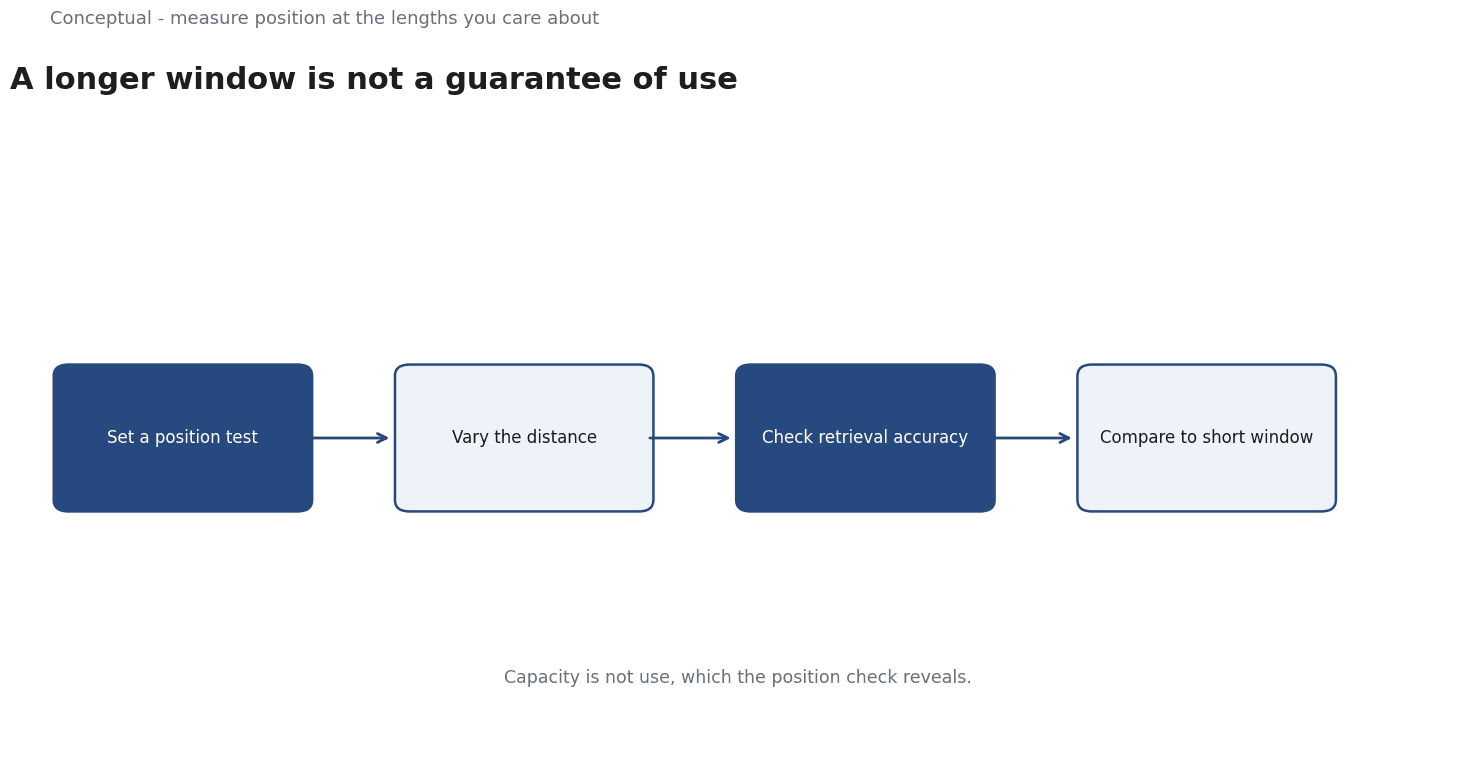
Three checks decide. First, does the model use the right passage at the beginning, middle, and end, as the lost-middle paper and long-context article advise, with a fixed test, as the rubric article requires? Second, does it hold up beyond the trained length, as the RoFormer paper and long-context article advise, with a conditional claim, as the scenario-analysis article requires? Third, what is the cost per correct answer, as the cost estimator and routing article require, with dated prices, as data governance requires, as the risk article requires residual risk, as the decision-memo article requires for a record?
Three conclusions follow.
Capacity is not use, which the position check reveals.
Length generalisation needs a test, as the RoFormer paper advises. And the decision should be recorded with cost, as the decision-memo article requires.
What position metrics cannot do
They cannot guarantee use of context, which the lost-middle paper shows, as the publication standard forbids guaranteed outcomes, as the risk article requires residual risk.
They do not establish a cause, which the causal-inference article treats as a different question, as the correlation article warns, as the decision-memo article requires for a record. And they cannot remove retrieval, which the retrieval and reranking articles treat, as the RAG article advises, as the cost estimator requires for the total, as the routing article treats as the decision metric, as the monitoring article advises for review.
A decision test
- Test position sensitivity, as the lost-middle paper advises.
- Check length generalisation, as the RoFormer paper advises.
- Compare with a retrieved baseline, as the retrieval article advises.
- Use a fixed test set, as the rubric article requires.
- Compute cost per correct answer, as the routing article requires.
- Use dated figures, as data governance requires.
- Record the decision and residual risk, as the decision-memo and risk articles require.
For the mechanism, see RoPE and Position Encoding; for the alternative, see Long Context Windows.
References & Further Reading
- Jianlin Su et al., 2021. RoFormer: Enhanced Transformer with Rotary Position Embedding — Rotary position embedding, which encodes relative position by rotating queries and keys.
- Ashish Vaswani et al., 2017. Attention Is All You Need — The transformer architecture that the NLP and LLM sections build on.