Routing Between LLMs: Cut Cost Without Losing Quality
Not every query needs the flagship model. Read the three cost strategies, the routing evidence, and a worked example with the failure modes.
A single-model policy treats every request as equally hard. In practice, most application traffic is easy: classify this ticket, extract this field, draft a short reply. A small share is genuinely difficult. Routing sends the easy work to a cheaper model and the hard work to a stronger one — and the published research suggests the saving can be large without giving up answer quality.
Direct answer: FrugalGPT identifies three strategies for reducing LLM inference cost — "prompt adaptation, LLM approximation, and LLM cascade" — and describes its cascade as learning "which combinations of LLMs to use for different queries in order to reduce cost and improve accuracy". RouteLLM trains routers that "dynamically select between a stronger and a weaker LLM during inference", reporting cost reductions "by over 2 times in certain cases—without compromising the quality of responses". The boundary: the savings depend on your traffic having a real easy/hard split, and the router itself makes mistakes.
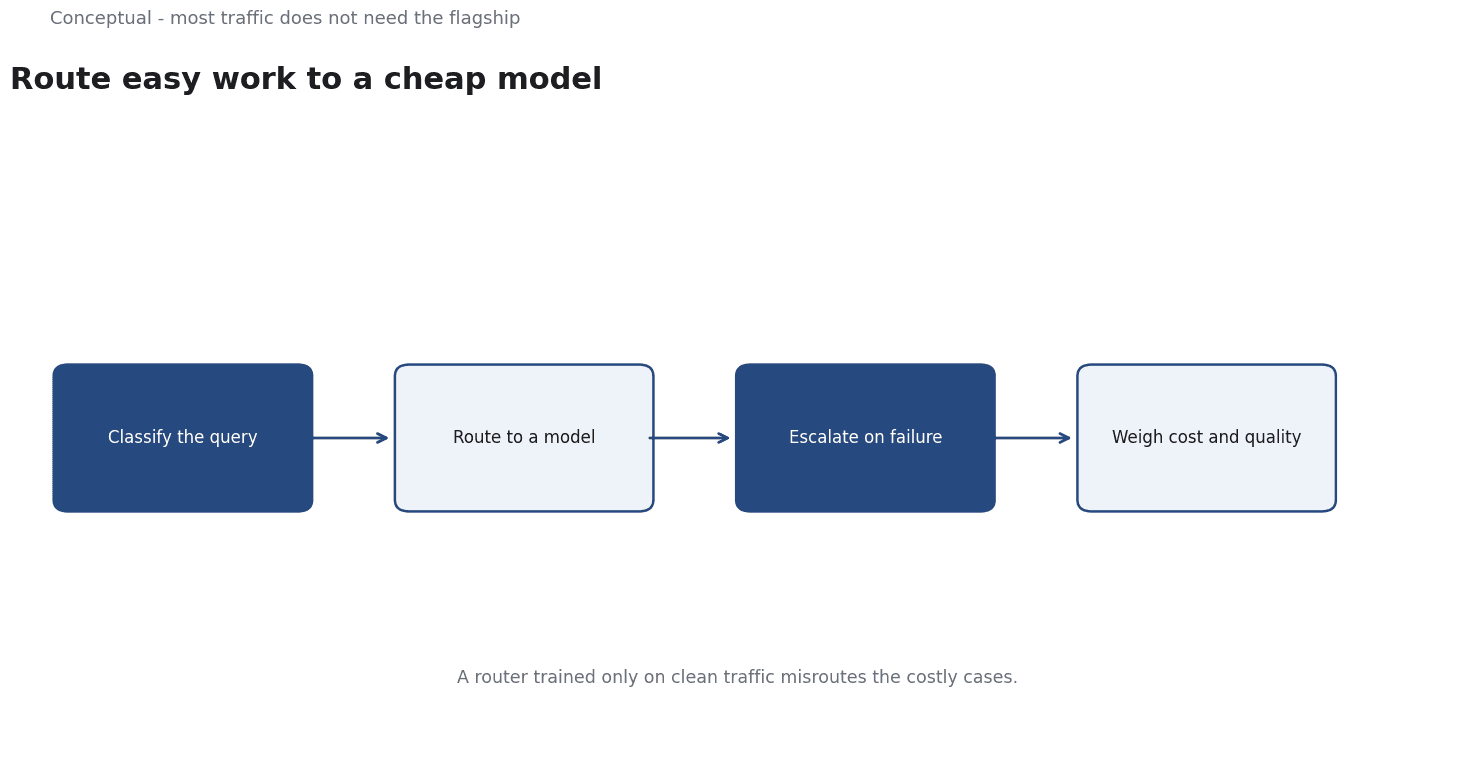
The three strategies
Prompt adaptation reduces the tokens you send — shorter instructions, fewer examples, better compression. It is the cheapest intervention because it changes no infrastructure.
LLM approximation substitutes a cheaper model for an expensive one on the assumption that it is good enough for the task. This is the simplest form of routing: one model for everything, chosen at the design stage.
LLM cascade sends a query through a sequence or a selection of models, using the cheaper ones first and escalating when confidence is low. FrugalGPT's version learns the combination from data rather than fixed rules.
RouteLLM's contribution is to learn the selection from preference data — comparisons of which model answered better — rather than hand-writing rules about query types.
The reported result is a cost reduction of over 2× in some cases, with response quality maintained on the benchmarks studied.
Two cautions about that number: it is a research result on public benchmarks, and "in certain cases" is doing real work in the sentence. Your traffic mix may not contain the same easy/hard distribution.
Why routing can work at all
The premise is that model capability is not needed uniformly. A query asking "what is the return policy?" may be answered correctly by a small, cheap model, while one asking a developer to find a concurrency bug across ten files may need a frontier reasoner. If the application could always use the small model, routing would be pointless; if it always needed the frontier model, routing would add cost for nothing.
Three conditions make routing valuable:
- A measurable quality gap. An evaluation must show that the cheaper model is adequate on a subset of queries. Vendor descriptions like "near-flagship performance" are not that evidence.
- A cost gap at your volumes. Published prices make this concrete: OpenAI lists GPT-6 Astra at $10/$50 per million input/output tokens and GPT-6.1 Sol at $2/$10 — a 5× list-price difference.
- An identifiable subset. The router needs features it can use — query length, task type, domain, or a small classifier's output — to decide which tier to call.
A worked example of routing economics
The following combines published list prices with a hypothetical workload.
A product handles 1 million queries a month, averaging 2,000 input and 500 output tokens each.
All flagship (Astra): input = 1M × 2,000 × $10/M = $20,000; output = 1M × 500 × $50/M = $25,000; total $45,000/month.
All cheap tier (Sol): input = 1M × 2,000 × $2/M = $4,000; output = 1M × 500 × $10/M = $5,000; total $9,000/month.
Route 70% to Sol, 30% to Astra: 0.7 × $9,000 + 0.3 × $45,000 = $6,300 + $13,500 = $19,800/month. Saving: $25,200, or 56%.
Now add the failure modes:
- Misrouting cost. If 5% of queries sent to Sol actually needed Astra and are re-run after a failed answer, the re-run adds 50,000 × Astra's per-query cost. Per query Astra costs $0.045, so re-runs add about $2,250 — small here, but the user experience cost of a wrong first answer may be larger than the token cost.
- Router cost. A classifier that inspects every query consumes tokens itself. At a few hundred tokens per query on a cheap model, that is a modest but nonzero line item.
- Evaluation cost. The labelled set that justifies the 70/30 split has to be built and maintained. This is a fixed cost that matters most at low volume.
Three decisions follow:
- Measure the split, do not assume it. A 50/50 split changes the blended cost substantially.
- Make escalation cheap. If a failed cheap answer can be re-run automatically without user-visible delay, misrouting is recoverable.
- Re-evaluate after model updates. A cheaper model that improves may take a larger share; one that regresses may force a change.
Building the evaluation that justifies routing
The 70/30 split in the worked example is only as good as the evidence behind it. A defensible evaluation has four properties:
It uses your traffic. Public benchmarks tell you what a model can do on someone else's questions. Sample real queries from your logs, with the sensitive fields removed, and label which ones the cheap tier handles acceptably.
It includes the failure modes. Add queries that are ambiguous, adversarial, or outside the normal distribution.
It scores the whole pipeline. Measure end-to-end correctness after escalation, not just the router's accuracy. A router that is 95% correct but sends the hardest 5% to a model that also fails is worse than one that routes more conservatively.
It is re-run on change. Keep the labelled set and the scoring script so that a model update, a price change, or a new query type triggers a fresh decision rather than a debate.
This is the same discipline as any other engineering measurement: the routing layer is a component whose behaviour must be verified, not a trick that is set once and trusted.
What routing does not solve
Bad prompts stay bad. Routing changes which model sees a prompt, not the prompt's quality. Prompt adaptation is a separate lever.
The router can be wrong. A classifier trained on last quarter's traffic may misroute new query types. RouteLLM's preference-based approach is more adaptive than fixed rules, but it still learns from past comparisons.
Quality metrics can be gamed. If the router optimises a proxy — say, response length or confidence — it may select models that score well on the proxy and poorly on the task. The evaluation must measure what the business cares about.
The counterargument — that models are getting cheaper, so routing will stop mattering — is partly true and misses the scale effect.
Even large price reductions leave a ratio between tiers, and at high volume the ratio determines the bill.
A decision test
- Establish the price ratio from published rates, with a date.
- Build a labelled evaluation set covering your real query types.
- Measure which queries the cheap tier handles acceptably, and at what rate.
- Choose a routing signal — query features or a trained router — and state why.
- Compute blended cost with the split and re-run rate explicit, as in the worked example.
- Make escalation transparent to the user where a wrong first answer has a cost.
- Re-run the evaluation when either model changes.
For the model options, see LLM Model Landscape 2026; for the broader architecture, see AI Integration Into an Existing Business.
References & Further Reading
- Lingjiao Chen, Matei Zaharia, James Zou, 2023. FrugalGPT: How to Use Large Language Models While Reducing Cost and Improving Performance — Three cost-reduction strategies (prompt adaptation, LLM approximation, LLM cascade) and the FrugalGPT cascade that learns model combinations per query.
- Isaac Ong et al., 2024. RouteLLM: Learning to Route LLMs with Preference Data — Routers that dynamically choose between a stronger and weaker LLM at inference, reporting cost reductions of over 2x in some cases without quality loss.
- OpenAI, 2026. Models | OpenAI API — The GPT-6 lineup with published per-million-token input and output prices, context windows, reasoning levels and knowledge cutoffs.