SAFE Notes and Convertible Instruments
Convertible instruments delay the valuation question. Read the mechanism, a worked conversion, and what the delay actually costs.
An early investor and a founder often cannot agree on a valuation, but both want to move. Convertible instruments — SAFEs and convertible notes — defer the valuation to a future priced round. That solves the immediate deadlock while creating a different set of questions about who converts at what price and with what rights.
Direct answer: A SAFE is an agreement that converts into equity at a future financing, typically using a valuation cap or a discount; a convertible note is debt that converts on similar terms. Investor education covers these as investment products with their own risks, and the term-sheet article treats the eventual priced round as the moment the terms become concrete. The boundary: deferring valuation does not remove it — it transfers the question to a later date with different information, and the cap-table article explains the resulting dilution.
The mechanism
A valuation cap sets the maximum valuation at which the instrument converts. An investor with a 4 million cap who invests 400,000 converts at a price no higher than if the company were valued at 4 million, which protects the investor if the round values the company higher.
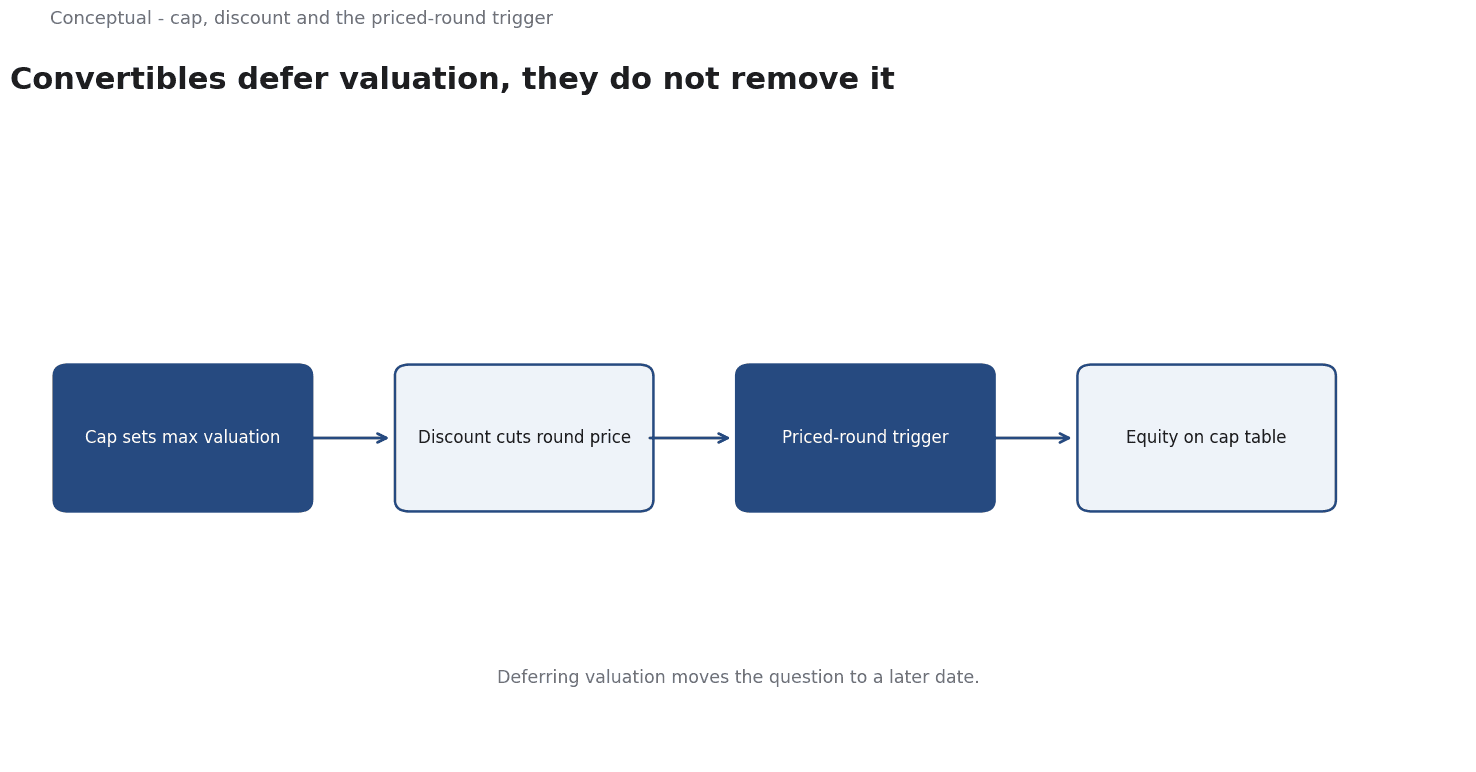
A discount gives the early investor a percentage reduction on the price paid in the next round, commonly expressed as 20%.
A conversion trigger is the priced round itself. Until then, the holder is not a shareholder in the same sense, which affects control and the cap table, as Cap Table Mechanics: Equity, Options, and Dilution explains for recording instruments correctly.
Three consequences follow. The instrument is simpler and faster than a priced round, which is why it is common at the earliest stage. It is not free of negotiation — the cap and discount are the negotiation, as Term Sheet Basics: What Founders Should Read Twice argues for reading terms, not labels. And it creates uncertainty about ownership until conversion, which the valuation article treats as a reason to model scenarios.
A worked conversion
The following is hypothetical and illustrative. An investor puts 400,000 into a SAFE with a 4 million cap and a 20% discount. The next priced round values the company at 10 million.
Using the cap, the conversion price is based on 4 million, giving the investor 10% of the company. Using the discount, the price is based on 8 million, giving 5%. The cap is more favourable, so it applies, and the investor converts at 10%. The founder's ownership is diluted by that 10% plus the new round, which the cap-table article models for cumulative effects.
Three checks decide whether this was a good deal. First, was the cap realistic relative to the company's prospects, which the startup-valuation article treats as a judgement with explicit assumptions? A very low cap transfers too much ownership. Second, did the instrument include a "most favoured nation" or similar clause that changes terms if later investors get better ones, as Term Sheet Basics: What Founders Should Read Twice warns about hidden terms? Third, did the conversion happen on the expected timeline, which the burn-rate article frames as a financing-dependency question?
Three conclusions follow.
The cap, not the discount, decided this outcome, so the negotiation should have focused there.
The delay cost the founder ownership relative to a higher-cap deal, which is the price of resolving the earlier disagreement. And the result must be recorded in the cap table with a date, as the data-governance article requires for relied-upon records.
What convertibles cannot do
They cannot remove disagreement about value; they postpone it, as the valuation article explains for conditional estimates.
They cannot replace legal advice on the specific terms and jurisdiction, which the copyright-and-AI article treats analogously for date-sensitive law. And they cannot fix a weak business: a convertible instrument finances a company, it does not make one viable, which the startup-validation article treats as the prior question.
A decision test
- State why valuation cannot be agreed now.
- Compare the cap and discount against realistic scenarios, as the valuation article recommends.
- Read the conversion trigger and any most-favoured clauses, as Term Sheet Basics: What Founders Should Read Twice advises.
- Model ownership after conversion with the cap table.
- Check the effect on the next round, as Cap Table Mechanics: Equity, Options, and Dilution explains.
- Obtain qualified legal review of the jurisdiction-specific terms.
- Record the instrument and its eventual conversion with dates.
For the priced round, see Term Sheet Basics; for the ownership effects, see Cap Table Mechanics.
References & Further Reading
- U.S. Securities and Exchange Commission (Investor.gov), 2026. Introduction to Investing — Primary regulator guidance on market mechanics and investor protection.
- Aswath Damodaran, 2026. Damodaran Online: Home Page for Aswath Damodaran — Publicly maintained datasets for industry averages, WACC, and valuation.