Small Language Models: When Smaller Is the Right Choice
A smaller model is cheaper and faster, not automatically worse. Read the task-fit test, a worked example, and what you give up.
The default assumption in many projects is to use the largest model available and only downgrade when cost forces it. That is backwards for tasks with a narrow scope. A small language model, fine-tuned or prompted for a specific job, can match a frontier model on that job while being faster, cheaper, and deployable closer to the data.
Direct answer: Choose a small model when the task is narrow, the output is verifiable, and latency or cost dominates. Large multimodal families such as Gemini illustrate the capability available at the top end; the edge-AI article covers the deployment techniques that make small models practical. The boundary: a small model has less general knowledge and weaker reasoning on unfamiliar tasks, so it is the right choice for a defined job, not as a universal replacement.
What "small" changes
Three differences matter:
Capability breadth. A small model knows less and reasons less well on unfamiliar problems. On a narrow task with a clear pattern, that gap can vanish.
Speed and cost. Fewer parameters mean faster inference and lower memory, which the KV-cache article quantifies. At high volume the difference is decisive.
Deployment flexibility. A small model can run on a laptop, a phone, or an edge device, which matters for privacy and offline use, as the cloud-versus-device article explains.
A worked selection example
The following is hypothetical and illustrative.
A company processes 50,000 support tickets a month, classifying them into ten categories. A frontier model achieves 95% accuracy at a cost of roughly $500 a month. A small model, fine-tuned on 5,000 labelled tickets, achieves 93% at $30 a month and half the latency.
Three questions decide:
- What does the two-point gap cost? If a misrouted ticket costs a few minutes of rework, the saving is clearly worth it. If it delays a safety escalation, it is not.
- Is the accuracy stable on new categories? The small model was tuned on ten categories. When an eleventh appears, it may fail badly, as the monitoring article warns about drift.
- Is there a verifier? Classification has a clear correct answer, so errors can be measured continuously and the model retrained when accuracy falls. The evaluation-rubric article covers the scoring method.
Three conclusions follow:
- The small model wins on economics if the error cost is low and the category set is stable.
- The frontier model wins on robustness to novel inputs.
- A hybrid is possible — small model for known categories, escalation to a larger one for low-confidence cases, which the routing article describes.
Where small models fit
Classification and extraction with defined outputs and labelled examples.
High-volume, low-stakes tasks where cost per request dominates.
On-device and offline applications where data cannot leave the device.
Drafting with review where a first version is enough and a human checks it.
Where they do not
Open-ended reasoning across unfamiliar domains, where broad knowledge matters.
Tasks with little training data for fine-tuning, where a general model's pretraining is the advantage.
Applications that need multimodal depth — high-resolution images, audio, or video — where the largest models currently lead, as the Gemini paper illustrates.
The counterargument — that small models are always cheaper — needs a caveat.
Measure the full pipeline, as the cost estimator explains.
The evaluation that decides
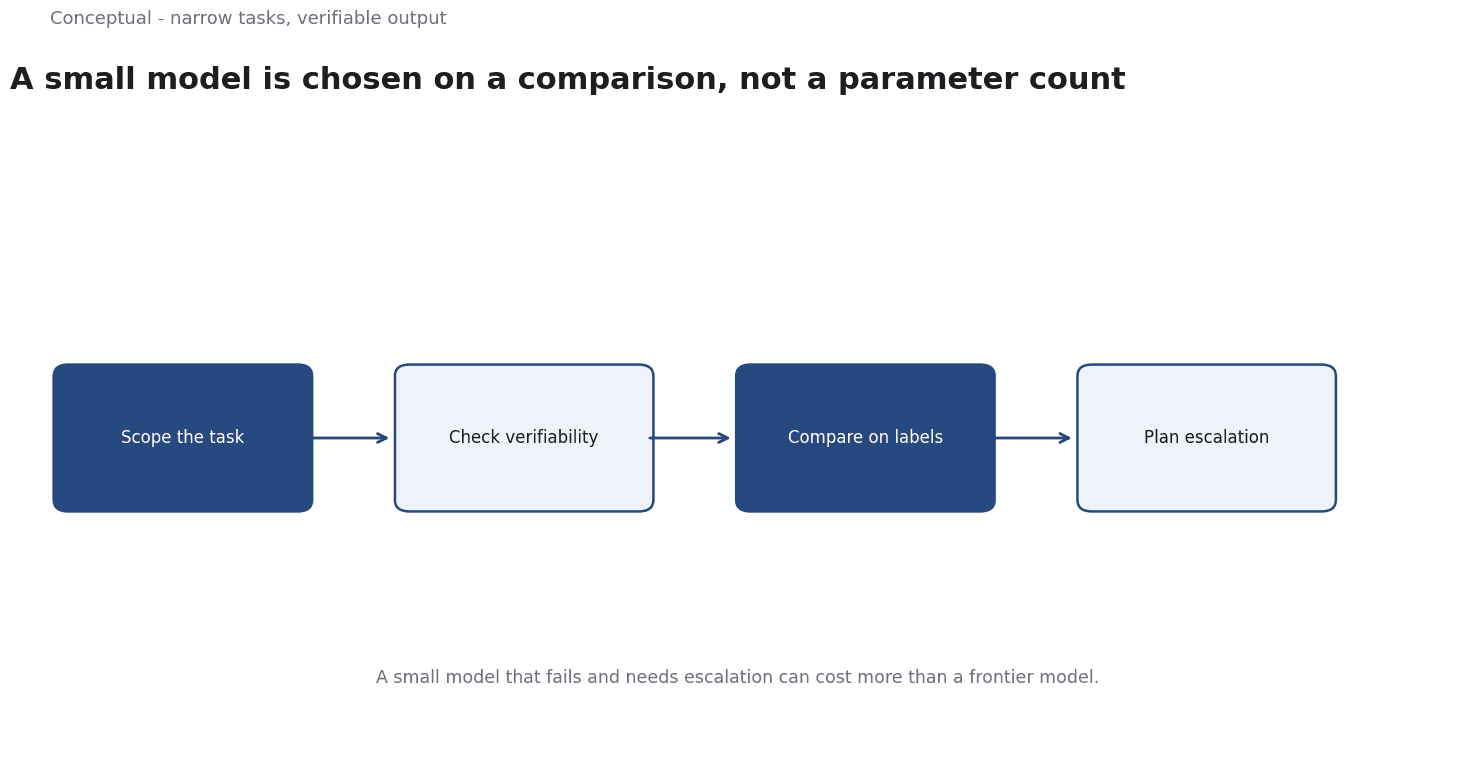
A small model should be chosen on a labelled comparison, not on a parameter count.
Three parts of the evaluation matter:
Task accuracy against a baseline. Score both models on the same held-out set from real work. A two-point gap is meaningful only if the set is large enough to detect it, as the confidence-interval article explains.
Behaviour on novel inputs. Include cases outside the fine-tuning distribution — a new category, a different phrasing, a malformed request. A small model may fail sharply here while a general model degrades gracefully.
Full-pipeline cost. Count escalation, review, and retries alongside token cost. A small model that handles 80% of cases and escalates the rest may beat either extreme, which the routing article shows.
These three measurements turn a size debate into an engineering decision with stated trade-offs.
A decision test
- Define the task narrowly and list its outputs.
- Check for labelled examples to fine-tune or evaluate.
- Measure accuracy against a frontier baseline on your own data.
- Price the error cost of the gap, not just the token cost.
- Test behaviour on novel inputs and define an escalation path.
- Measure latency and memory on the target hardware.
- Re-evaluate when the task or data changes.
For the deployment techniques, see Edge AI; for the hardware, see Why GPU Computing Is Becoming a Strategic Resource.
References & Further Reading
- OpenAI, 2026. Models | OpenAI API — The GPT-6 lineup with published per-million-token input and output prices, context windows, reasoning levels and knowledge cutoffs.
- Anthropic, 2026. Models overview - Claude Platform Docs — The current Claude model lineup (Opus 5, Fable 5.2, Sonnet 5.5, Haiku 5.5), supported inputs and the official model-selection guidance.