Social Media Content Calendar Template
A calendar is a coordination tool, not a strategy. Read the columns that matter, a worked week, and the measurement that prevents busywork.
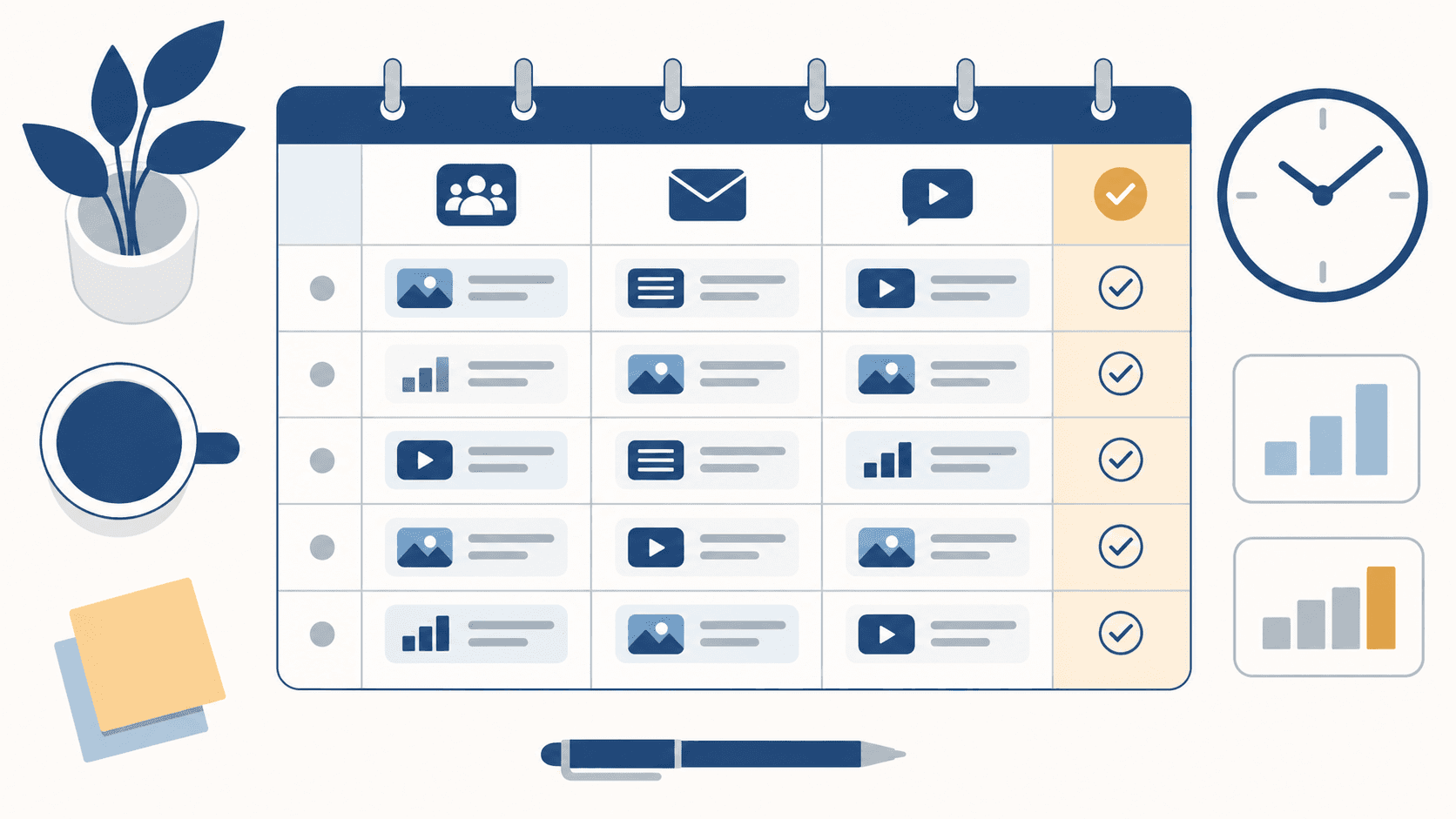
A social media calendar full of posts can still be useless. The calendar's job is to coordinate a message across channels and make it possible to learn from what was published. Without an outcome column, it becomes a record of activity that nobody evaluates.
Direct answer: A useful calendar includes the audience, the decision the post serves, the channel, the asset, the owner, the date, and the measured outcome. Marketing-communications principles explain why consistency across channels is about meaning, not identical copy, and research standards apply if the calendar's claims come from surveys. The boundary: a calendar is a plan, not evidence that the content worked — the outcome column supplies that.
Columns that matter
Audience and decision. Who is this for, and what are they trying to decide? A post without a decision is decoration.
Channel and format. The same idea expressed differently for each platform. Consistency means the same underlying claim, not the same text.
Asset and owner. What is being published and who is accountable. A calendar without an owner is a wish list.
Date and context. When it goes out and what else is happening — a launch, an event, a news cycle.
Outcome. The measured result against a stated metric.
This is the column most calendars omit, and the one that turns a plan into a learning system.
A worked week
The following is hypothetical and illustrative.
A B2B brand publishes three posts in a week about the same topic — a guide to reducing manual reporting:
| Day | Channel | Decision served | Format | Outcome metric |
|---|---|---|---|---|
| Tue | "Is this problem worth solving?" | Short problem statement with a question | Qualified comments and profile visits | |
| Wed | Newsletter | "How would I do it?" | Worked example with numbers | Click-through to the guide |
| Fri | X | "What do practitioners think?" | A quote from the guide with a link | Saves and replies |
Three observations follow:
- The same claim, different jobs. Each post states the same underlying idea but serves a different stage of a decision. Copying one text into three channels would have served none well.
- The metrics differ by job. Comments are meaningful for a problem statement; click-through is meaningful for a worked example. A single "engagement rate" would flatten the difference.
- The outcome column is filled in later, with a date. Without that habit, the calendar records publishing, not results, and next quarter's plan is made from memory.
How to keep it usable
Plan one cycle at a time. A quarter-long calendar is an estimate; a two-week cycle is a plan. Revisit the next cycle using the outcomes from the last.
Reserve space for reactive content.
The reserved slots should be explicit, not filled at the last minute from whatever is convenient.
Review by decision, not by channel. After a cycle, ask which decisions were served well and which posts produced qualified action. The answer may be that one channel consistently underperforms for a particular decision, which is a useful finding.
If the calendar's claims involve survey data — for example, "our audience prefers X" — apply research standards: define the population and wording, as AAPOR requires. A survey of engaged followers is not a survey of the market.
What a calendar cannot do
It cannot create a strategy. If nobody has decided what the brand stands for, the calendar will publish a mix of unrelated claims. Communications research on consistency is about meaning, not scheduling.
It cannot guarantee reach. Platform distribution changes, and a well-planned post may be seen by few people. The calendar is not a distribution system.
It cannot substitute for review. A plan that is never evaluated produces the same content next quarter, whether it worked or not.
The counterargument — that social media is too fast for a calendar — is fair for real-time conversation and wrong for planned content.
Keep the calendar for the planned portion and leave explicit room for the reactive portion.
A decision test
- Name the audience and decision for every planned post.
- Adapt the format to the channel, keeping the underlying claim consistent.
- Assign an owner and a date.
- Set one outcome metric per post.
- Fill the outcome column after publication, with a date.
- Review by decision at the end of each cycle.
- Reserve explicit space for reactive content.
For the consistency principle, see Brand Consistency Across Channels; for the research standard, see AAPOR.
References & Further Reading
- Wikipedia contributors, 2026. Marketing communications - Wikipedia — The coordination of messages across channels and the distinction between consistent and identical communication.
- American Association for Public Opinion Research, 2026. AAPOR — The professional association for public opinion and survey research; its standards and resources underpin the survey-design discussion.